Clivia summer care requires doing the "three reductions and one increase" well
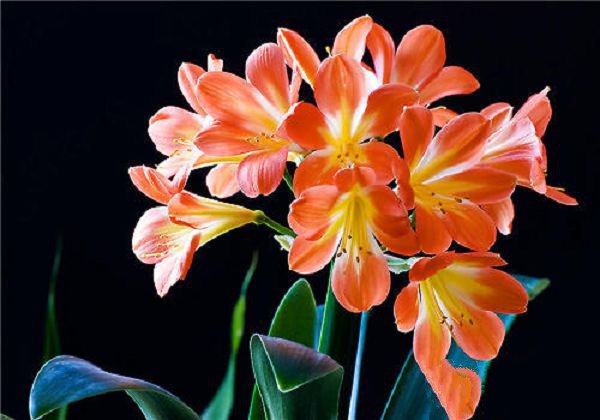
The hot summer is also very hard for Clivia to endure. Clivia likes a semi-shaded environment and is afraid of direct light. If you do not pay attention to giving Clivia a suitable environment in summer, Clivia will develop phenomena such as stretching its neck and bolting leaves.
Clivia
1. Reduce temperature
In summer, place Clivia in a ventilated place. If the ambient temperature is above 35°C, the water in the soil evaporates too quickly, which will make Clivia's water and nutrients unable to meet demand. Therefore, it is best to place the potted Clivia on a water pool or water basin (raised with wooden boards), and frequently spray water around the plant and on the leaf surface to improve Clivia's temperature and humidity environment, so that it can grow in a small environment below 25°C with a relative humidity of 60% to 70%.
2. Reduce light
Clivia is a medium-light flower, suitable for soft light in spring and autumn, and not suitable for exposure to scorching sun. Therefore, in summer, Clivia should be placed in a well-ventilated environment without strong direct light. It is best to place the potted plant under a shade shed, with sunlight coming through the gaps in the shade shed, so that the plant receives weaker light. If it is placed in a place where direct sunlight can be blocked at noon and sunlight can be seen in the morning and evening, that is most ideal.
3. Reduce fertilizer
When the room temperature rises to 25°C, reduce the amount of fertilization. Summer temperatures are high, and Clivia is in a semi-dormant or dormant state. During this period, its root system has weak absorption capacity. If fertilizer is applied or slightly too much fertilizer is applied, the fertilizer will accumulate around the root system for a long time, easily causing root rot and stem rot. However, during this period, if the temperature of Clivia's growing environment is lowered below 25°C, then some dilute liquid fertilizer can be applied appropriately to promote its growth and shorten the dormant period; if the temperature drops below 20°C and the humidity also meets the requirements, then fertilizer can be applied as usual.
4. Increase humidity
Clivia has broad leaves and a soft texture, and requires higher soil water content and greater air humidity. In the hot summer, Clivia grows slowly and its root system absorbs little water, but the amount of water evaporated from the leaf surface is very large. Therefore, Clivia cannot lack water, otherwise the fleshy roots will shrink, the leaf shape will be thin and weak, and the leaves will be dull and lusterless. When watering, adhere to the principle of watering when half-dry, and watering thoroughly when watering. But do not water as soon as the surface soil looks dry, otherwise the potting soil will remain moist for a long time, and it is very easy to cause root rot and yellow leaves. When watering, be sure to pay attention not to let water run into the leaf center, so as to avoid rotten heart disease and cause "beheading".