Orchid Care Methods: A Flower Enthusiast Shares Two Years of Growing Experience
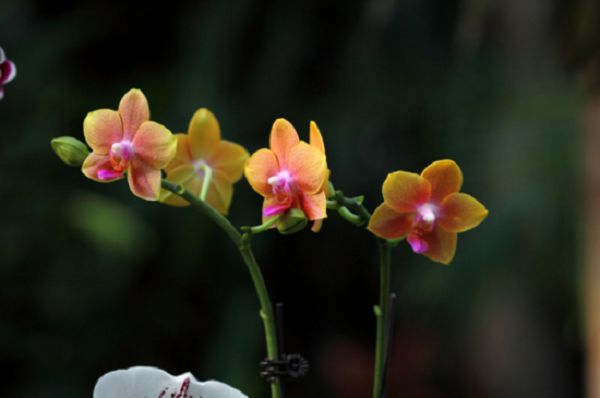
The orchid is one of China's top ten famous flowers. People have always regarded the orchid as a symbol of nobility and elegance, and it is listed alongside "plum, bamboo and chrysanthemum," together known as the "Four Gentlemen." The following is a summary of a flower enthusiast's two years of orchid growing experience, which is very helpful for growing orchids.
Orchid care methods and experience sharing. Mixing potting medium can be said to be the thing that causes the most fuss when you first start growing orchids. At the beginning, I would peel off bark whenever I saw it, dig up leaf mold whenever I saw it, and after bringing it home I would sift it, sun it, boil it, and was just short of frying, steaming and stewing it. When I heard others say that their potting medium had such-and-such a shortcoming, my heart would tighten and I would instantly feel like an idiot. I would search Baidu and Taobao for good medium formulas, and when I saw the six-in-one, eight-in-one and ten-in-one mixes on Taobao I would hurry to buy them, then repot, over and over again, tired but happy. The result was that after all this fussing back and forth, all that was left was soil and pots.
Watering is the second major hurdle when you first start growing orchids. The saying "don't water until dry, and when you water, water thoroughly" has stumped countless people. Weighing the pot, the chopstick method, over and over again, it is always hard to control properly. Later, after reading an article in a friend's blog space, I finally had some insight. The general content is as follows:
Water is an essential element for plant growth. Water content in plants is very high, up to 80{bf} or more. Only when plants have sufficient water can they grow normally. This is because the various biochemical reactions within plants, such as nutrient conversion, cell division and photosynthesis, all require water to take part. During growth, plants usually rely on water uptake to make cells elongate or expand. If water is lacking, the turgor pressure of plant cells decreases, and growth slows or stops.
The main flow of water within plants. For terrestrial plants, water is taken in by the root hairs, flows along the roots to the stem, leaves, flowers and fruit, participates in the various growth activities within the plant and is consumed, while part of the water is lost to the atmosphere through the surfaces of the stem, leaves, flowers and fruit.
The main roles of water for plants. First, it provides the water necessary for plant growth. Second, it acts as the solvent that transports various nutrients; the organic fertilizers, inorganic fertilizers and other nutrients that plants need must all dissolve in water and then be transported into the plant through water. Third, by losing water to the atmosphere, plants can dissipate the radiant heat they absorb, avoiding a large rise in body temperature. Fourth, the vaporization of environmental water can carry away a large amount of heat energy and regulate the ambient temperature.
The plant's active protection regarding water. When water within a plant is insufficient, it will instinctively close the stomata on its surface, reducing the rate of water loss and preventing massive water loss. Plants also close their stomata during dormancy, at night, or during the hot and dry midday of summer, in order to reduce the rate of water loss and protect the water within their bodies.
The amount of water consumed and lost by a plant and the amount of water taken in by the roots must be in balance. When the former is greater than the latter, the plant's water content drops, and water potential and turgor pressure decrease accordingly, affecting the plant's normal growth. When a certain limit is exceeded, the plant's normal physiological processes will be severely disrupted, causing damage to the plant, and even death. This condition of water deficit is theoretically called water stress.
The harm of water to plants. When there is too much water in the soil, it can waterlog the soil and block the oxygen supply to the root system, hindering aerobic respiration and causing damage to the plant's root system.
In summary, our principle for watering during orchid cultivation is: give as much water as possible without damaging the root system, and do not advocate dry growing. Especially during the growing period, do not withhold water, otherwise the seedlings that grow will be toothpick seedlings.
Perhaps someone wants to ask: whenever the temperature is high, giving a lot of water makes the seedlings collapse; if we don't withhold water, what should we do? As for this question, I personally think it is not the water's fault, as long as you use clean, drinkable water. It should be the fault of fertilizer (or pesticide), especially the potting medium, and also temperature. Hehe, pass the blame to others. Keep reading and maybe you'll understand something.