What causes the dry tips on spider plant leaves?
Spider plant, also known as creeping saxifrage and orchid grass, is a perennial evergreen herbaceous plant of the Asparagaceae family. The spider plant not only has considerable ornamental value, but the plant can also be used to purify the air, and the whole plant has medicinal value. However, when we grow spider plants, we often encounter many problems that affect their growth, and dry tips are one of them. So what is the reason for dry tips on spider plants? Let's take a look below!
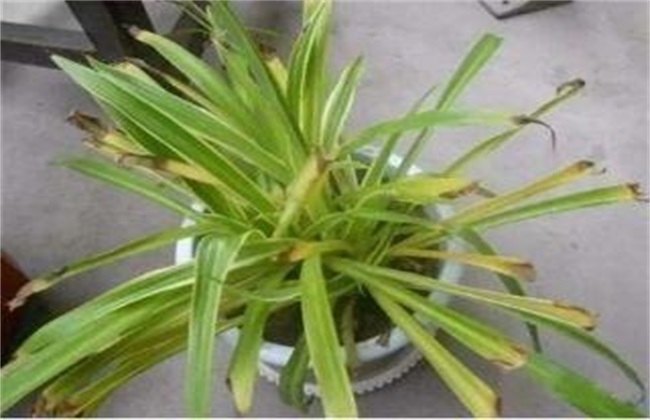
1. Lighting reasons
Spider plant is a flowering plant that loves light very much and needs a large amount of light during its growth. If the spider plant is kept in a dark, low-light environment for a long time, then its leaves cannot effectively carry out photosynthesis, resulting in insufficient nutrient accumulation, which leads to dry tips. It may also be that there is too much dust on the leaves, which likewise affects the spider plant's photosynthesis. Therefore, when growing spider plants, we should not only pay attention to maintaining good light duration and intensity, but also pay attention to regularly cleaning the leaves and keeping the leaves dry-tipped so that the leaves can carry out photosynthesis normally, which can effectively reduce the dry tip phenomenon.
2. Improper fertilizing
During the growth of the spider plant, fertilizing is a way to provide growth nutrients for the spider plant. However, when fertilizing, we must pay attention to controlling the amount of fertilizer. If too much fertilizer is applied, then because the spider plant cannot absorb it all, the remaining fertilizer in the soil burns the roots, affecting nutrient absorption. This leads to dry leaf tips, but it is also not good to go without fertilizing for a long time. If no fertilizer is applied for a long time, the spider plant will also suffer from a lack of nutrients, causing dry leaf tips. Therefore, we need a reasonable fertilizing method; generally, fertilizing about once every ten days or so is enough.
3. Improper watering
Water is an indispensable substance throughout the entire growth period of the spider plant. Spider plants like to grow in a moist environment. When watering, if the amount of water is too little, the soil is too dry, and the roots cannot absorb water, which naturally causes dry leaf tips. However, watering should not be too much either. Too much watering can easily cause waterlogging and can also very easily cause the same phenomenon. So during the growth of the spider plant, we should water reasonably, ensure the soil has a certain moisture content, water promptly when there are signs of drought, and while ensuring the spider plant's water requirements are met, avoid water accumulation.
4. Humidity too low
Spider plants also have certain requirements for air humidity, because air is also a main way for spider plant leaves to absorb water. If the air humidity is too low and water is not sprayed regularly, then the leaves' water absorption will be affected. As a result, the leaves will gradually show dryness and dry tips and other phenomena. So when growing them, we should pay attention to regularly spraying water on the leaves to improve the glossiness of the leaves, and also spray water appropriately around the plant to maintain air humidity. Then there should be appropriate ventilation to let the air circulate, which can alleviate the dry leaf tip phenomenon.
The above is a brief introduction to what causes dry tips on spider plants. That is all for today's introduction. This article is for reference only, and I hope it can be helpful to everyone!