Reasons why orchids grow only leaves and do not bloom after being kept for several years
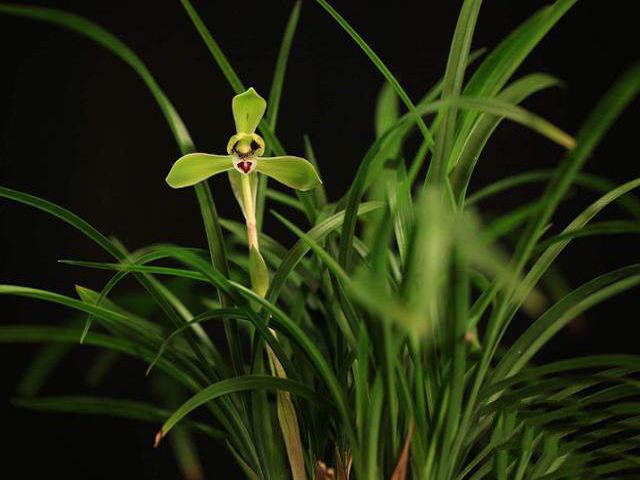
Winter is a good time for many orchids to develop flower buds. Those whose orchids have grown flower buds are delighted, never tiring of looking at them ten times a day, while those whose orchids have not grown flower buds are anxious, and even looking twenty times a day they still cannot see any flower buds. Why do your orchids grow only leaves and not bloom after being kept for several years? If you want the answer, keep reading.
1. Confirm the variety
If you want your orchid to bloom, you must first confirm the orchid's variety. Some growers are not very familiar with orchids, and when buying, whatever variety the seller says it is, in reality it may not be. For example, if you want to buy a Cymbidium sinense (Chinese orchid), the seller sells you a Cymbidium faberi (Chinese orchid), and if you care for the Cymbidium faberi according to the methods for Cymbidium sinense, then it will not bloom. This is because Cymbidium sinense does not need vernalization to bloom and can bloom with normal care, while Cymbidium faberi needs vernalization to bloom, and without vernalization there is no way for it to bloom. Therefore, confirming the orchid's variety is very important. Different varieties have different growth habits, and only when the care methods suit its temperament can it bloom normally.
2. Confirm the flower bud differentiation time
After confirming the orchid's variety, we can roughly determine the orchid's flower bud differentiation time, and thereby use some methods to let it smoothly complete flower bud differentiation, so that there is a foundation for blooming. For example, for Cymbidium goeringii (Chinese orchid), in the Jiangsu and Zhejiang area flower bud differentiation is roughly between the Beginning of Summer and Grain in Ear, and in northern regions it is delayed by half a month to twenty days. When Cymbidium goeringii is about to enter flower bud differentiation and has already entered flower bud differentiation, we can, according to weather conditions, appropriately apply a little phosphorus and potassium fertilizer, increase light, strictly control water, and increase ventilation, to prompt smooth flower bud differentiation. If during the orchid's flower bud differentiation period water, fertilizer, light and other management are improper, the flower buds cannot differentiate or cannot differentiate completely, thereby losing the foundation for blooming, and no matter how hard you try afterward it is all in vain. Different varieties of orchids also differ in flower bud differentiation time. Find your own orchid's flower bud differentiation time, pay special attention to it, and the foundation for blooming is there.
3. Care and management during the reproductive growth period
From the time the orchid enters flower bud differentiation, it changes from vegetative growth to reproductive growth, and fertilization should also gradually shift from nitrogen fertilizer or nitrogen-phosphorus-potassium balanced fertilizer toward phosphorus and potassium fertilizer, to promote flower bud growth. If during the reproductive growth period phosphorus and potassium fertilizer is insufficient, even if the flower buds have differentiated they may not be able to grow out. In the reproductive growth stage, besides fertilization, light should be gradually increased; especially after autumn when temperatures gradually drop, sufficient light is a necessary condition for flower buds to sprout smoothly. If the orchid variety you keep needs vernalization, when the flower buds emerge from the soil and grow to two or three cm and clearly slow down or stop growing, you can carry out low-temperature vernalization. The vernalization temperature should be kept between 5~10, and the vernalization time should be no less than 40 days, so that the flower buds can smoothly emerge and bloom.
Besides the three points above, Chinese orchids with fewer than three plants also cannot bloom; at least one pot must have more than three pseudobulbs for there to be a possibility of blooming. Many growers' orchids do not grow flower buds after being kept for several years, mostly due to care problems: improper management during the flower bud differentiation period prevents flower buds from differentiating, or after flower bud differentiation, not paying attention to fertilization prevents flower buds from growing out. If you want orchids to bloom, you must pay attention starting from the flower bud differentiation period, rather than waiting until the flowering period to find a solution.