Detailed explanation of ventilation management techniques for chicken coops in the four seasons
Whether chickens are raised in confinement or free-range, there must be a chicken coop for the flock to live in or rest in at night. However, chicken coops are generally enclosed or semi-enclosed, and the smell inside is not very good, so ventilation must be provided at all times. Some toxic gases produced by excrement are very harmful if they remain indoors. Therefore, attention must be paid to ventilation in all four seasons. So let us learn together how to ventilate.
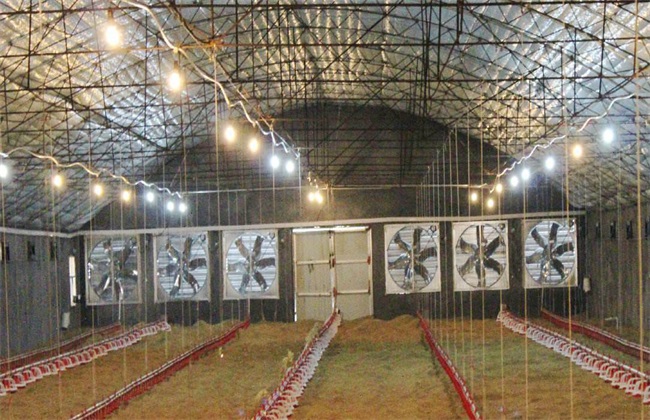
1. Ventilation methods
Mechanical ventilation is further divided into positive-pressure ventilation and negative-pressure ventilation. Negative pressure uses exhaust fans to forcibly discharge polluted air. Positive pressure uses fans to forcibly discharge air, and the exhaust volume is less than the intake volume; natural ventilation uses open windows to form thermally driven air movement between natural wind and indoor air, suitable for open chicken coops, but in order to remove toxic gases, axial-flow fans are used; mixed ventilation is divided into longitudinal, with exhaust fans installed on the gable at one end and air inlets set on the other side. Transverse ventilation means the fans and air inlets are set on two opposite walls of the chicken coop.
2. Ventilation in spring and autumn
In these two seasons, temperatures vary greatly, rising and falling unpredictably, so ventilation can be carried out during the day when temperatures are higher. As long as the temperature does not drop to the point where the flock cannot adapt, ventilation should be strengthened as much as possible. The main purpose is air exchange, discharging waste gas, moisture, and dust. When the temperature drops at night, longitudinal ventilation cannot be used, and transverse ventilation is needed. In spring and autumn, the overall mixed ventilation method is used.
3. Ventilation in summer
Summer ventilation has a cooling effect. The greater the wind speed, the cooler the flock feels, so ventilation can be strengthened in summer. Longitudinal ventilation is used, with cooling pads installed, suitable for enclosed chicken coops. The ventilation volume must be specially calculated, and the most suitable ventilation volume is determined according to the area and space of the chicken coop. For natural ventilation, more skylights can be opened.
4. Ventilation in winter
In winter, to keep warm, all exhaust ventilation must be closed, and timed minimum ventilation for the chicken coop should be used. When using it, be careful that outdoor cold air cannot blow directly onto the flock, and note that ventilation should be differentiated according to the size of the flock. Regular ventilation is needed, with ventilation time set, generally not exceeding five minutes per cycle. If the temperature fluctuates too much, stop ventilation.
Ventilation in chicken coops must take temperature effects into account. According to seasonal temperature changes, choose a suitable ventilation method; it does not have to be a fixed ventilation method.