How to grow poinsettias? Detailed guide to cultivation methods and precautions
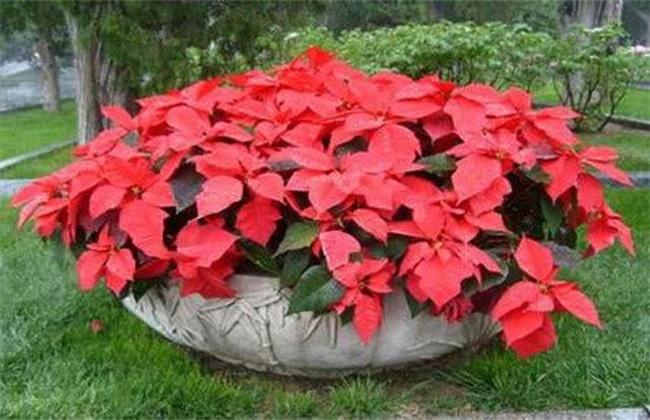
Poinsettia is an evergreen shrub with smooth stems and branches and green young shoots. Its "flowers" are actually composed of brightly colored, leaf-like bracts, while the true flowers are a cluster of tiny yellow-green florets in the center of the bracts, giving it good ornamental value. It is widely cultivated in most regions of China and is commonly seen in parks, botanical gardens and greenhouses. So how should poinsettias be grown? Let's find out together.
1. Soil selection
Poinsettia has certain requirements for soil. Besides fertile soil with good drainage, the soil should also be pollution-free and odorless. The growing medium is often based on peat, mixed with one or more materials such as perlite, vermiculite, ceramsite, wood shavings, bark, and river sand. After high-temperature sterilization, the pH value should be kept between 5.5-6.5.
2. Temperature and light
Poinsettia is a subtropical plant and likes to grow in sunlight. If its stems and leaves receive sufficient light during growth, this promotes stem and leaf growth. It needs a daily light duration of less than 12 hours for normal flower bud differentiation. During flower bud differentiation it is relatively sensitive to red light; short periods or weak red light can affect normal flower bud differentiation, so light exposure should be prevented during flower bud differentiation. The suitable growth temperature is 18-25 degrees. Below 16 degrees, growth slows down; at 13 degrees, growth stops; it cannot withstand sub-zero temperatures. Under windy conditions, freezing damage can occur at 5 degrees, and temperatures above 29 degrees are extremely unfavorable for growth.
3. Watering and fertilizing
During the growth period, poinsettia is relatively sensitive to fertilizer and water. Uneven watering, whether on the dry side or the wet side, can cause adverse reactions. Too much watering can cause leaves to droop and fall in mild cases, or root rot in severe cases; insufficient watering can cause leaves to curl and wither. Watering should follow the principle of watering when dry and stopping when wet, according to plant size and climate changes. In summer, when temperatures are high and the plant grows vigorously, water demand is greater, so it should be watered once in the morning and once in the evening every day. Poinsettia likes fertilizer. Before growth, nitrogen fertilizer should be the main type; as flowering approaches, phosphorus and potassium fertilizer should be added to promote larger and more colorful bracts. However, each fertilization should not be too concentrated, and raw fertilizer must not be applied. After fertilizing, water once the next morning to dilute it.
4. Precautions
Poinsettia is relatively sensitive to water. During the growth period, as long as water is sufficient, its stems and leaves can grow quickly; conversely, if water is insufficient or there is drought, leaves will fall off, so controlling the water for poinsettia directly affects its growth and development. Poinsettia is a light-loving flower and grows robustly under strong light. Apart from needing shade and cooling in summer, it should have sufficient light in other seasons.
The above is an introduction to poinsettia cultivation methods and precautions. We hope it helps you. If you want to learn more related knowledge, please stay tuned to us.