How to raise chickens in a bamboo forest? A full analysis of the key technical points
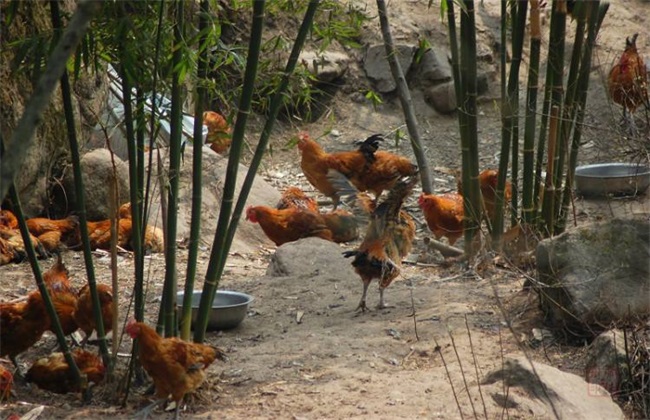
Bamboo grows in all kinds of places, and in rural areas there is bamboo in front of and behind the houses. Free-range chickens at home generally go into the bamboo forest during the day to forage and move around, which is essentially a range for the chickens. So if you actually want to raise chickens and set up a farm, you can set up a chicken farm in a place with a large bamboo forest, so the chickens can be raised naturally on free range. This way the quality of the chickens improves and the price rises too, and the chicken droppings can fertilize the bamboo. It is a win-win farming model.
1. Choosing breeds
Generally, when choosing a breed it is better to choose some local chickens suited to the local environment. Local chickens adapt to the local environment, and they are also the chickens local people mainly buy, so compared with other broiler types the price is much higher. Choose chickens with strong disease resistance, good foraging ability and a liking for activity. You can also choose excellent breeds produced by crossing local chickens with other chickens.
2. Choosing the site
It is best to find a place far from the village, not upstream of a water source but with abundant water, for example a spot somewhat away from a reservoir, where a large bamboo forest is planted. For convenient transport, it is best to have a main road at the foot of the hill, and you can look for a suitable, not very high hillside along the road from the township to the county town.
3. Building the chicken coop
The chicken coop should be warm in winter and cool in summer, with ventilation facilities and complete warmth-keeping facilities. You can use local bamboo and wood and buy some bricks to build the chicken coop. The coop should be about 6 m wide and about 10 m long; do not make it too long and narrow, otherwise it easily becomes congested and hard to enter. Build it directly in a slanted-roof style so the roof does not collect water. The coop should have electrical facilities, some tools and cleaning equipment. Use wire mesh to enclose the area along the outer edge of the bamboo forest to keep outside animals from getting in and harming the flock.
4. Brooding management
Chicks should be raised for a period before being released to range. Within two days of hatching, keep them at 35°C and 75% humidity; within one week, keep them at 33°C and 60% humidity; within two weeks, keep them at 30°C and 55% humidity; then gradually lower it to natural temperature, by about 2 to 3°C per week. Ventilate at noon on warm days. Give light for the first three days, reduce light time after one week, and then use normal daylight. They should start eating within three days: give water first, with glucose added to the water, and feed within a few hours after they drink. Mainly feed fine feed, mixed with water, with free access to feed: feed 6 times a day, then 4 times a day after one week, and 3 times a day after one month. Once they are eating normally, they can be released to range.
5. Free-range management
After release to range, train the flock to return to the coop, for example by calling out at feeding time; after a while the flock will know to come back on its own. Count and check the number every day when they return to the coop. Check the protective netting often so that wild animals do not tear it. Besides foraging, they still need to be fed once in the morning and once in the evening every day. Because they often forage outside, they may sometimes get parasites, so they can be dewormed regularly.
Bamboo forest chicken farming is mainly about finding a suitable farming environment and how to build the chicken coop; after that, brooding is much the same as ordinary chicken farming. Free-range management requires attention to many issues, and in practice there may be more small problems or some problems not yet discovered.