How to fertilize during the non-flowering period: Flowering-period management of potted jasmine
Jasmine is renowned worldwide for its fragrance; its flowers combine the sweet richness of roses, the clear freshness of plum blossoms, and the distant ethereality of orchids, so its scent appeals to both refined and popular tastes. That is why the poet Jiang Kui said, “If in years to come I were to compile a history of flowers, I would rank it as the finest fragrance in the world.” He also said, “Though it has no dazzling beauty to astonish the crowd, it is fortunate in having a clear fragrance that surpasses the nine autumns.”
Jasmine (Jasminum) is an evergreen small shrub or climbing plant belonging to the Oleaceae family. Its leaves are elliptical and emerald green, with a shining luster. Varieties are divided into single-petaled and double-petaled types; the double-petaled small white flowers are dainty and delicate, smooth and glossy. Jasmine was once called “Moli” and also “Moli,” meaning to overshadow all other flowers. Jasmine has both high ornamental value and high economic value. Its flowers can be used to extract aromatic oil, and it is one of the important raw materials for making pomade, essence, and concrete. It can also be used to scent tea, producing jasmine tea, which has a lasting fragrance and is clear and sweet to the taste.
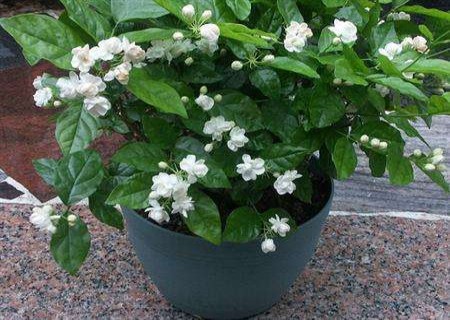
Jasmine is extremely fond of fertilizer; as long as it is properly cared for, a potted jasmine can bloom three times a year. Key points for jasmine flowering-period management:
1. Early flowering period: In early June, jasmine successively produces early flowers. At this time, pick off the flowers together with the leafy young shoots to encourage new shoots to grow again and make the branches and leaves luxuriant. At this time, apply dilute fertilizer water twice a week and keep the potting soil moist.
2. Full flowering period: At this time, fertilizer and water management need to be strengthened, with thin fertilizer applied frequently, fertilizing once every 2 days with fully decomposed organic liquid fertilizer, in a fertilizer-to-water ratio of 1:4. Watering should be sufficient, generally once a day. Watering is usually best done in the morning, while fertilizing is best done in the evening. Continue this until late July; because of sufficient fertilizer and water, the flowers can be made larger and more numerous.
3. Formation of the second flush of flowers: At this time, fertilizing should be slightly more concentrated than before, generally with equal parts fertilizer and water. To encourage jasmine to bloom better, a superphosphate solution can also be sprayed on the leaves. By late August, gradually reduce fertilizing to once every 6-7 days; watering still needs to be relatively frequent, maintaining once every two days.
4. Formation of the third flush of flowers: At this time, stop fertilizing, and gradually reduce the amount of watering as well. Because the weather has gradually turned cooler, the formation of flower buds will be affected, so this batch of flowers is fewer in number. After mid-October, flowering ends, and it is only necessary to keep the potting soil slightly moist.
Jasmine flowers are pure white and strongly fragrant, blooming continuously from summer to autumn, with July to August being the full flowering period, when the flowers are large, fragrant, and numerous. Strengthening flowering-period management, doing a good job of controlling “water, fertilizer, and light,” pruning appropriately, and preventing and controlling pests and diseases well are the keys to making jasmine produce more flowers and more fragrance.
1. Water frequently
Jasmine likes a moist environment, and during its flowering period, watering is even more important. Because summer temperatures are relatively high and the plant transpires heavily, sufficient water should be given; water thoroughly once each in the morning and evening, and also spray the plant's leaves and the area around the pot with clean water once each in the morning and afternoon to increase air humidity. However, note that on cloudy and rainy days, water less or not at all, and on rainy days also take care to avoid rain soaking, preventing water accumulation in the pot.
2. Fertilizer should be generous