Calendula Bloom Period Regulation and Post-Bloom Fertilization for Lush Branches and Leaves and Year-Round Blooming
Calendula (pot marigold) is a very common potted flower in the home. Getting it to bloom in a pot is by no means the ultimate goal of flower lovers; lush branches and leaves are what bring more joy. How do you make calendula lush with branches and leaves and blooming in all four seasons?
[Start with seed selection]
Planting calendula should of course start from seed, as only then is there a sense of accomplishment. When calendula matures, it is exactly the transition between spring and summer, with more rain, and the harvested seeds vary in quality, so when selecting seeds you should choose high-quality ones. Before planting, you can soak the seeds first and discard the seeds that float on the surface of the water.
[Cover with slightly thicker soil]
When sowing, to let calendula grow robustly, you can cover it with a layer of thick soil. Calendula has a very high germination rate. When the seedlings grow to 3 leaves, they can be transplanted; timely transplanting is what promotes root development.
[Control water and fertilizer]
During the growing period of calendula, watering should not be excessive; keeping the soil moist is enough. In high humidity and heavy rain or high-temperature weather, root rot is easily caused, leading to plant death. During the growing period, pay attention to fertilizing; apply a thin liquid fertilizer once every 20 days. Before and after flowering, applying 2~3 times a quick-acting fertilizer based mainly on phosphorus and potassium helps the growth of calendula.
[Pinch off the growing tips in time]
After the seedlings are transplanted, when they grow to 6 leaves, pinch off the growing tips to promote the sprouting of side buds and more flowers. If you like calendula to produce large flowers, you may skip pinching, but as the plant grows, you must keep removing the side buds. This allows nutrients to be concentrated and promotes flower bud development. In this way, calendula can be lush with branches and leaves and also produce very large flowers.
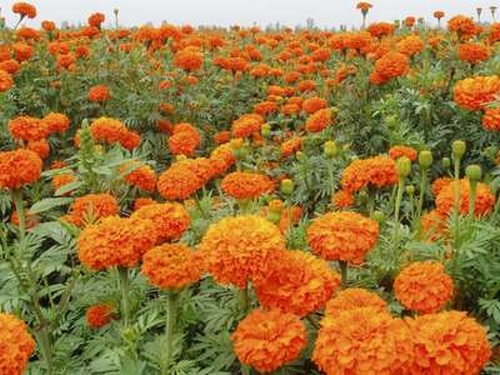
Calendula plants are dense, and the flower colors are dazzling and eye-catching. Orange-yellow, purplish-red, yellow and other colored flowers shining in the sunlight look noble and elegant. The blooming period of calendula is in early spring. If you want the beautiful calendula to bloom in all four seasons, you can regulate its blooming period, so that you can harvest beautiful calendula flowers in all four seasons.
[Methods for regulating the blooming period of calendula]
The conventional blooming period of calendula is early spring. If you want it to have flowers in other seasons, technical measures need to be taken accordingly; in this way, calendula can be made to bloom in all four seasons.
① Calendula blooming in autumn. After blooming in early spring, promptly cut off the faded flowers, and at the same time strengthen fertilizer and water management to promote the sprouting of new branches. In the hot summer, it should be moved to a ventilated, cool place, and attention should be paid to watering, so that it can bloom again in autumn.
② Calendula blooming in summer. It needs to be sown at the end of March. For direct garden landscaping, it can be broadcast-sown directly. After the seedlings come up evenly, thin out the overly dense ones appropriately, then pay attention to reasonable fertilizer and water management, and it can bloom in June.
③ Calendula blooming in winter. Sow in late August, transplant the seedlings into pots after they emerge, and after the frost descends move them into a greenhouse at 8~10°C for cultivation, keeping the soil moist and fertilizing, so that they will bloom in the depths of winter.
Calendula is magnificent and grand. Planting a pot of calendula makes the whole room bright and comfortable. By regulating the blooming period of calendula so that it blooms in all four seasons, why not do it?