How to fertilize a Christmas cactus to make it bloom when it is not in bloom? Flowering period care tips
Recently, the Christmas cacti in the science park are also budding, and their half-open look fills us with anticipation. After the Autumn Equinox, all Christmas cacti begin flower bud differentiation and form buds during this period, which shows that plants can adjust their growth according to the length of daily sunlight. Sometimes flower-loving visitors also come to ask us, saying that the Christmas cactus they grow only produces buds but does not bloom. What is going on?
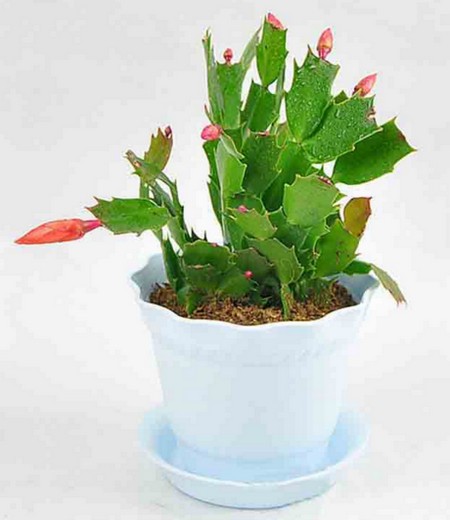
A potted grafted Christmas cactus that has taken shape and is properly supported can reach a crown diameter of two to three chi after three years, and can bloom two to three hundred flowers at the same time, with both form and color being beautiful. Especially in the depths of winter, when outdoor flowers and plants are all withered, the Christmas cactus is in full bloom and full of vitality. The emerald green, thick, leaf-like stems set off one after another brightly colored small flower, making it especially beautiful. But to make it colorful year after year is not an easy thing; in addition to careful cultivation at ordinary times, care and management before and after flowering are particularly important.
After the autumn turns cool, the Christmas cactus can form buds and enter the flowering period. At this time, move the plant indoors to a sunny place to avoid damaging the buds due to the large temperature difference between day and night. At the same time, prune the flower shape, appropriately cutting off uneven stem segments and the excessive weak small buds hanging on the main stem segments. Do not be reluctant to part with them. There are two necessary reasons for doing this: First, after trimming, the plant shape is well proportioned, maintaining an umbrella shape, achieving the goal of beauty. Second, removing the weak and excessive buds makes the whole flowering period grow vigorously and the flowers uniform in size. Otherwise, the buds on the top stem segments will wither due to insufficient nutrients.
During the flowering period, apply a granular compound fertilizer once every ten days, shallowly buried in the soil along the pot soil. Never let it get close to the roots, so as not to burn the roots. The pot soil should just be allowed to alternate between wet and dry. If you do a good job of care and management before flowering, then in winter and early spring of the following year you will see a pot of beautiful and spectacular Christmas cactus as you wish.
From the end of February to early March of the following year, the flowering of the Christmas cactus will gradually weaken and then end. At this time, the Christmas cactus is about to enter its dormant period. Most of the stem segments that previously bore flowers become soft and wrinkled. Although some still have a few remaining flowers, they should all be cut off, and attention should also be paid to trimming the plant shape. Around the Spring Equinox, place the plant on a balcony or in a sheltered, ventilated spot by a window away from rain. The pot soil should be kept dry, and water mist should often be sprayed on the plant to keep the branches bright. Once the dormant period is over and new buds sprout, normal fertilizing and watering can resume.
1. The Christmas cactus can be watered when it is blooming, but water less and try not to water, otherwise it is very easy to cause bud drop. When the Christmas cactus is blooming, water as little as possible and do not fertilize. Watering once every half a month is fine. It is best to water in the morning, with the water temperature similar to the environment. The pot soil should not be too dry or too wet. Water evenly so that most of the pot soil is moistened and no water flows out of the bottom of the pot. This is especially important when planting in clayey soil. Never water thoroughly. Simply put, water less.
2. Do not move the position of the Christmas cactus when it is blooming. The buds of the Christmas cactus have a strong phototropic tendency. Frequently changing places will make the buds frequently twist toward the sunlight, and the final result is that the neck is twisted off. Therefore, when the Christmas cactus is blooming, be sure not to change its position, otherwise you may see continuous bud drop.