How to manage the flowering and fruiting stages of potted kumquat? Detailed fruit-stage care tips
Potted kumquats often drop flowers and fruit. For example, too much rain during the flowering period, excessive water control, or an insufficient supply of fertilizer and water when new shoots emerge, as well as high temperatures, can all easily cause flower and fruit drop. For this reason, fruit-stage management and control work should be done well.
Before and after flowering, in addition to proper fertilizer and water management, the leaves should also be misted with water before noon and in the evening to lower the temperature. If new shoots are found emerging, they should be removed promptly. During flowering, flowers should be thinned appropriately to save nutrients.
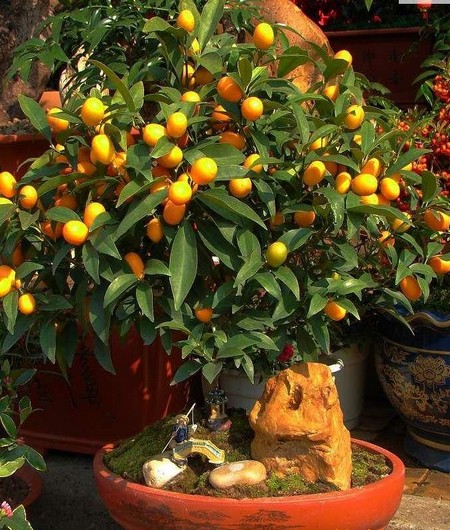
After the flowers fade, spray 0.3%-0.4% urea or 0.3% compound fertilizer, and add 15 ppm of 2,4-D. This has a significant effect on fruit retention in potted kumquats.
After young fruit has set, when the young fruit grows to 1 cm in size, fruit thinning should also be carried out. Generally, it is advisable to keep 2-3 fruits per branch. Within the same leaf axil, sometimes 2-3 young fruits are borne, and only one can be selected and kept, so that the fruits are distributed evenly over the whole plant.
Afterward, the autumn shoots should be cut off promptly to prevent a second fruiting, so as to facilitate good fruit development -- uniform fruit size and ripeness, improving ornamental value.
Under normal conditions, the fruit gradually turns yellow after the Start of Winter. To coordinate with Spring Festival viewing, if the fruit ripens too early, shading and increased application of nitrogen fertilizer (0.4% urea) can be used to delay the ripening period.
If the fruit ripens too late and has not turned yellow by the Spring Festival, 25 days before the intended ripening period, apply 1500 ppm ethephon to the fruit, or spray 20-50 ppm gibberellin; both are significantly effective.