The morphology, habits and care highlights of the succulent Adromischus poellnitzianus
Succulent plant - the morphology, habits and care highlights of Adromischus poellnitzianus!
Chinese name: Shenxiangqu
Alternative name: Shenxiangqu
Latin scientific name: Adromischus poellnitzianus
Family and genus: Crassulaceae
Origin and distribution: South Africa
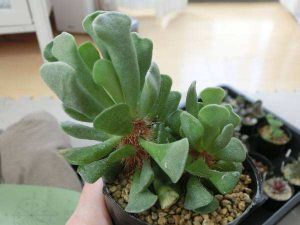
Adromischus poellnitzianus, a succulent of the genus Adromischus in the family Crassulaceae, is native to the Western Cape region of South Africa and is a perennial herb of the genus Adromischus in the family Crassulaceae. Its axe-shaped leaves are highly succulent, with rounded, blunt, wavy leaf margins; the leaves are green or bear light brown markings. The stem is thick and short, and it sends out many hairy aerial roots, which is one of its major features. Individual plants vary greatly in appearance, with some having whiter leaf margins, more obvious markings, or poorly developed aerial roots on the stem. It likes a sunny, cool and dry environment and has no obvious dormant period.
The growth habits of Adromischus poellnitzianus
It likes a sunny, cool and dry environment and has no obvious dormant period. Cultivation points: the optimum growing temperature is 15-25 degrees, and in winter it should not go below 7 degrees; the soil mix can generally be a mixture of leaf mold, vermiculite, coarse sand or perlite, with a small amount of plant ash and bone meal added; during the growing season, water thoroughly only when the soil has dried out; during the growing season, fertilize generally about once every 20 days; apart from the high temperatures of summer, leaf cuttings can be taken for propagation at any time above 10 degrees. Select healthy, plump leaves, let them dry for 1-2 days, then lay them flat on the soil; they will soon root and sprout, but they should not be transplanted too early.
Adromischus poellnitzianus has longer leaves than Adromischus cristatus, with no wavy edge at the leaf tip, and its brown stem is wrapped in densely growing aerial roots, giving it a peculiar appearance. Adromischus poellnitzianus likes a sunny, cool and dry environment and has no obvious dormant period. Cultivation points: the optimum growing temperature is 15-25 degrees, and in winter it should not go below 7 degrees; the soil mix can generally be a mixture of leaf mold, vermiculite, coarse sand or perlite, with a small amount of plant ash and bone meal added; during the growing season, water thoroughly only when the soil has dried out; during the growing season, fertilize generally about once every 20 days;
The propagation method of Adromischus poellnitzianus
The optimum growing temperature for Adromischus poellnitzianus is 15-25 degrees, and in winter it should not go below 7 degrees; the soil mix can generally be a mixture of leaf mold, vermiculite, coarse sand or perlite, with a small amount of plant ash and bone meal added; during the growing season, water thoroughly only when the soil has dried out; during the growing season, fertilize generally about once every 20 days; propagation can be done by leaf cuttings. Apart from the high temperatures of summer, this can be done at any time above 10 degrees. Select healthy, plump leaves, let them dry for 1-2 days, then lay them flat on the soil; they will soon root and sprout, but they should not be transplanted too early.
The propagation of Adromischus poellnitzianus can be done by leaf cuttings. Adromischus poellnitzianus has longer leaves than Adromischus cristatus, with no wavy edge at the leaf tip, and its brown stem is wrapped in densely growing aerial roots, giving it a peculiar appearance. It does not flower. Propagation can be done by leaf cuttings. Apart from the high temperatures of summer, this can be done at any time above 10 degrees. Select healthy, plump leaves, let them dry for 1-2 days, then lay them flat on the soil; they will soon root and sprout, but they should not be transplanted too early.