- 网站首页
- Growing Techniques
- How to prune a crape myrtle bonsai? Detailed methods and techniques
Crape myrtle is a very interesting flowering tree, and it has a special trait: “Crape myrtle blooms for a hundred days of red, and a gentle stroke of the branches makes the whole tree move.” That is why crape myrtle is also called the ticklish tree. The crape myrtle has a graceful tree form, curved branches and trunk, bright flower colors, and it blooms in the summer and autumn when few flowers are in bloom, making it an important flowering tree species for summer and autumn in gardens. Thanks to continuous breeding and selection by growers, the currently popular cultivars include: fast-growing rose-red crape myrtle, Wenjiang double-red crape myrtle, fast-growing brilliant-red crape myrtle, Japanese red-leaf arbor crape myrtle, Red Rocket crape myrtle, Red Fireball crape myrtle, American Velvet crape myrtle, and others.
Crape myrtle is grown as a flowering bonsai. Its trunk xylem is relatively hard, and its branches are slender and not easy to bend and shape, so pruning and shaping are mostly used to form the straight-trunk style, slanting-trunk style, curved-trunk style, and so on. Crape myrtle has strong sprouting ability and tolerates pruning. In terms of styling, through shortening and thinning cuts for shaping, combined with fertilizer and water management, a beautifully shaped bonsai that blooms every year can be developed in a short time.
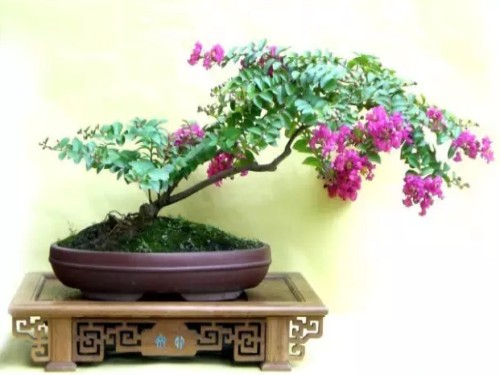
There are two pruning methods: shortening and thinning.
1. Shortening means cutting back the trunk and branches to build up new growth. First determine the height of the first section of the trunk, then through cultivation let the trunk reach a certain thickness before cutting it back to form the second section. In some cases, shortening and cutting back can be done once a year, and each section can be left 5-20 cm depending on the styling needs. While cutting back the trunk, side branches should also be cultivated, that is, branches are cultivated simultaneously, constantly making them thicker, taller, and longer. Through 2-3 years or longer of cultivation and reasonable cutting, the tree can achieve a beautiful body, straight and curved trunk and branches in good order, and many side branches with a natural density.
2. Thinning means cutting away branches that are too dense. Pruning generally includes winter pruning, routine pruning, and post-bloom pruning.
(1) Winter pruning. A heavy pruning approach can be used. At this time the tree is dormant, and after cutting, the internodes are short, and nutrients are concentrated on the 2-3 buds of the shortened branch, so the buds sprout strongly, and the newly grown branches are strong, which is beneficial for the second cutback (in summer or the following winter). When cutting, leave 1-2 main branches on each section of the main trunk, paying attention to layers and structure. Branch shortening generally leaves 3-5 cm per section; the sections of the lower branches can be longer, and the sections of the upper branches should be shorter than those of the lower layer, while side branches are shortened to about 3 cm.
(2) Routine pruning. During the growing season, promptly cut off shoots sprouting from the roots, and thin out symmetrical branches, crossing branches, and vigorous water sprouts. During the cultivation stage, the stump is not allowed to bloom. In summer, before flower buds form, promptly cut off the inflorescences to reduce the large amount of nutrients needed for blooming and maintain normal growth of the branches and trunk. When the newly grown trunk and branches become woody, carry out short pruning to form curved trunks and curved branches. New branches that sprout in spring must not be short-pruned; let the tips of the 1-year-old branches set buds and bloom.
(3) Post-bloom pruning. The blooming period basically ends in mid-October, so flowering branches should be cut off promptly. Flowering branches with an unsuitable opening angle should be cut off entirely, and flowering branches to be kept should be shortened as required.
Crape myrtle bonsai should undergo one heavy pruning in winter. In early April of the following year, new branches and new shoots sprout, and after sprouting they grow very quickly. By early to mid-May, the new shoots can reach about 15 cm. At this time, prune and pinch the new shoots once, keeping the new branches at about 8 cm to 10 cm, and cut off everything above, prompting it to grow double branches at the top. Keep the branches to be used, and all other unused branches, such as parallel branches, inner-canopy branches, overlapping branches, and vigorous water sprouts, should be completely cut off.
In mid-June, on the branches that have been pruned, double forked branches grow at the upper end. When the new branches grow to about 8 cm, inflorescences will grow after pinching. At this time, prune one of the two forked branches, cutting below the flower stalk and above the bud (as the branch for the second blooming).
The first blooming is in early to mid-July, and the flowers bloom neatly and concentratedly. After blooming, promptly cut off the faded flowers to encourage the axillary buds to grow new branches (as the branches for the third blooming). After the second blooming, the faded flowers should also be cut off to encourage it to grow new branches (as the branches for the fourth blooming). The third blooming is in mid to late August, and after blooming, cut off the faded flowers in the same way. The fourth blooming is in late September. If the temperature during the year is normal, crape myrtle will bloom a fifth time.
- 请使用count标签查询 Industry News
- 请使用count标签查询 Agricultural Machinery
- 请使用count标签查询 Edible Gardening
- 请使用count标签查询 Grain Crops
- 请使用count标签查询 Fruit Tree Cultivation
- 请使用count标签查询 Flower Cultivation
- 请使用count标签查询 Macadamias
- 请使用count标签查询 Agricultural Products
- 请使用count标签查询 Pests & Diseases
- 请使用count标签查询 Flowers & Gardening
- 请使用count标签查询 Soil & Composting
- 请使用count标签查询 Vegetables
- 请使用count标签查询 Agricultural Technology
- 请使用count标签查询 Growing Techniques
- 请使用count标签查询 Succulents
- 请使用count标签查询 Agriculture Encyclopedia
- 请使用count标签查询 Flowers
- 请使用count标签查询 Plants
- 请使用count标签查询 News
- 请使用count标签查询 Birds
- 请使用count标签查询 Policy
- 请使用count标签查询 Fertilizer
- 请使用count标签查询 Pesticides
- 请使用count标签查询 Nursery Stock
- 请使用count标签查询 Mushroom Cultivation
- 请使用count标签查询 Medicinal Herb Cultivation
- 请使用count标签查询 Fodder & Green Manure
- 请使用count标签查询 Livestock Farming
- 请使用count标签查询 Apple Cultivation
- 请使用count标签查询 Coffee Cultivation
- 请使用count标签查询 Organic Farming
- 请使用count标签查询 Avocados
- 请使用count标签查询 Green Manure
- 请使用count标签查询 Orchids
- 请使用count标签查询 Livestock Farming
- 请使用count标签查询 Melons & Fruits
- 请使用count标签查询 General News
- 请使用count标签查询 Watermelons
- 请使用count标签查询 Oranges
- 请使用count标签查询 Wax Apples
- 请使用count标签查询 Tomatoes
- 请使用count标签查询 Strawberries
- 请使用count标签查询 Pears
- 请使用count标签查询 Cherries
- 请使用count标签查询 Passion Fruit
- 请使用count标签查询 Mangoes
- 请使用count标签查询 Dragon Fruit
- 请使用count标签查询 Blueberries
- 请使用count标签查询 Pepino Melons
- 请使用count标签查询 Pomelos
- 请使用count标签查询 Lychees
- 请使用count标签查询 Bird's Nest Fern
- 请使用count标签查询 Bananas
- 请使用count标签查询 Pothos
- 请使用count标签查询 Pineapples
- 请使用count标签查询 Figs
- 请使用count标签查询 Koi
- 请使用count标签查询 Lemons
- 请使用count标签查询 Cacti
- 请使用count标签查询 Muskmelons
- 请使用count标签查询 Goji Berries
- 请使用count标签查询 Sugarcane
- 请使用count标签查询 Soybeans
- 请使用count标签查询 Rice
- 请使用count标签查询 Cyclamen
- 请使用count标签查询 Peaches
- 请使用count标签查询 Jujubes
- 请使用count标签查询 Sugar Apples
- 请使用count标签查询 Plums
- 请使用count标签查询 Wampees
- 请使用count标签查询 Waxberries
- 请使用count标签查询 Longans
- 请使用count标签查询 Custard Apples
- 请使用count标签查询 Guavas
- 请使用count标签查询 Kiwis
- 请使用count标签查询 Grapes
- 请使用count标签查询 Mulberries
- 请使用count标签查询 Plant Pests & Diseases
- 请使用count标签查询 Salaks
- 请使用count标签查询 Persimmons
- 请使用count标签查询 Starfruit
- 请使用count标签查询 Mint
- 请使用count标签查询 Mangosteens
- 请使用count标签查询 Durians
- 请使用count标签查询 Papayas
- 请使用count标签查询 Cilantro
- 请使用count标签查询 Sweet Potatoes
- 请使用count标签查询 Bitter Melons
- 请使用count标签查询 Chili Peppers
- 请使用count标签查询 Ginger
- 请使用count标签查询 Millet
- 请使用count标签查询 Pumpkins
- 请使用count标签查询 Herbs
- 请使用count标签查询 Peanuts
- 请使用count标签查询 Cauliflower
- 请使用count标签查询 Loquats
- 请使用count标签查询 Coffee Cultivation
- 请使用count标签查询 Winemaking
- 请使用count标签查询 Organic Tea Garden
- 请使用count标签查询 Tea
- 请使用count标签查询 Seed Industry
- 请使用count标签查询 Livestock Farming
- 请使用count标签查询 Aquaculture
- 请使用count标签查询 Specialty Farming