How do you keep koi so they grow fast? Authentic Japanese koi are about to arrive in Harbin
AuthenticJapanesekoiare about to arrive in Harbin! [Expand your knowledge] How many kinds of koi are there? How do you choose? What do the 10 most beautiful "legendary koi" look like...
Many friends who love keeping fish started with tropical fish
and later discovered a problem -
within a single breed they all look exactly the same!
As pets, if you can't tell who is who,
how can you build and deepen your bond with them?
We even want to give them names!
So many people gradually fell in love with koi
each one looks different!
Friends who love koi know that many "koi" on the market now may show different red, white and black color patterns, but the colors are not bright enough, the sections are not clear enough, and they blur into one mass - in fact, they can only be called "mongrel koi".
In the future, people in Harbin will have something to feast their eyes on - right at their doorstep they can admire importedJapanese koi.
Recently, under the guidance and active recommendation of the Heilongjiang Entry-Exit Inspection and Quarantine Bureau, Heilongjiang Xinhong Koi Fishery Co., Ltd. passed the review of the General Administration of Quality Supervision, Inspection and Quarantine and obtained the qualification of "domestic isolation facility permitted to import Japanese koi".
It is reported that this is the first Japanese koi import isolation facility in our province to be approved by the General Administration, becoming one of the three Japanese koi import isolation facilities in China.
It is understood that the isolation facility's hardware and breeding technology are advanced. Importing Japanese koi will raise the level of koi breeding technology in our province and form a modern ornamental fishery industry integrating quality fish, seedlings and breeding.
The reporter learned from Heilongjiang Xinhong Koi Fishery Co., Ltd. that the company is currently in negotiations with Japanese koi export enterprises. If the negotiations succeed, the first batch of Japanese koi will soon "swim" into our city's ornamental fish market.
So then
how can you select good fish on the market?
Japanese breeders are very particular about koi
Generally speaking, common koi have, besides a white base, also hi (red), and some also have sumi (black).
If the white base carries only red, the variety is called "Kohaku"
If the white base carries only black, with black on both head and body, it is called "Shiro Utsuri"; if only the body has black, it is called "Bekko".
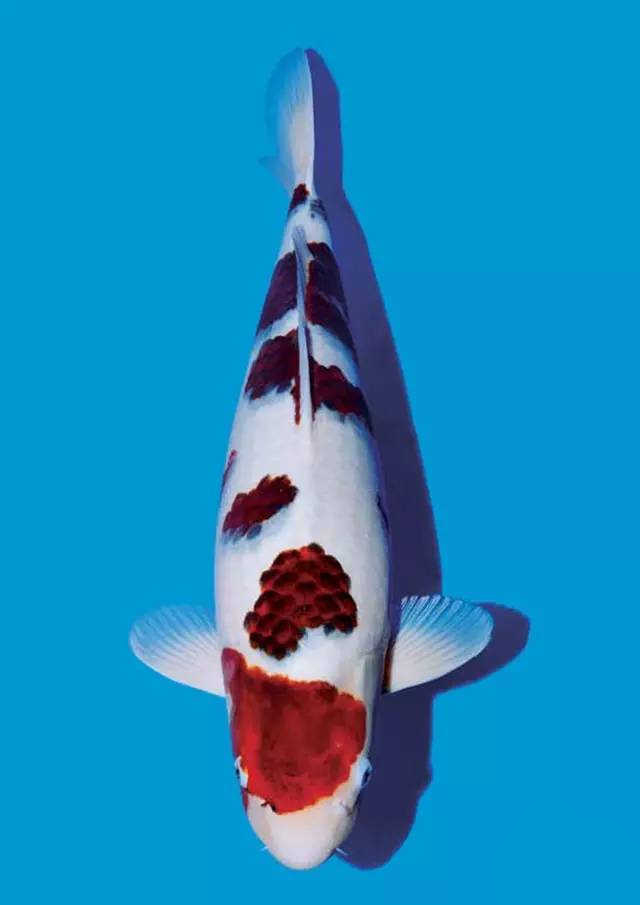
If all three colors - red, white and black - are present, "Kohaku" + "Shiro Utsuri" is called "Showa Sanshoku"; "Kohaku" + "Bekko" is called "Taisho Sanshoku”
Among them
Kohaku, Showa, Taisho
are called the "Gosanke"
Each variety must have the "correct" appearance:
Appreciation points for "Kohaku"
Appreciation points for "Showa"
Appreciation points for "Taisho"
Sometimes it is hard to imagine from descriptions alone
Take a look at the most famous in Japanese history
ten legendary koi
and you will roughly know what a good fish looks like
[Look, they each have their own nicknames]
1 First place "Kato Showa"
"Kato Showa" (219 points) has very beautiful red patches; its red pattern winds like a great river along the back, extending from the head all the way to the caudal peduncle. Although there are not many black patches, even the "motoaka" can be distributed in important positions, and it brings out the true flavor of Showa Sanshoku, displaying the brilliance of Showa Sanshoku and rewriting the history of Showa Sanshoku using black patches as the base color, becoming a model of modern Showa and sweeping appreciators off their feet - truly an unmatched "beauty".
2 Second place "Loulan"
"Loulan" (105 points), a Kohaku with the uniquely delicate and pure white base color cultivated by the Ogawa fish farm, its glossy, lustrous red quality defeated the "Yocho" that could almost sit beside it at the time, thereby winning the second-place throne.
3 Third place "Yocho"
As for the contest for runner-up position, it was between two Kohaku koi, and it was truly hard to separate them. If one were to say that "Yocho" (100 points) and "Loulan" (105 points) were both runners-up, that would not be an exaggeration. They likewise attracted hobbyists with beautiful and delicate white patches, and their red patches also had very peculiar variations; their distribution was different from the traditional color-patch distribution of Kohaku, creating a precedent for natural beauty.
4 Fourth place "Kikkou Kohaku"
"Kikkou Kohaku" (84 points) - this is a koi that emphasizes the beauty of the white base color, allowing the thick and even red patches covering it, as if refined, to be displayed to the fullest. In short, its quality is especially excellent, making it a superb koi that became a topic among koi hobbyists as a Kohaku.
5 Fifth place "Tanaka Sanshoku"
"Tanaka Sanshoku" (45 points) is also an especially high-quality legendary koi. Not only is the white skin base good, the red patches and red plate are also very good, and with powerful blue-black on the shoulders, it has the momentum to settle the world at a single stroke. Tanaka Sanshoku is the kind of koi that is hard to forget after seeing it just once.
6 Sixth place "Asahi"
"Asahi" (39 points), reminiscent of the bright red of the rising sun, is a legendary koi among Kohaku that lives forever in the hearts of koi hobbyists. And when appreciating it, it always gives people a warm, intimate feeling.
7 Seventh place "Koto Zakura"
"Koto Zakura" Kohaku (33 points) is a giant Kohaku whose body shape has such overwhelming presence that it shocks appreciators; its body is huge and stout, and its color patches are deep. From it we can feel that this is an excellent koi bred with superb feeding technology.
8 Eighth place "Matsumoto Sanshoku"
"Matsumoto Sanshoku" (29 points) makes one feel that even among 90-bu koi there can still be such excellent quality. Despite its advanced age, it still retains such high-quality red patches and snow-white base, and it is a Taisho Sanshoku that won its reputation because of this.
9 Ninth place "Dainichi Sakura"
"Dainichi Sakura" (18 points), famous for its excellent quality. Whether red plate, black, or skin base, all are outstanding. It is a fine work loved by experts, and also a koi that producers all hope to produce one day.
10 Tenth place "Crown Sanshoku"
"Crown Sanshoku" (15 points). Looking at it now, although this Taisho Sanshoku is considerably inferior to the above nine legendary koi in the quality of its red, its highly individual pattern is a legendary koi that many hobbyists very much want to own.
Common features
1. Very good body shape, full and smooth. 2. Glossy, lustrous and bright color. 3. Distinctive pattern with balanced distribution. 4. Solid scales and good skin base.
5. Excellent quality.
So, are you stunned?
Wait for the arrival of the first batch of Japanese koi
and feast your eyes
Harbin Daily reporter Wang Guan
Editor: Zhang Linlin
。