Which koi varieties are considered to have spirituality? Introduction to artificial breeding methods
Artificial breeding of koi 1. Artificial natural breeding of koi Select parent fish of the same variety with excellent quality and good bloodline, and place them in an independent clean water pond or net cage at a male-to-female ratio of 1 : (2~3) to let them spawn naturally. 2. Artificial dry-method insemination of koi Select parent fish of the same variety with excellent quality and good bloodline...
1. Artificial natural breeding of koi
Select parent fish of the same variety with excellent quality and good bloodline, and place them in an independent clean water pond or net cage at a male-to-female ratio of 1 : (2~3) to let them spawn naturally.
2. Artificial dry-method insemination of koi
Select parent fish of the same variety with excellent quality and good bloodline, and place them in an independent clean water pond or net cage at a male-to-female ratio of 1 : 2, with spawning nests suspended on the water surface.
When they are chasing each other and are about to begin spawning, scoop out the female fish, anaesthetise it with an anaesthetic, wipe the water off the fish body with a dry towel, gently press the abdomen, and collect the squeezed-out eggs in a small tray. Note that there must be no water at this point.
Then, scoop out the male fish in the same way, anaesthetise it with an anaesthetic, wipe the water off the fish body with a dry towel, gently press the abdomen, draw up the flowing milt with a pipette, place the milt into the eggs already collected, and stir evenly with a chicken feather (or duck feather or goose feather).
Finally, evenly scatter the stirred fish eggs onto the spawning nests in the water. Note that the eggs should not be scattered too densely and must be even. This process must be done quickly and accurately.
3. Koi hatching
After the fertilised eggs have absorbed water, a uranium bicarbonate solution (0.04%) + salt (0.04%) can be splashed over the whole pond to prevent damage from water toxins, then transfer them to clean water for hatching. It is best to add an air pump to aerate so that the water has a slight flow, which is beneficial to the respiration of the eggs.
4 . Koi fishFry rearing
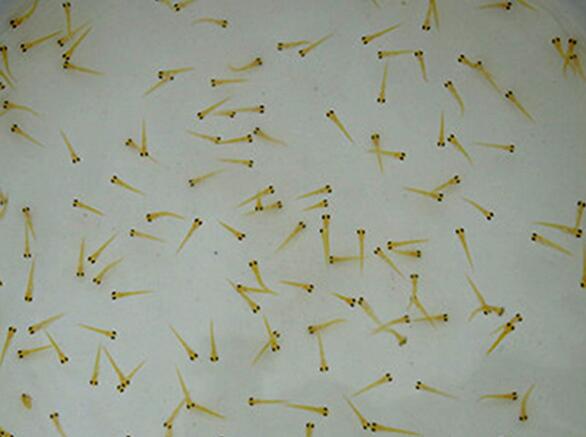
The moment a koi fry bursts out of the egg, a new life is born.
When the water temperature is low, the accumulated temperature takes longer, and hatching requires more time; conversely, when the water temperature is high, the accumulated temperature takes less time, and hatching requires less time.
Because nutrients are consumed during the hatching period, if the hatching time is too long, the fry that hatch will be very weak.
But it is not that the shorter the better either. If the time is too short, the fry that emerge often include a certain number of deformed fry with incomplete development, and these fry are also not easy to survive. It is ideal to control hatching so that the fry emerge in 3~4 days, that is, when the water temperature is 22~25°C it is most suitable.
But it is not that the shorter the better either. If the time is too short, the fry that emerge often include a certain number of deformed fry with incomplete development, and these fry are also not easy to survive. It is ideal to control hatching so that the fry emerge in 3~4 days, that is, when the water temperature is 22~25°C it is most suitable.
After the fry hatch, they do not eat. They rely on the nutrition of the yolk to develop and maintain survival. At this time the fry mostly attach to the pond edge or the spawning nests and aquatic plants without moving. If the water is stirred, they will jump repeatedly, but they still cannot swim.
At this time it is best not to disturb them. If an air pump has been turned on for oxygenation, it is best to reduce the air flow so that the fry move less, which helps them develop and grow.
At a water temperature of 22~25°C, after 3~4 days the fry begin to develop fully. At this time a bright spot can be seen in the middle part of the fry. This is the swim bladder, which experts call the “waist spot”.
At this point, the fry can swim horizontally, which also proves that they have developed to a very good degree, and the yolk that supplied nutrition has also been fully absorbed. They are ready to eat.
When this situation is seen, feeding should begin. Experts call this the “opening feed”. If it is not fed in time, the fry will die from weakness.
What are the opening feeds? Generally there are the following two major categories.
(1) Natural opening feed:
In natural water bodies there are countless tiny living things, such as rotifers, paramecia, cladocerans, copepods, algae and so on. These tiny organisms are all very good natural opening feed for fry.
In natural water bodies there are countless tiny living things, such as rotifers, paramecia, cladocerans, copepods, algae and so on. These tiny organisms are all very good natural opening feed for fry.
They can provide the fry with sufficient nutrition, enabling the fry to grow rapidly. When rearing fry in a culture pond, the most important thing is to fertilise the water and cultivate these opening feeds for the fry.
(2) Artificial opening feed:
There are usually cooked egg yolk water, fish meal, and brine shrimp. Now there are also artificially compounded microencapsulated feeds, thereby ensuring the normal [development] of the fry. In the process of rearing fry, attention must be paid to the feeding amount, which should be moderate. It is necessary both to ensure that the fry can eat their fill and to avoid affecting water quality due to excess, causing oxygen deficiency and fouling the water
There are usually cooked egg yolk water, fish meal, and brine shrimp. Now there are also artificially compounded microencapsulated feeds, thereby ensuring the normal [development] of the fry. In the process of rearing fry, attention must be paid to the feeding amount, which should be moderate. It is necessary both to ensure that the fry can eat their fill and to avoid affecting water quality due to excess, causing oxygen deficiency and fouling the water
As the fry grow, continuously increase the feeding amount by an appropriate amount and expand the range of feed supplied, to ensure the nutritional needs of the fry.