Tips for Selecting Juvenile Koi and Daily Breeding Management Methods
Daily management is very important when breeding koi. Since koi live in water, among the daily management tasks, water management ranks first. The quality of the water directly affects the normal growth of koi. When the water is fresh and clear with sufficient oxygen, the fish live healthily...
Koi Breeding——Sufficient Dissolved Oxygen
Koi are large ornamental fish; they eat more than other ornamental fish, naturally produce more waste, and pollute the water more heavily. When there is sufficient oxygen in the water (dissolved oxygen generally no less than 3-5 mg/L), the fish live lively and healthy.
The water body for keeping koi should be as large as possible, and aeration should be ample; usually an air pump is used for aeration.
If keeping them in anaquarium, generally a small air pump of about 10 watts is used, and 2-3 air stones are enough;
If keeping them for viewing in a pond, note that because the pond water is deeper and the pressure at the bottom is greater, an ordinary small air pump cannot push air to the bottom, so the aeration effect will be poor. In this case, a larger air pump should be used so that air can be pushed up from the bottom; usually a pump of 60 watts or more is needed, and more air stones should be installed and distributed so that aeration is more thorough.
Nowadays, koi breeding usually involves installing a biological filtration system. Biological filtration requires a great deal of oxygen; only with sufficient oxygen can biological filtration work well and the water quality be better. When choosing air stones, it is best to buy ones that produce small, dense bubbles; bubbles that are too coarse and large do not help oxygen dissolve in the water and only waste resources and increase noise.
Koi Breeding——High-Quality and Efficient Filtration System
The quality of the water depends to a large extent on the quality of the filtration system. When the filtration system is good, the water is fresh and clear, there are fewer harmful substances in the water, and the fish live healthily and lively.
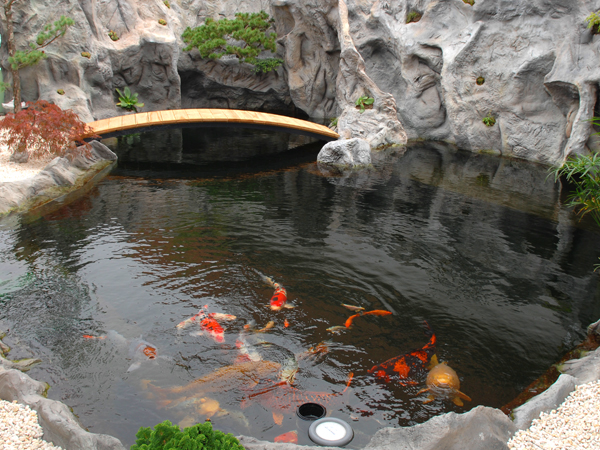
Koi Breeding——Changing the Water
Koi are not very demanding about the water used for breeding; usually tap water, well water, mountain spring water, river water, lake water and so on that meet the "Water Quality Standard for Freshwater Aquaculture of Pollution-Free Food" can all be used to breed koi.
When using tap water to breed koi, pay special attention that the tap water used must be dechlorinated, because tap water has chlorine added to disinfect and sterilize it, and chlorine is harmful to koi; if it is not removed, chlorine poisoning can easily occur and kill the fish.
Usually, letting fresh tap water stand for 3-5 days, or adding 1-2 grams of sodium thiosulfate per cubic meter of water, can effectively remove the chlorine in the water; if using well water, attention should be paid to testing the water temperature; when the water temperature suddenly drops or rises by 2-3 °C, koi are prone to illness;
if the water temperature difference is too great, the fish easily catch cold. The most suitable living water temperature for koi is 22-35°C; in this temperature range, koi swim actively, have a robust constitution and a strong appetite. If the temperature fluctuates by as much as 7-8 °C, the fish will lie motionless at the bottom.
If the temperature changes even more abruptly, koi may even die immediately. Besides paying attention to water temperature as mentioned above, note also that although well water is relatively clear, because it is groundwater it is usually low in oxygen, so it should be aerated before use; at the same time, test whether the water contains minerals harmful to fish, and also test the pH value. Koi need to live in slightly alkaline water, and the suitable pH value is 6.8-7.5. If the pH value changes too much, koi will also fall ill because they cannot adapt.
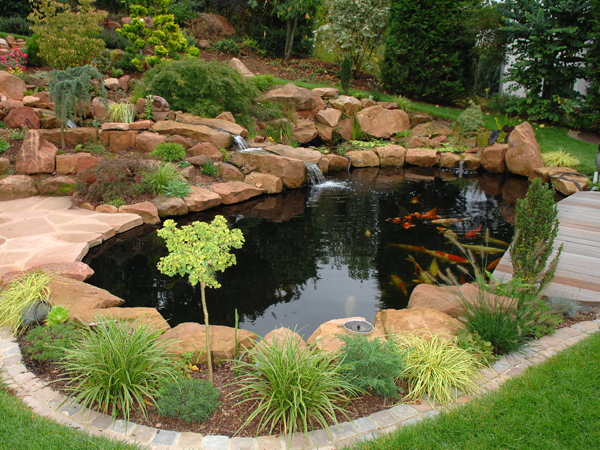
If the breeding water comes from mountain spring water, river water or lake water, besides paying attention to water temperature and pH value, special attention should be paid to whether the water contains harmful pollutants; especially when using it for the first time, it is particularly important to find out whether there are pollution sources upstream of the water source. If possible, it is best to send a water sample to the relevant department for testing and use it only after it is confirmed to be up to standard.
After a period of rearing, the breeding water needs to be partially replaced to keep the breeding water fresh and clear.
Especially in summer, when the water temperature is relatively high, in order to make the fish grow faster, the amount fed is often increased, and at the same time the fish's waste output increases. At this time, because the load on the water is increasing while the high water temperature weakens the water's oxygen-dissolving capacity, the water quality is especially prone to deteriorating. When you find that the water in the fish pond (tank) has suddenly turned cloudy white, it is time to change the water immediately; otherwise, fish are very likely to die from lack of oxygen and gasping at the surface.
If the filtration system is good, generally changing the water once a month or even once a quarter is fine;
if the filtration system is average, the interval for changing the water should be once every 15 days .
If there is no filtration system, the water must be changed once a day.
When changing the water, note that the amount changed each time should be one fifth of the total water volume; changing more easily causes disease in the fish because the water temperature and water quality change too much. At the same time, the water added should be clean and free of harmful substances; especially when using well water or mountain spring water, even more attention should be paid to this.