How do you cull Showa Sanshoku koi fry? Learn how to select koi in three minutes
Showa Sanshoku koi fry culling tips: Showa Sanshoku fry should undergo their first selection within 3 ~ 15 days of hatching, and this is very important. The fry that will eventually grow into Showa Sanshoku are gray-black; these gray-black fry grow relatively weakly and are fewer in number, while the others...
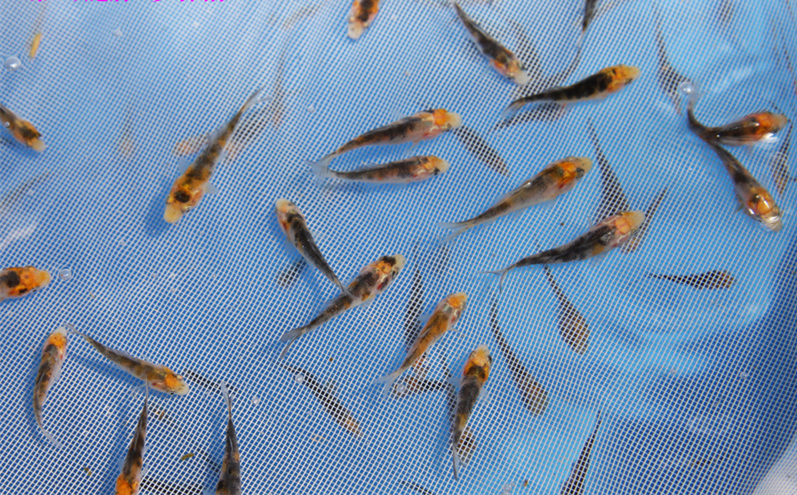
Showa Sanshoku fry should undergo their first selection within 3 ~ 15 days of hatching , and this is very important. The fry that will eventually grow into Showa Sanshoku are gray-black; these gray-black fry grow relatively weakly and are fewer in number, while the other red, white, or red-and-white fry grow faster. The black fry of Showa Sanshoku grow slowly, and they will become weaker and weaker and eventually die, so the earlier the first selection is carried out, the more Showa Sanshoku you are likely to obtain.
During the first selection, pick out the black fry, and the white or orange-yellow fry can be discarded. If you do not select in time, by the time they are raised to a larger size, you may end up with not a single Showa Sanshoku left. The stocking density should also be lower; usually, keeping it below half the density used for Kohaku fry is sufficient, and the feed should be relatively abundant as well to ensure their rapid growth and survival.
Compared with Kohaku andTaisho Sanshokuthe second selection of Sanshoku is later, about 60 days. At this time, the Showa Sanshoku body color is relatively dark, with almost no white markings. You need to observe carefully: those with deep orange markings beneath the black patches should be kept, while those with black-yellow markings may be Hi Utsuri; if the pattern distribution is reasonable, they can be kept, otherwise they should be culled. However, the markings of Shiro Utsuri appear relatively late and may not be fully developed even at nearly one year old; as long as you see faint gray patches beneath the white and the distribution is reasonable, they should be kept.
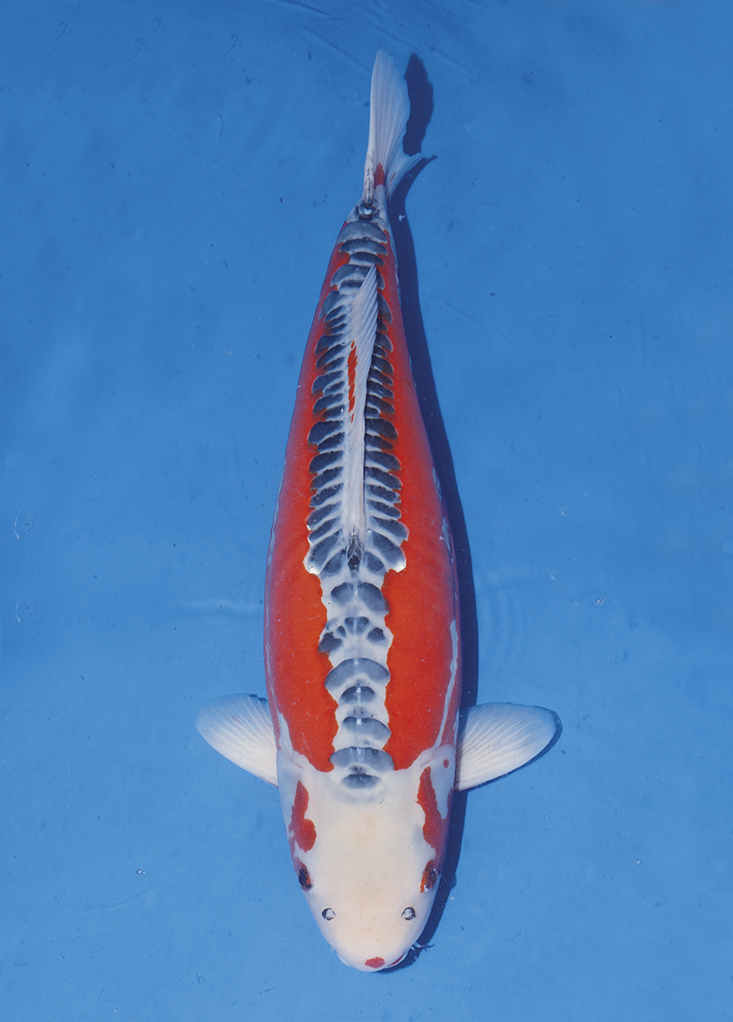
For koi within three years of age, this is first of all the period when quality begins to show, and moreover, when they can be judged and selected, the kiwa portion is very small; what matters is to judge based on the nature of the parent koi and what they will become after growing. This is important not only when selecting tosai, but equally important for two-year-old and three-year-old koi that are growing.
At around three years of age, the pattern may have been good when purchased as tosai, but by the time they reach three years old, due to changes in the pattern and the fading or increase of color patches, it is often difficult for them to remain and continue to be grown into large fish. By the time they reach three years old, observing sibling koi from the same spawn to understand what they were like as tosai and selecting based on their changes is a very good method.
When purchasing koi, it is often not easy to see the parent koi; it is best to observe the other sibling koi from the same spawn and make a comparison, which is a good way to understand the quality of the koi.