What is the color difference between Koi Ginrin Matsukawabake and Shusui?
Introduction to Ginrin Matsukawabake Koi. Ginrin Matsukawabake has the scales a normal koi should have on its body, and does not belong to the few-scaled or scaleless type. Its scales are silver, with jet-black patterns distributed over the silver base. The pectoral fins, fins and the posterior three fins all have black patterns but these do not extend to the edges...
Ginrin Matsukawabake has the scales a normal koi should have on its body, and does not belong to the few-scaled or scaleless type. Its scales are silver, with jet-black patterns distributed over the silver base. The pectoral fins, fins and the posterior three fins all have black patterns but these do not extend to the edges. In some of them the ginrin becomes fully covering, with no pattern at all over the entire back of the fish, and black patterns appearing only on the belly.
The ginrin of Ginrin Matsukawabake is its greatest feature. The silver scales evenly distributed over the whole body glitter and are crystal clear, making anyone who sees it feel their eyes light up and giving them an urge to own it right away. This is also one of the points that makes it so popular as an ornamental fish.
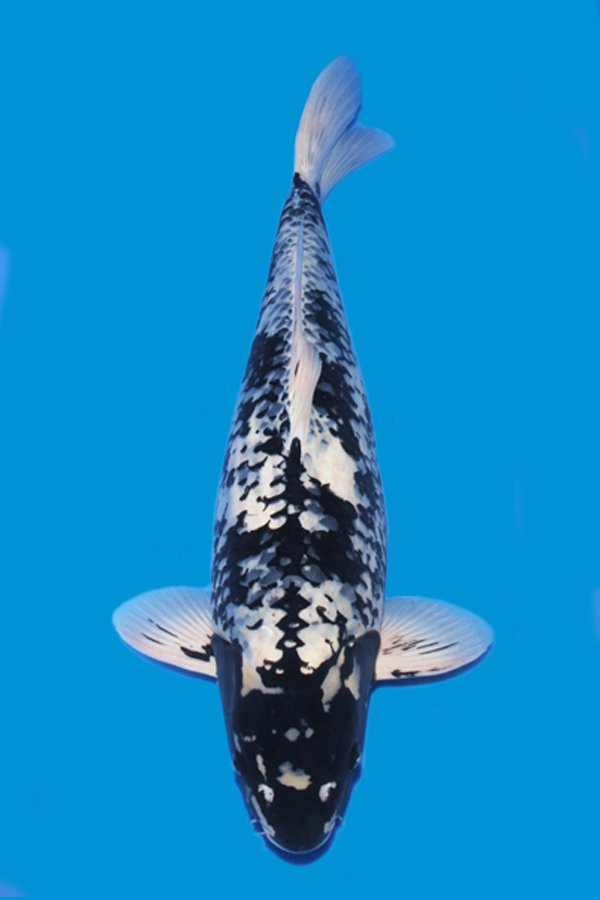
The life of Ginrin Matsukawabake lies in the way the silver is presented. The ginrin must emerge comprehensively, evenly and neatly, and the overall color must appear smooth and translucent. The silver base portion of its ginrin must be presented more than the pattern; if there is too much pattern it will cover its silver, and a strong ornamental effect cannot be obtained. It is best if the entire back of the body shows the ginrin effect, with very little pattern appearing.
Secondly, the edge of the silver base of the ginrin must be clear and tidy, without any stains or ink marks, and without too much pattern interspersed. It is best if the whole area is silver base with no pattern in the middle, and only a little pattern appearing at the edges.
If the edge of the silver base of the ginrin and the front insert portion appear blurred and cannot show the ideal silver effect, then this is a problem with the silver of the scales. In Ginrin Matsukawabake, the fish scales in the 2-3 rows to the left and right of the shoulder opening and backbone will not show ginrin. The crimson, jet-black and white base that appear on the ginrin glitter, and the brilliant ginrin makes Ginrin Matsukawabake all the more precious.
At present Ginrin Matsukawabake is in an endangered state, mainly distributed in China, Japan and Germany. In addition, Ginrin Matsukawabake is an oviparous fish. Its main food, animal-based bait, includes: such as water fleas and tubifex worms. Its territoriality is very weak, and the rearing water temperature is generally 20-30°C, with the PH required to be slightly alkaline. Generally between 7.2-7.5.