Which Koi varieties have good colors? Detailed guide to selection and culling methods
Koifishculling is mainly about eliminating poor fish and selecting good ones with ornamental value,koi. So how do you cull to select top-grade koi with ornamental value? Culling koi is essentially about looking at the koi's body shape and red markings, and to select top-grade koi, the koi must go through layer upon layer of observation, discussion and appreciation by koi connoisseurs to eliminate unqualified koi.
Koi culling is not only the culling at judging shows; there is also the culling of parent fish and the culling of fry, and the selection points differ for different varieties.
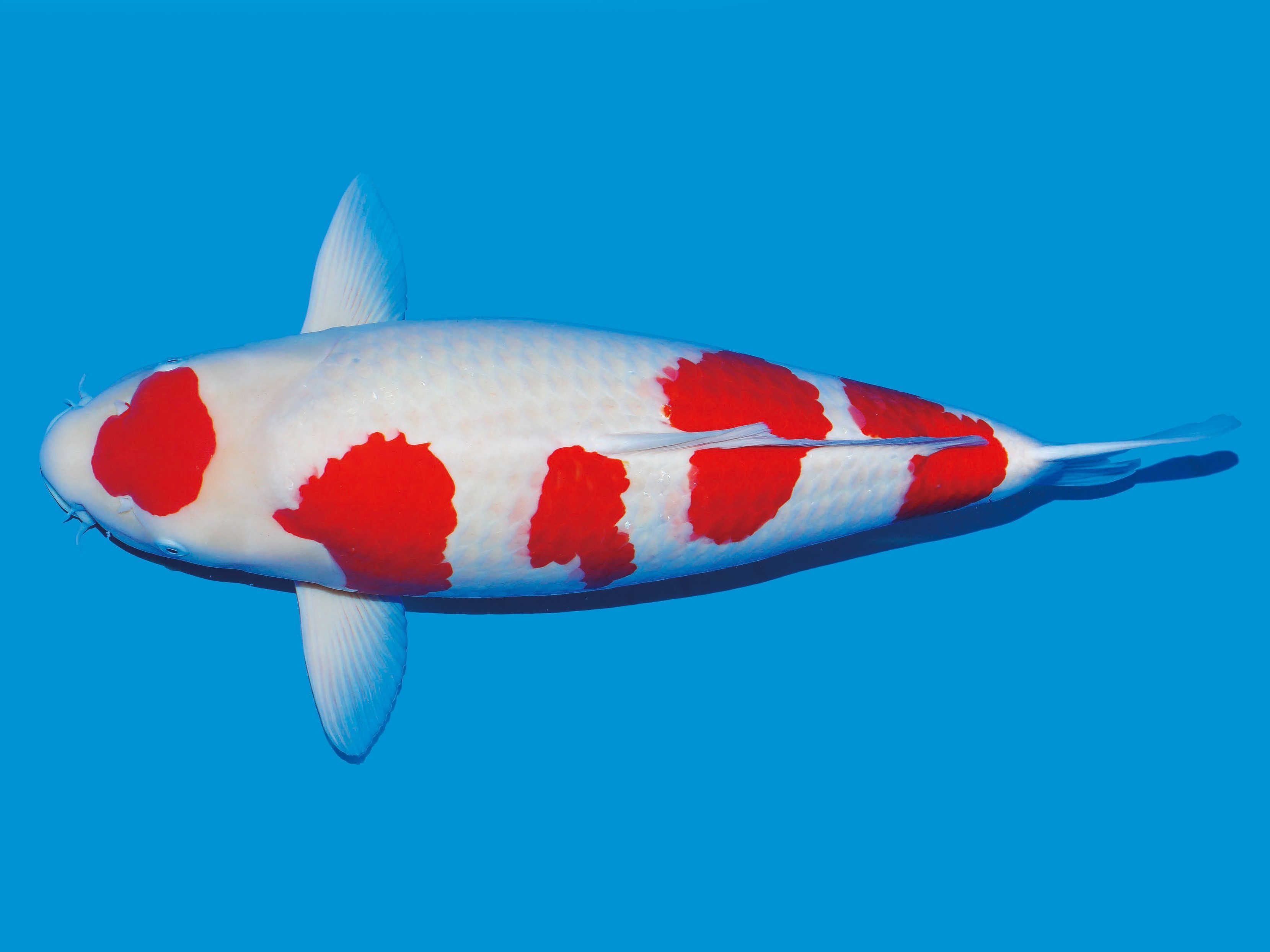
First, the culling at judging shows is actually about how to appreciate koi. The culling of koi at judging shows can be said to be the most luxurious, the most lavish, and also the most exciting and joyful koi culling. If your koi receives extremely high ratings at a judging show, many expert koi keepers will want to buy it from you, and the prices they offer will absolutely astonish you. According to surveys, some koi keepers have offered millions to buy a single koi. So what are the selection points for koi at judging shows? There are six in total:
1. Eyes: whether the distance between the two eyes is wide enough; if the distance between the eyes is wide, this koi will grow relatively large.
2. Lips: whether the lips are thick; koi with thin lips are very difficult to raise into large fish.
3. Pectoral fins: pectoral fins that are too small, too pointed, or triangular are all bad; if a koi's pectoral fins have too large a forward sweeping range when swimming, looking like it is struggling, it indicates that this fish is not very healthy; the body shape from the pectoral fins to the caudal peduncle should grow very smoothly, without sudden bulges or depressions.
4. Head: whether the head is long enough, whether the cheeks on both sides of the head are full, whether the top of the head is full; koi with a flat top of the head are not ideal
5. Tail: the caudal peduncle should be thick and sturdy, the caudal fin should not be too long, and the notch of the caudal fin's fork should not be too deep; the highest point of the body height should be slightly in front of the dorsal fin; if it is in the middle of the dorsal fin, that is very bad.
6. Barbels: the barbels must not be too short, but since koi will break or damage their barbels by hitting walls when startled or by rubbing due to parasitic infection, even if they regrow they will still be very short, so this point is for reference only.
Next, the culling of koi parent fish is also very important, because it relates to the fry after koi breeding. Without good fry, no matter how much judging is done there will be no top-grade koi. In order to breed more outstanding koi, the selection of parent fish must have a healthy constitution, no physical defects, deep, vivid and glossy colors; clear markings that are balanced left and right, a coordinated body shape, with a body height to body length ratio of 1:(2.6-3) being better, a beautiful swimming posture, and obvious and clear variety characteristics. The body shape of parent fish should be selected as relatively flat top and bottom, with a flat oval cross-section, and an overall spindle shape. The age requirements for selecting male and female koi parent fish also differ. Although koi essentially reach sexual maturity at a relatively early age, in order to breed higher-quality koi, age requirements are also necessary; for male fish it is best to choose those between 3 and 5 years old, while female koi are selected later, between 4 and 10 years old, and such parent fish have a relatively robust constitution, full gonads, relatively lively sperm and eggs, and very high fertilization and hatching rates, making them very ideal as parent fish; if the koi parent fish are too old or too young, the fertilization and hatching rates will be greatly reduced.
The culling of koi fry is one of the preparatory conditions for keeping koi: among koi, body shape is valued most. How can we select a good body shape, and which parts are the key points? The body shape selection of koi fry is mostly consistent with the appreciation standards at judging shows. What also needs to be examined is its swimming posture. Put the fry in a basin and see whether it swims with difficulty; difficulty indicates that it is not very robust. The body shape from the pectoral fins to the caudal peduncle must be very smooth. Although the color during the fry stage is not yet very attractive, it must be ensured that there are no stray colors, that the color patches are evenly distributed, and that no color swirls reach the eyes, cheeks or nose.
Variety culling: Kohaku: red and white must be coordinated and have a sense of overall unity; neither the white quality nor the red quality may be muddy. It must be even and fine. The red must be thick and solid, with a balanced, even and symmetrical sense of charm. Red basically has two tones: one is a dark red with purple as the base tone, which is lower in style but not easy to fade; the other is a bright red with orange as the base tone, which gives people a bright and soft sense of excitement and is relatively higher in style.
Taisho Sankeis a koi with even, coordinated red and black markings on a white background. But the head absolutely must not have black markings. The appreciation of the red quality of Taisho Sanke is the same as for "Kohaku." It must be balanced left and right with a stable center of gravity. The black markings are required to have the same evenness, density and luster as the red quality. Generally, the sumi (black) color of Taisho Sanke is unstable; only when the koi grows to between 2 and 5 years old will the sumi color gradually appear and stabilize.
Showa Sanshoku appreciation: The red color of Showa Sanshoku is appreciated with the same requirements of balance, coordination and symmetry as the red of Kohaku; while the sumi (black) color is the key point of Showa Sanshoku appreciation. The sumi markings on the head should form a lightning pattern, ideally splitting the head in a "eight" or "person" shape, and the very center of the top of the head (the nose area) should be black. Black markings on the body that wrap from the belly up to the back are more beautiful than those extending from the back down to the belly. The black markings on the pectoral fins must be round; stripe-shaped sumi markings must not appear, and the sumi markings should be jet black or blue-black with luster, so that when paired with vivid red they appear even more bold and unrestrained. Purple-black or lusterless sooty color must absolutely not appear. The sumi color of Showa Sanshoku, like that of Taisho Sanke, is unstable.
For more koi questions, please visitKoi Forumfor consultation, thank you!
。