Detailed Explanation of Key Points in Jinding Duck Breeding and Management Techniques
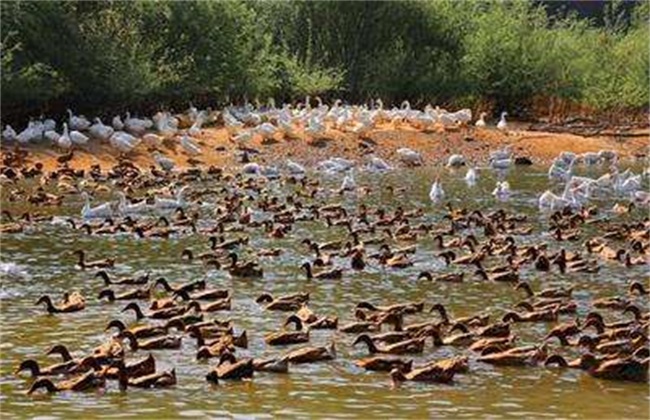
The Jinding duck is a type of brown duck, also known as the South China duck, and is a traditional improved poultry breed from the Fujian region. It has a strong physique and strong foraging ability, and features high egg production, heat tolerance and cold resistance, and high feed conversion rate. Breeding it requires attention to daily feeding management, so how should Jinding ducks be raised? Let's learn about it together.
1. Feeding of Ducklings
Ducklings refer to young ducks from just hatching to 20 days of age. Ducklings are afraid of both cold and heat, so just after hatching the temperature should be controlled between 30-32 degrees, and the temperature should be gradually lowered as the ducklings grow. Within 24 hours of hatching, they should be given an appropriate amount of large water intake, and then start feeding, which helps eliminate the dirt accumulated in the digestive tract during the embryonic period. Start feeding is to adapt to its rapid growth and development nutritional needs, and complete formula feed should be used for feeding, with the method of small amounts and frequent feeding. After 3-4 days from hatching, put them in shallow water to promote digestion and metabolism and keep the ducklings' bodies clean, but they should not be placed in water for too long, and attention should also be paid to changes in water temperature.
2. Feeding During the Growing Period
The growing period generally refers to young ducks from 20-40 days of age. At this time the ducks are lively and active, and as the days of age increase, their grazing time can be gradually extended. Feeding can also be flexibly controlled according to foraging conditions, mainly ensuring the flock eats its fill. As the days of age increase, the ducks' individuals grow larger, feed consumption increases, and their tolerance for coarse feed also strengthens. In order to reduce feed costs, protein feed can be appropriately reduced. At this time, they should also be raised in groups. For slower-growing ducks, they can be separated out and given strengthened feeding management to promote their growth and development, ensuring they grow in line with the flock.
3. Feeding of Young Ducks
Young ducks refer to those from 41 days of age until before laying, also called reserve ducks. Ducks at this stage are relatively easy to raise, with a strong physique, strong foraging ability, strong adaptability to climate, and rapid growth and development, so feeding should be adapted to local conditions, making full use of the outdoors for grazing, reducing feed supplementation, and lowering feed costs. When the flock cannot eat its fill while grazing, complete formula feed should be supplemented in the chicken house to ensure its nutritional needs for growth and development, laying a solid foundation for egg production and promoting earlier laying.
4. Feeding of Adult Ducks
Adult ducks already have egg-laying ability, so in terms of feeding, sufficient feed supply must be ensured, especially protein feed, which must be supplied stably over the long term, and feed must never be switched at will. If feed needs to be changed, it should be done gradually. During this process, if a decline in egg production or other abnormal phenomena occurs, management should be strengthened promptly or the change should be stopped. During the laying period, noise should be reduced to avoid frightening the flock and lowering egg production, and the environmental sanitation inside and outside the duck house should be kept clean.
The above is an introduction to the breeding and management techniques for Jinding ducks. We hope it can help you. To learn more related knowledge, please stay tuned to us.