How do you identify male and female pigeons in meat pigeon farming?
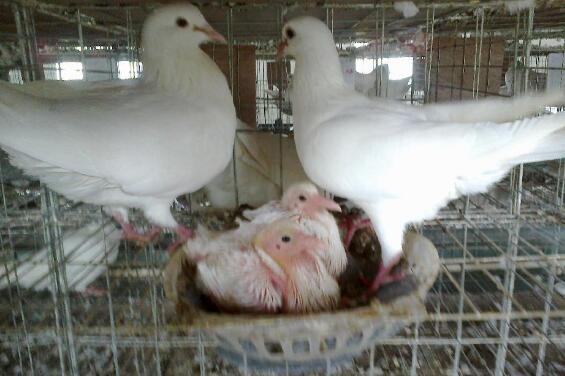
In the process of farming meat pigeons, how do you identify male and female pigeons?
Squab identification
(1) Cloaca identification method: 4 to 5 days after the squab hatches, the upper edge of the male pigeon's cloaca covers the lower edge and protrudes slightly; in the female pigeon, the lower edge protrudes and covers the upper edge.
(2) Feeding identification method: among squabs in the same clutch, those that compete to be fed by the parent pigeons are mostly male pigeons; the opposite indicates female pigeons.
(3) Behavior identification method: among squabs in the same clutch, male pigeons grow faster and are larger in body size, while female pigeons grow more slowly; when the head of a squab is touched by hand, the male pigeon reacts sensitively, raises its feathers, and is lively and aggressive; the opposite mostly indicates a female pigeon.
Young pigeon identification
(1) Look at appearance: the male pigeon has a large, broad head shape, a large but short beak, a large and prominent cere, and large, thick shank bones; the female pigeon has a more compact body shape, a small round head, a smaller cere, a long and narrow beak, a thin and soft neck, and short, thin shank bones.
(2) Holding by hand: when young pigeons are held by hand, male pigeons resist strongly and can make a "coo-coo" call; female pigeons are more docile.
(3) Feeling by hand: when feeling the abdomen and pelvis by hand, the male pigeon's keel process is thicker and longer, the distance between the pubic bones is narrow and tight, and the shank bones are thick and round; the female pigeon has a wider distance between the pubic bones (about 4 to 5 cm), a slightly shorter keel process, and thin, flat shank bones.
(4) Cloaca examination: when the male pigeon's cloaca is closed, it protrudes outward, and when opened it is slightly hexagonal; when the female pigeon's cloaca is closed, it sinks inward, and when opened it is cauliflower-shaped.
(5) Feathers: observe that the male pigeon's feathers are glossy, and the tips of the primary flight feathers are more pointed; the female pigeon's feathers are less glossy, and the tips of the primary flight feathers are more blunt.
Adult pigeon identification
(1) Male pigeons often chase female pigeons; the male pigeon's neck air sac expands, the neck feathers and back feathers puff up, and the tail feathers spread out like a fan. Female pigeons are relatively gentle and frequently accept the male pigeon's courtship.
(2) Because of courtship and mating between male and female pigeons, the male pigeon's tail feathers are relatively dirty, while the female pigeon's back feathers are relatively dirty.
(3) During kissing, the male pigeon opens its beak, the female pigeon puts her beak into the male pigeon's beak, and after kissing, the female pigeon naturally crouches down and accepts mating from the male pigeon.
(4) Incubation times differ. Male pigeons mostly incubate the eggs from 10:00 to 16:00 each day, and the female pigeon incubates at other times.