How to raise Jingjiang Ma ducks? A duck farmer shares breeding tips and experience
These nimble ducks are no ordinary birds. In the eyes of the local people, they are not only representatives of the region's distinctive poultry breed, but also carry a long-standing tale of military merit. What kind of duck has such a legend? It is the Jingjiang Ma duck of Hubei. It is not only delicious in meat, but also a champion at laying eggs. Though small in size, they are agile and quick. The Jingjiang Ma duck has tight plumage all over its body, a delicate head, and a black bill. Male and female Jingjiang Ma ducks differ greatly. The male duck has a long neck, brown feathers on its back and loin, and a light black tail. The female duck has a small head, hemp-colored feathers on its neck, a slender and flexible neck, and muddy-yellow back feathers with black stripes. An adult duck weighs 1.4-1.5 kg. The Jingjiang Ma duck matures early. Under normal feeding conditions, the age at first laying is 85-90 days, and the peak laying period can be reached at 150 days. The laying rate is 90%, and the number of eggs laid during the 500-day laying period is 240-300.
Duck raising: Seven key points for the maintenance and management of fermented-bed duck raising. Environmentally friendly farming is the future trend
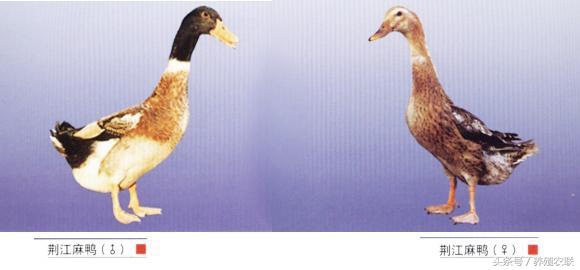
Jingjiang Ma duck (male) Jingjiang Ma duck (female)
Farmers generally raise Jingjiang Ma ducks mainly in pens, and the scale can be large or small, but the size of each duck flock should not be too large; 300 to 500 ducks is suitable. When grouping, try to ensure uniform size, the same age in days, the same breed, and the same sex. Stocking density varies with duck age, season, and temperature. Generally, from 4 to 10 weeks of age, 20 to 12 ducks per sq m; from 11 to 20 weeks of age, 12 to 8 ducks per sq m. In winter, when the temperature is low, the density should be appropriately higher; in summer, when the temperature is high, the density should be lower. For fast-growing ducks, the density should be appropriately lower; for slow-growing ducks, the density should be appropriately higher.
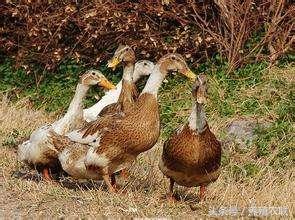
Jingjiang Ma duck
The body weight of Jingjiang Ma ducks should not be too thin or too fat. More than 1500 grams is considered too fat, so feed should be mildly restricted, and more green feed and roughage can be appropriately given. For green feed, species such as chicory and cocksfoot can be selected. For ducks that are poorly developed and light in weight, the feeding amount should be appropriately increased. The average daily feed amount per duck should be kept at about 150 grams. In addition, add a small amount of fresh animal-based feed, feed 3 to 4 times a day, and make the intervals between feedings as equal as possible to avoid uneven hunger and fullness at feeding time.
Healthy Duck Farming Techniques / Healthy Farming Wealth-Building Techniques Series
In the management of young ducks, the duck house must be clean and disinfected regularly. The duck house should be warm in winter and cool in summer, well ventilated, and kept clean and dry. Drinking and feeding utensils and waterers should be washed once a day, and the duck house should be disinfected regularly. They should also be given appropriate exercise, which promotes the development of duck bones and muscles and prevents excessive fatness. Every day, drive the ducks to move inside the house at fixed times, 5 to 8 minutes each time, 2 to 3 times a day. If conditions permit, short-distance and short-duration herding can be done. Farmers should also have more contact with the duck flock to increase the ducks' boldness and prevent flock panic. Young ducks are timid, and egg-type breeds are especially nervous and sensitive. Take advantage of feeding, watering, and changing bedding to have more contact with the duck flock, and consciously cultivate the ducks' boldness, so as to avoid panic in the flock when strangers approach or the environment changes, which can cause serious losses.
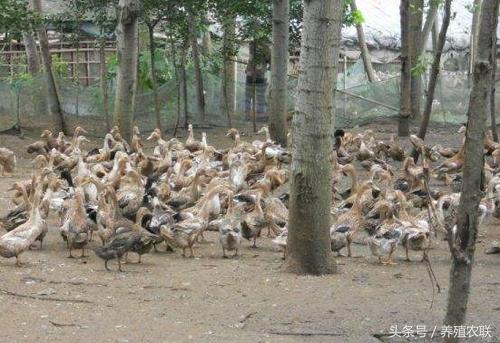
Jingjiang Ma duck
Duck raising: Meat duck farming needs to prevent three kinds of poisoning. Large-scale meat duck farming has high benefits
In addition to good feeding, prevention of infectious diseases should also be strengthened. There are two main infectious diseases in duck raising: cholera and duck plague. The general immunization program is: inject fowl cholera vaccine once at 60 to 70 days of age, inject fowl cholera vaccine again around 100 days of age, and inject attenuated duck plague vaccine once at 70 to 80 days of age. For laying ducks kept for only 1 year, one injection is enough; for laying ducks kept more than 2 years, inject once every other year.
Friends interested in farming can follow the official account: Farming Quick Guide. There are wonderful farming news and technical articles shared every day. Submission email: [email protected].