2017 National Bamboo Rat Farming Market Analysis: Why Is Success So Hard?
First half of 2017, by region across ChinaBamboo rat seedlingsPrices
The following data was compiled from quotes given by bamboo rat farmers; the price data covers January to June 2017 and is meant to serve as a reference.
Seedling unit: yuan/pair
Bamboo rat seedling prices in Yunnan Province:
Honghe Hani and Yi Autonomous Prefecture 500
Bamboo rat seedling prices in Guangxi:
Guilin City 290
Nanning City 300
Liuzhou City 330
Baise City 240
Bamboo rat seedling prices in Guangdong:
Huizhou City 380
Bamboo rat seedling prices in Sichuan Province:
Guang'an City 500
Bamboo rat seedling prices in Guizhou:
Qiandongnan Miao and Dong Autonomous Prefecture 450
Qiannan Buyei and Miao Autonomous Prefecture 480
Bamboo rat seedling prices in Fujian:
Sanming City 500
Bamboo rat seedling prices in Hunan:
Huaihua City 380
Yongzhou City 300
Changde City 500
Bamboo rat seedling prices in Zhejiang:
Wenzhou City 380
Bamboo rat price trends by province before 2017!
[Hunan]
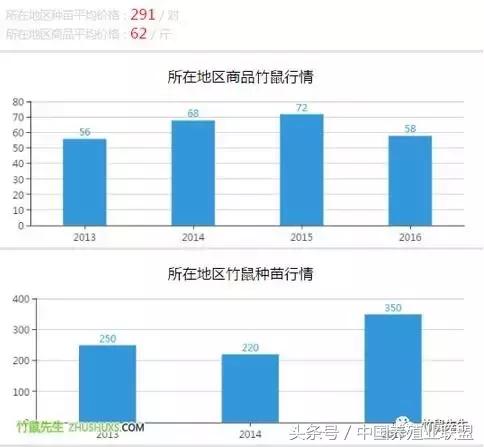
[Guangxi]
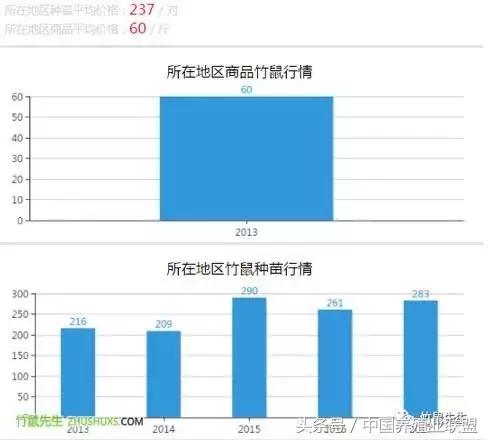
[Sichuan]
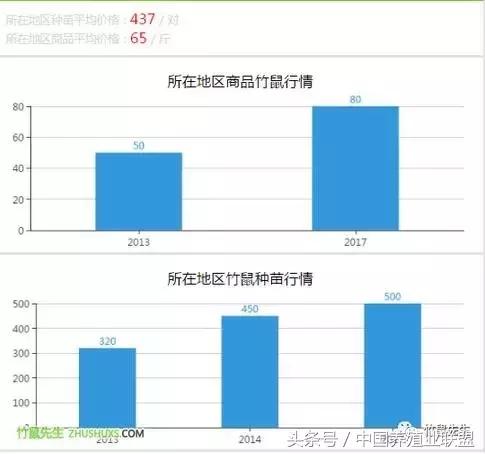
[Guizhou]
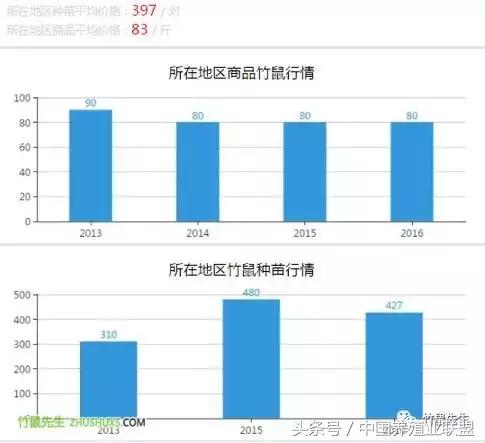
[Yunnan]
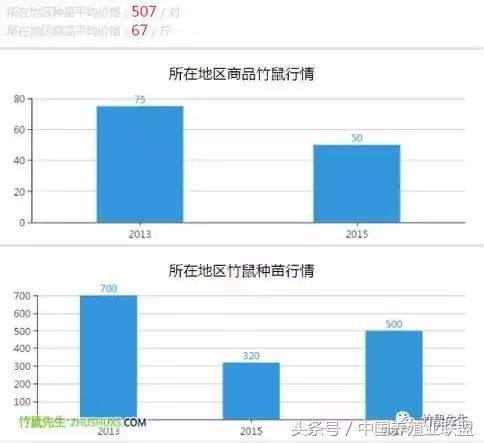
[Zhejiang]
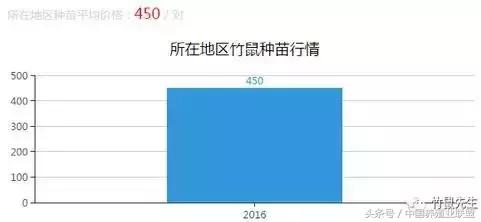
[National commercial bamboo rats, bamboo rat seedlings]
Nationwide, bamboo rat seedling prices have generally shown an upward trend. Prices in 2013 and before were affected, especially in the Guangxi region, where prices were over 100. Price data from 2016 shows an average price of 328, fluctuating up and down; it is guessed that most prices should be around 300, though of course prices in areas such as Sichuan, Chongqing and Yunnan are somewhat higher. 300 is only a general figure.
For commercial bamboo rats nationwide, prices are basically between 60 and 80; there is no doubt about this.
[Distribution of bamboo rat farms by province across China]
As the chart shows, bamboo rats are mainly kept, and have a relatively broad following, in Guangxi, Hunan, Sichuan, Guangdong, Yunnan, Guizhou, Jiangxi, Chongqing and other places.
Forecast of future price trends in the bamboo rat industry
I have been learning about and following the bamboo rat industry for some time, and at the same time I have gradually joined the ranks of farmers. During this period I browsed through Tieba, moved between forums and QQ groups exchanging views, and also visited nearby farms to observe and learn, benefiting a great deal.
So, on the eve of starting my own farming, I wanted to publish my views, and so I have boldly written this article.
Captive farming has a history of more than ten years, and the farming technology and conditions are mature, but that does not mean success is easy. According to incomplete online statistics,the failure rate for individual bamboo rat farmers is as high as 80%(this is not alarmist talk).
Forecast of future price trends in the bamboo rat industry
I think the most troublesome problems are:
1. Having no planning at all for the bamboo rat project, let alone a long-term plan. (The so-called "raise two and see how it goes.")
2. Not having the most basic farming environment, site and resource conditions.
3. Not having enough startup capital, or follow-up capital. Raising bamboo rats is like a marathon, with a long cycle; at the fastest it still takes a year and a half to two years before they give birth, survive and generate income. But I have talked with quite a few owners, and some have raised them for three to five years yet still have only a few dozen or about a hundred. Why? They know the market very well, so why are they standing still?
4. Not having mastered farming technology, knowing only a little about farming, always thinking that buying a book, looking up answers online, or discussing in forums and groups will solve everything. Yet on the road of farming there are too many problems beyond one's control, and they lose animals to disease and breeding.
5. Not having unshakable willpower. Raising bamboo rats is not like raising chickens or pigs. Most people, especially family members, will strongly oppose it. Mr. Bamboo Rat - they have few channels for getting information, and they have a resistant and wait-and-see attitude toward new things, especially with the word "rat" in the name. Even if at the beginning you firmly persuade your family and friends, later, halfway through your farming, they will obstruct you in every possible way and completely break down your original resolve. It is said that success means persevering one more time than failure. Back in the cold winter of 2013, how many farmers with dreams fell; those beliefs were destroyed amid the downturn.
The problems mentioned above may seem rather negative, and they are also blunt, but in my view they can serve as reminders and warnings from the standpoint of a novice farmer. Of course, I am offering a modest spur to induce others to come forward with valuable contributions, and I hope the veterans will give plenty of guidance.
Over tea and after meals, let us talk about future bamboo rat price trends. These are my humble opinions; if there is any dispute, please kindly change your posture when reading the post.
Getting to the point, let us look from back to front. Around 2010, media outlets rushed to report on the bamboo rat industry. That was when it could be considered to be rising rapidly. Media coverage had both pros and cons. The advantage was that it added fuel to the fire and pressed the fast-forward button for the bamboo rat industry. The disadvantage was that it egged on a large number of people who were themselves not suited to starting a business or to farming to crowd into this industry; these people had neither capital nor the ability to bear risk. In such an environment, what you see today is seedling speculation, with prices driven higher and higher. From a macro perspective, the ultimate consumption of the bamboo rat industry flows to the market and to the dining table, but farmers found that selling seedlings was easier and more profitable than selling commercial animals.
If you build a high-rise with shoddy, jerry-built work, it goes up fast and falls fast too. So, in such an environment, the entire market industry will become diseased.
In 2013, the bamboo rat industry could be said to have entered a cold winter. It was not the weather that was cold; it was the farmers' hearts that went cold. Based on what I learned while lingering in Tieba and forums, in the summer and autumn from June to October 2013, commercial prices were about 35, and seedling prices were about 200 per pair (please correct me if this is wrong). In this cold winter, many people lamented: Heaven does not help Han, but helps you lot.
Water-Don't-Worry - clean water lines and disinfect drinking water to reduce the occurrence of intestinal diseases
Learn farming technology, understand the farming market, and ask about farming problems. Welcome to follow the "China Farming Industry Alliance" WeChat public platform, WeChat public account: zgyzylm