Are cultured crystals and natural crystals the same in composition, and how should consumers tell them apart
What are cultured crystals? Natural crystal is a national defense mineral resource. When electrified, natural crystal produces continuous and stable high-frequency oscillation, so it is mostly used in the military to make oscillators for electronic instruments, and it is an indispensable and precious resource. But crystal is, after all, a limited mineral resource, so substitutes are needed, which led to the later development of "regenerated crystal," that is, cultured crystal.
How are cultured crystals made? The regenerated crystal currently produced in Japan is cultivated artificially by what is called the hydrothermal method. The basic principle is the same as the way natural crystal forms: a large amount of "anhydrous silicic acid" is injected into a sturdy tall furnace cylinder two or three stories high, silicon dioxide is added, the lower part is heated to about 400 degrees Celsius, the upper part is kept at about 360 degrees Celsius, and a "seed crystal" for the crystal to attach to and crystallize on is suspended in this solution; its role is just like the cotton thread used for rock sugar to crystallize on! The seed crystal is mostly made from natural crystal or regenerated crystal cut into thin slices. The seed crystal is somewhat like a transparent ruler about 20 cm long, and the crystal crystallizes outward on both sides of the seed crystal, so the original "ruler" is sandwiched by the regenerated crystal.
Natural crystal and cultured crystal have the same constituent elements and the same growth direction, and the same hardness, specific gravity, refractive index, and even birefringence, so can't cultured crystal replace natural crystal? From the perspective of electronic parts, cultured crystal is indeed much cheaper than natural crystal, easier to obtain, more stable in quality, and standardized in size and specifications, so it has indeed replaced natural crystal.
As is well known, different natural crystals can emit various energies beneficial to the human body, because natural crystal absorbs the essence of heaven and earth in nature for thousands, tens of thousands, or even hundreds of millions of years, and helps improve the human body's qi. But cultured crystal does not have this effect. If what you seek from crystal is health and wealth, or if you want to ward off evil, improve your luck, and adjust feng shui, it is still more suitable to buy natural crystal!
Introduction to synthetic crystal
The production of synthetic crystal arose from industrial needs. The appearance of colored synthetic crystal made a major contribution to supplementing the shortage of natural colored crystal. However, people know very little about the basics of synthetic crystal, and thus many misunderstandings have arisen about synthetic crystal. Some people confuse synthetic crystal with glass; some people think synthetic crystal is fake crystal; some people think synthetic crystal is made by melting crystal material from small fragments (melted crystal); some people call synthetic crystal artificial crystal. These understandings and terms are all incorrect. First, the silicon-oxygen tetrahedra in synthetic crystal are in a regularly arranged crystalline structure. In glass, the silicon tetrahedra are irregularly arranged, and some physical properties of glass and synthetic crystal are very far apart, and their market prices are also very far apart, so they cannot be lumped together. As for crystal fragments that have been melted at high temperature, they have already become quartz glass material. Calling synthetic crystal artificial crystal is also very nonstandard.
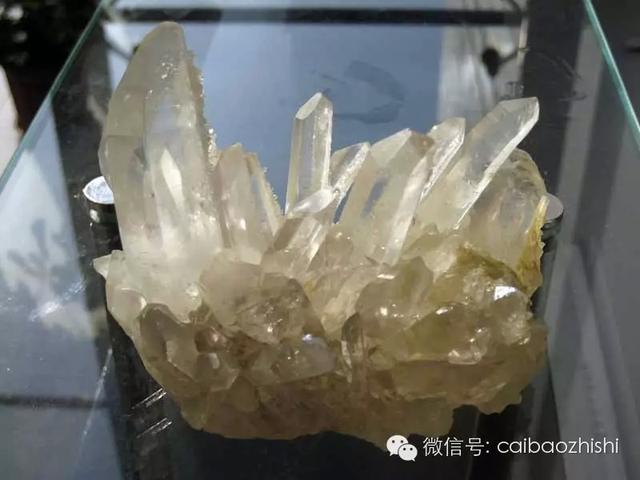
Synthetic crystal is a kind of artificial gemstone. It is a crystal grown by the hydrothermal method under certain physicochemical conditions in an autoclave. According to the naming rules for gems and jades, if an artificial gemstone has no natural counterpart, such as strontium titanate, which has no counterpart in nature, it is named "artificial strontium titanate"; if an artificial gemstone has a natural counterpart, such as silicon dioxide crystals grown by the hydrothermal method, which have their counterpart natural crystal in nature, it is named "synthetic crystal," and cannot be called "artificial crystal," nor "cultured crystal" or "melted crystal," and even less "pure crystal." Because these names, which are neither scientific nor standard and are invented at will, easily produce ambiguity and mislead. The physicochemical properties of synthetic crystal and natural crystal are basically the same, so synthetic crystal cannot be called "fake."
Methods for making synthetic crystal
Synthetic crystal is a kind of crystal grown on the base of a seed crystal. There are mainly two orientations of the seed crystal: one perpendicular to the z-axis, and the other parallel to the y-axis. Synthetic crystals of different colors have different seed crystal orientations, and the doped ions are also different.
The world's first hydrothermally synthesized crystal was born around 1905. By the 1970s, the former Soviet Union had synthesized citrine and amethyst. To date, a large amount of synthetic crystal is used in the jewelry industry worldwide every year. The main varieties are synthetic colorless crystal, synthetic amethyst, synthetic citrine, and a small amount of green, blue, and yellow-green bicolor synthetic crystals. China's synthetic crystal technology is very mature, and it can synthesize both colorless crystal and colored crystal.
Definition: crystal made by artificial methods. This includes colorless synthetic crystal mainly used for industry and colored synthetic crystal mainly used for the jewelry industry, both synthesized by the hydrothermal method.
Their main components, optical properties, and physical properties are the same as those of the corresponding natural varieties, but they are purer and more suitable for industrial or jewelry industry requirements. Synthetic colored crystal must have some colorants or doped ions added to form color centers and display beautiful colors, or it may be changed to another color by irradiation treatment or heat treatment.
For example, rose-colored or light greenish-brown is produced by adding titanium, light brown by adding vanadium, green by adding chromium, brownish-brown or dark green by adding manganese, purple or bright yellow-green, yellow-brown, yellow by adding iron, brick-brown or light blue, blue by adding cobalt, light greenish-cyan by adding nickel, light yellow by adding copper, and dark brown by adding aluminum. [1] Amethyst is the noblest and most beautiful member of the crystal family. It is also called feng shui stone, and Japanese people call amethyst energy stone. Amethyst has a purple color because a trace amount of Fe (iron) element is mixed in, and iron oxide is the main cause of its vivid purple. Amethyst can also form other styles; most are the inward-growing geode (amethyst geode) growth mode, while outward-growing amethyst clusters (the most common on the market are white crystal clusters) are extremely rare.
Identification methods
1. Color
Synthetic crystal is a crystal formed under relatively stable conditions provided artificially, so its batch samples show excessive uniformity. Colorless synthetic crystal can have a uniform high transparency, while colored synthetic crystal shows a uniform, consistent color. Sometimes, affected by the concentration of the colorant, the color may be too deep or too light, and the color is stiff and fake-looking. For example, synthetic amethyst can have a uniform deep purple, while also carrying a blue tint; natural amethyst generally has uneven color depth, and the color is soft and true.
2. Seed crystal
A seed crystal plate can be seen in synthetic crystal. The seed crystal plate is a plate-like crystal cut from natural crystal to serve as a seed crystal, so it is called a "seed crystal plate." Seed crystal plates come in colorless and colored types. There is a clear boundary and color difference between the seed crystal plate and the later-grown crystal. Affected by the supersaturated solution in the autoclave or temperature fluctuations in the autoclave, some impurities or spontaneously formed microcrystals fall on the crystal face or defective parts of the seed crystal plate, forming tiny fluffy twin crystals. Under microscopic observation, the twin crystal surface appears grayish-white and foggy. Very fine stress cracks also often appear near the seed crystal plate, and the fracture surfaces are bent and arranged at a certain angle to the seed crystal plate.
3. Inclusion characteristics
Inclusions are also called the internal features of gem minerals. Crystal inclusions are extremely varied, and can truly be called "a wonderful mineral world, a rich and colorful mineral museum." Therefore, when identifying crystal, the key is to look at the crystal's inclusions. In synthetic crystal, what mainly appears is aegirine, or microcrystalline nuclei of quartz, in a breadcrumb-like form. They may come from undissolved raw materials. When the growth conditions of synthetic crystal are relatively stable, the "breadcrumbs" are very sparse. When the growth conditions are unstable, especially when interruption occurs during the growth stage of synthetic crystal, "breadcrumbs" appear in large numbers in some planes parallel to the seed crystal plate, just like "tabletop dust," with one or even two or three layers running through the entire crystal. Beginners often take these "breadcrumbs" or "tabletop dust" as evidence of natural crystal. If carefully observed under a high-power microscope, the "breadcrumbs" in natural crystal are mostly tiny gas-liquid two-phase inclusions, while the "breadcrumbs" in synthetic crystal are uniform tiny crystallites.
4. Color banding
Color banding can appear in synthetic amethyst and synthetic citrine, but only one set of color banding appears, and the color banding is parallel to the seed crystal plate. So-called color banding refers to band-like colors within the crystal. The color banding of synthetic amethyst is parallel to the rhombohedral direction, while that of synthetic citrine is parallel color banding perpendicular to the crystal's optical axis.
5. Twinning
Twinning is when two or more crystals of the same kind grow together in a regular intergrowth according to a certain symmetry law. Brazilian-law polysynthetic lamellar twinning often appears in natural crystal, and the twinning may run through the entire crystal or may appear only in part of the crystal. In natural crystal, non-twinned areas can show a bull's-eye interference figure, while twinned areas can show a "propeller"-shaped interference figure. In synthetic crystal, however, a bull's-eye interference figure is generally visible, while a "propeller" interference figure cannot be seen.
Welcome to follow the official WeChat public account of "Color Gem Knowledge": caibaozhishi. You are welcome to interact online with Color Gem Bunny, and I will serve you wholeheartedly!