Modern Intelligent Monitoring System for Aquaculture Water Quality Environment
The continuous deepening of China's agricultural and aquaculture scientific research technology and the continuous improvement of environmental protection awareness have raised higher requirements for continuous real-time monitoring of various water quality parameters, but at present China's agricultural production still mostly remains at the level of traditional manual experience-based judgment, with very little automated control. Aquaculturefarmingenvironment intelligent system is a new farming method that has emerged during the development of the aquaculture industry toward modernization, enterprise operation, and large-scale development, achieving high-density, high-yield, and high-efficiency fishery production. The intelligent aquaculture water quality monitoring system is oriented toward the development needs of intensive, high-yield, high-efficiency, ecological, and safe aquaculture. Based on IoT technologies such as intelligent sensing, wireless sensor networks, communications, intelligent processing, and intelligent control, it is an aquaculture IoT system that integrates online collection of water quality environment parameters, intelligent networking, wireless transmission, intelligent processing, early warning information release, decision support, and remote and automatic control into one system.
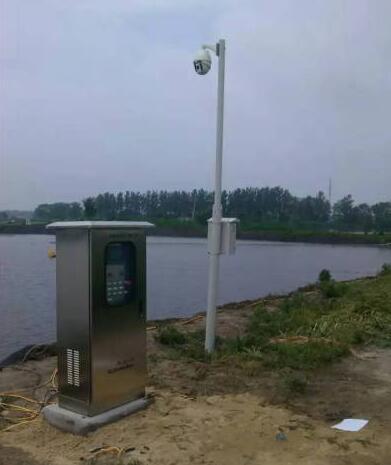
Aquaculture Environment Intelligent System
The aquaculture environment intelligent system is oriented toward the development needs of intensive, high-yield, high-efficiency, ecological, and safe aquaculture. Developed based on IoT technologies such as intelligent sensing, wireless sensor networks, communications, intelligent processing, and intelligent control, it is an aquaculture IoT system that integrates online collection of water quality environment parameters, intelligent networking, wireless transmission, intelligent processing, early warning information release, decision support, and remote and automatic control into one system. Farmers can use information terminals such as mobile phones, PDAs, and computers to grasp aquaculture water quality environment information in real time, obtain abnormal alarm information and water quality warning information in a timely manner, and according to water quality monitoring results, automatically adjust and control equipment in real time, achieving scientific aquaculture and management, and ultimately achieving the goals of energy saving and consumption reduction, green environmental protection, and increased production and income.
Aquaculture technicians in the monitoring center can, through the monitoring system, grasp aquaculture water quality environment information in real time, obtain abnormal alarm information and water quality warning information in a timely manner, and according to water quality monitoring results, adjust and control equipment in real time, achieving scientific aquaculture and management, and ultimately achieving the goals of energy saving and consumption reduction, green environmental protection, and increased production and income. In addition, users can also grasp water quality information and employee work conditions of aquaculture farms distributed in different locations in real time through the network.
Advertisements
The water quality monitoring station can be optionally equipped with dissolved oxygen sensors, pH sensors, water level sensors, salinity sensors, turbidity sensors, etc. Together with an intelligent data collector, it mainly realizes online collection, processing, and transmission of aquaculture water quality environment parameters. The aeration control station includes a wireless control terminal, a distribution box, an air compressor, and aeration oxygen-increasing pipelines (or aerators). The wireless control terminal aggregates the information collected by the water quality monitoring station and, according to the dissolved oxygen requirements of different aquaculture species, controls the action of the aeration equipment through an algorithm model. The on-site and remote monitoring center includes a WSN wireless access point and an on-site monitoring computer. The data aggregated by the wireless control terminal is summarized through the wireless access point to the on-site monitoring computer. Users can query water quality parameter data locally, and at the same time the monitoring computer analyzes and processes the data, makes control decisions, and sends control instructions to the distribution box through the wireless access point.
The remote monitoring center receives the data information aggregated by the wireless control terminal through the GPRS remote access point. Users can remotely query water quality information through information terminals such as mobile phones, PDAs, and computers, and can also make control decisions by analyzing and processing the data, and remotely control the aeration equipment. This aquaculture water quality online monitoring system includes a full set of software and hardware facilities such as high-precision sensor probes (i.e., sensors), data collection and analysis terminals, wireless communication terminals, intelligent oxygen transmission control cabinets, intelligent mobile display terminals, internet cloud servers, and online mobile display and control software, providing a strong technological backing for the informatization and intelligentization of aquaculture. The system allows management personnel in related fields to view online the sampling data of probes at each monitoring site. At the same time, it provides an SMS prompt function, making it convenient for managers to understand the values of various water quality parameters in a timely manner, allowing managers to obtain news of water quality problem alarms at the first opportunity. Thus measures can be taken in time to avoid losses.
When the system is running, the dissolved oxygen, temperature, and other data collected by the RIU are transmitted in real time to the WEB server through the DTU. The WEB server stores these data in real time and provides users with the function of querying at any time through web pages. At the same time, according to the alarm or prompt conditions set by the user, the system sends dissolved oxygen and temperature information in real time via SMS to the user's designated mobile phone, so that users can understand water quality conditions anytime and anywhere.
Finally, the editor of Gongcaiwang will introduce to everyone two of the most popular and most welcomed water quality sensors currently, and both are high-quality products imported from the United States. You should know that the United States is globally famous for its strict testing requirements on the quality of exported products, and is deeply trusted by countries around the world.
American sensorex water quality sensor (general-purpose pH electrode) - S200C:
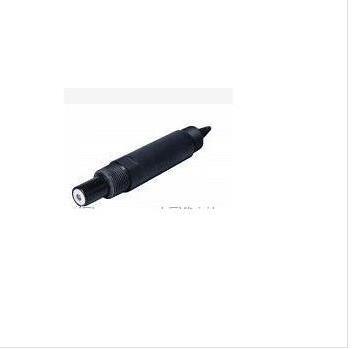
Water Quality Sensor (General-Purpose pH Electrode) - S200C
This series of electrodes mainly adopts an economical design suitable for multi-purpose solutions such as online installation or bypass installation. It has a rugged spherical or flat pH glass design, and the housing materials all use rugged and durable epoxy resin or Ryton material. This general-purpose electrode is an economical multi-purpose pH electrode that can adapt to online or submersible installation, with multiple models available for selection (single liquid junction or double liquid junction, glass bulb measurement surface or flat surface measurement scalar, etc.).
General-Purpose pH Electrode Specifications:
1. Measurement range: 0-14 pH (+/-2000 mV for ORP module)
2. Housing material: PVC, Ryton, CPVC, Polypropylene, Epoxy
3. Maximum operating temperature: 65 - 100 degrees, depending on model (PVC material only for 65 degrees)
4. Maximum pressure: 100 psig
5. Interface: BNC (other interfaces added upon request; multiple interfaces available)
6. Signal cable length: 30 inches or customized upon request (Cap-cable S653 required for S222 Series)
7. Process connection: MNPT interface for submersible or online installation
American sensorex chlorine dioxide sensor - CLD502, CLD505 and CLD510:
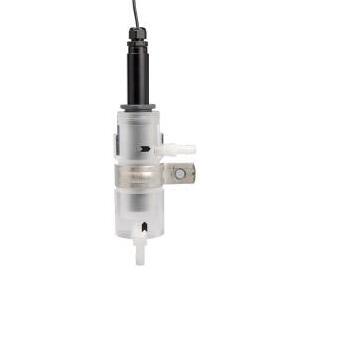
Chlorine Dioxide Sensor - CLD502, CLD505 and CLD510
The CLD series (chlorine dioxide sensors) adopts advanced amperometric measurement technology. Designed for water treatment disinfection applications, and used with chlorine dioxide, pools, etc., these sensors have three ranges available for selection to detect chlorine dioxide concentration. The detection ranges of CLD502, CLD505 and CLD510 are 0-2ppm, 0-5ppm and 0-10ppm respectively. The sensor outputs a 4-20mA signal, adjusted according to the range 0-2, 0-5 or 0-10ppm. The membrane cap and filling solution are easy to replace, maximizing sensor life. The sensor can be installed with a flow cell for new equipment, and can also be used to replace other chlorine dioxide sensors with 4-20 mA output. (For compatibility, please consult us.) A flow meter (FM001) is available as an option to help provide consistent flow, thereby enhancing system stability.
Features of Chlorine Dioxide Sensors CLD502, CLD505 and CLD510
1. Amperometric sensor technology
2. Real-time continuous measurement
3. Range: 0-2 or 0-10ppm
4. Built-in temperature compensation
5. Large-volume electrolyte chamber
6. Easy replacement of membrane and electrolyte
Technical parameters of chlorine dioxide sensors CLD502, CLD505 and CLD510:
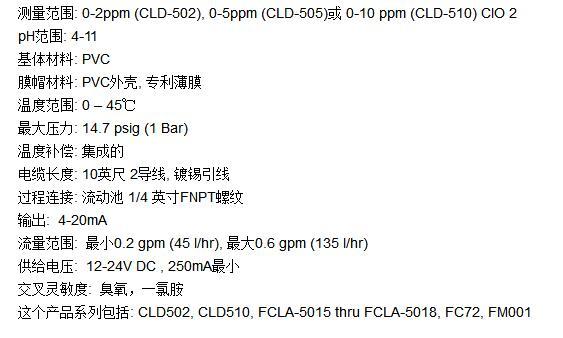
Technical parameters of CLD502, CLD505 and CLD510