Which flowers are most suitable for growing at home? An old gardener tells you
Nowadays, the varieties of plants grown at home are as numerous as the hairs on an ox, almost too many to count. Among these plant varieties, some are rather delicate, while others have strong vitality and are easy to grow. Each has its own characteristics, and their appearances and varieties are all different. So for gardening enthusiasts whose experience is not yet enough to feel completely confident, which flowers are more suitable for growing at home?
Perhaps you can consider the following few varieties. The editor does not know everyone's preferences, but suggests starting with these plants that are not so difficult. They are very suitable for growing as home greenery, and interested friends can take a careful look.
Mosquito repellent geranium
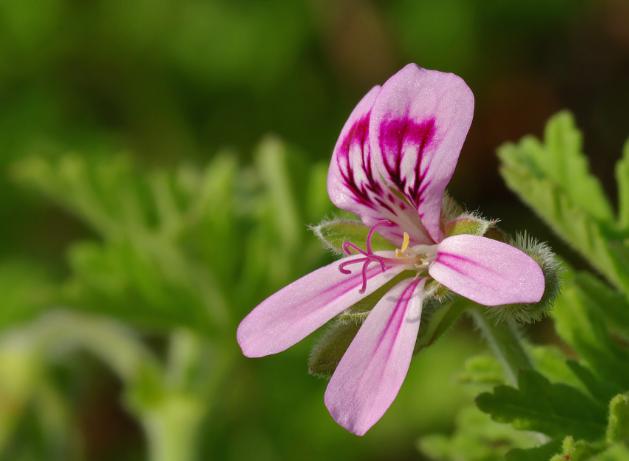
Mosquito repellent geranium, whose scientific name is Pelargonium graveolens, is a perennial herbaceous plant of the genus Pelargonium in the family Geraniaceae. The plant is shrub-like and can grow to about 1 m. Its stems are upright, grayish-green on the outside, woody at the base, and about 80-90 cm tall. The upper part of the stem is fleshy and densely covered with glossy, soft fine hairs. Mosquito repellent geranium has very long leaf stalks, and the leaves are broadly heart-shaped and ovate, with 5-7 palmate lobes on each leaf. The lobes may divide again, and the edges of the lobes are serrated. This plant can also produce small flowers. The entire mosquito repellent geranium plant has a special fragrance. This scent is harmless to humans, but mosquitoes and flies are very afraid of it, which is also the origin of the name mosquito repellent geranium. Placing mosquito repellent geranium indoors in summer can both beautify the environment and repel mosquitoes and insects, truly achieving two benefits at once. In addition, the essential oil extracted from mosquito repellent geranium can also be used as aromatic oil, with quite powerful effects.
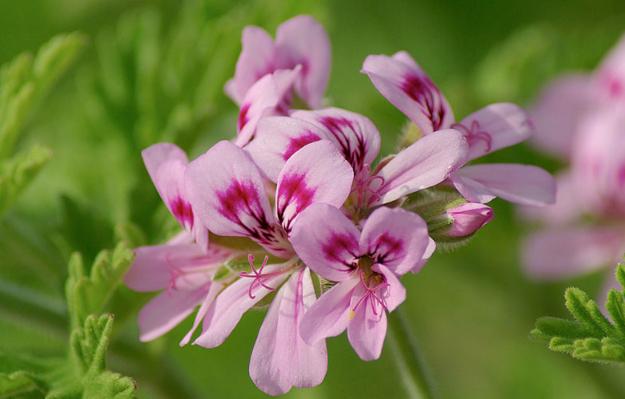
Mosquito repellent geranium is a plant that likes high temperatures, though it can also tolerate low temperatures. In a normal environment, it is suitable for growing at temperatures of 1-40 degrees. When the winter temperature is below 12 degrees, it is best to keep it warm. The hotter the summer, the greater the volatilization of the fragrant molecules of mosquito repellent geranium. This fragrant substance, which combines the scent of Pelargonium plants with citronellal-containing plants, can affect the surrounding environment through photosynthesis in ordinary times and play a role in safely repelling mosquitoes and insects. This plant grows very quickly and needs to be repotted once a year, preferably between February and March in early spring. When repotting, base fertilizer should be applied and new fertilized culture soil should be used. After new buds appear, apply a dilute organic liquid fertilizer once a week. For watering mosquito repellent geranium, during the high-temperature period from July to August, it needs frequent spraying to lower the temperature, and the potting soil should often remain moist. Mosquito repellent geranium likes light and ventilation. If there is sufficient sunlight and fresh air, it will also bloom continuously, full of fragrance.
Dwarfpetunia
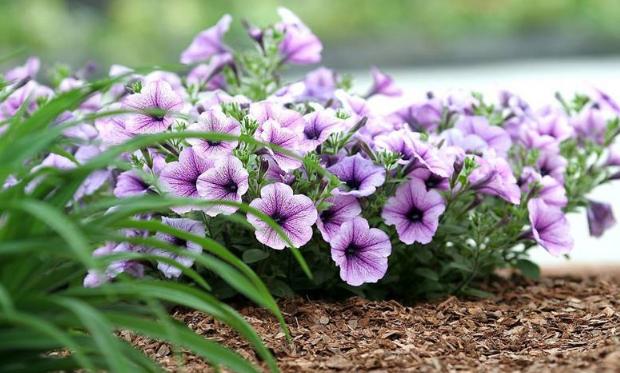
Petunia, whose Chinese scientific name is Petunia hybrida, is a perennial herbaceous plant of the genus Petunia in the family Solanaceae, though when grown as an ornamental plant it is mostly cultivated as an annual or biennial. It is usually about 20-40 cm tall, with stems creeping along the ground and covered with sticky soft hairs. Petunia has opposite, entire leaves, soft leaf texture, and mostly ovate shapes. Its flowers are solitary and funnel-shaped, with diverse and charming colors, including white, purple, and various shades of red. It originated in South America, and now it is grown in countries all over the world.
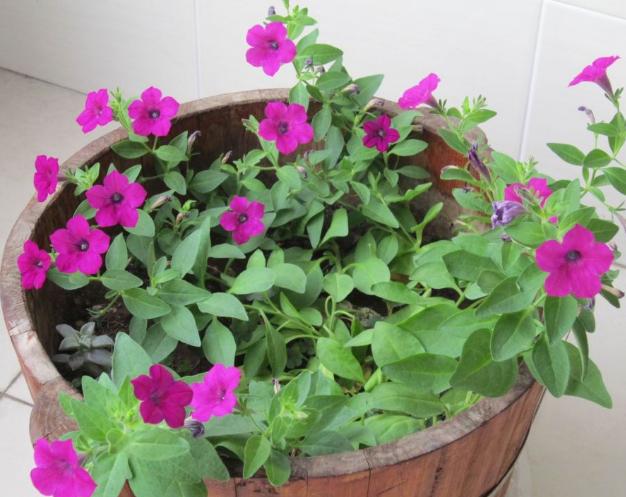
Petunia is a plant variety that likes warmth and sufficient sunlight. It fears both waterlogging and frost. The most suitable temperature for its growth is 13-18 degrees, and in winter it should not go below 4 degrees, so heating must be considered. In summer, it can tolerate high temperatures of 35 degrees; above that, it needs shading and enhanced ventilation. Summer is the vigorous growth period for petunia, and sufficient water must be provided. In midsummer, it can be watered once each in the morning, at noon, and in the evening. If there is a period with more rain, the frequency of watering can be reduced. It should be noted that too much rain has an adverse effect on the growth and flowering of petunia, so sheltering it from rain needs to be considered. The most suitable soil for planting petunia is loose, fertile, and well-drained sandy loam.
Living stone
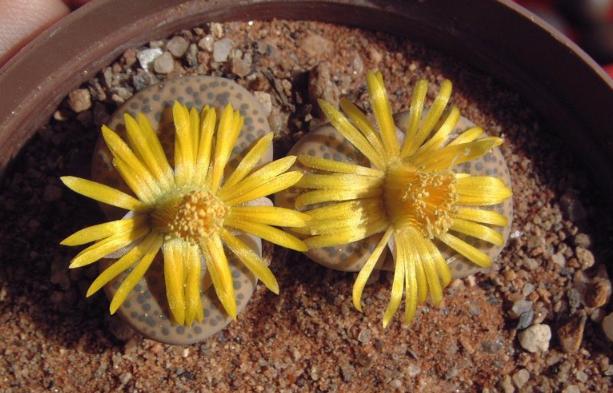
Living stone, of the family Aizoaceae and genus Lithops, also known as stone flower or butt flower, is a small perennial succulent plant. This plant looks very much like a stone. It originated in rock crevices and gravel in southern Africa and is known as a "living stone." It has quite strong vitality and can grow and bloom locally during the non-rainy season. During the flowering season, living stones can spread a colorful carpet over the desert. The stem of living stone is very short, so short that it is almost invisible to the naked eye. Its leaves are fleshy and thick, usually formed by two opposite leaves joined into an inverted cone. Living stones grown for more than 3 years will produce small white, pink, or yellow flowers in autumn from the gap between the opposite leaves. The flowering time is mostly in the afternoon, closing in the evening, and opening again the next afternoon, which is very distinctive.
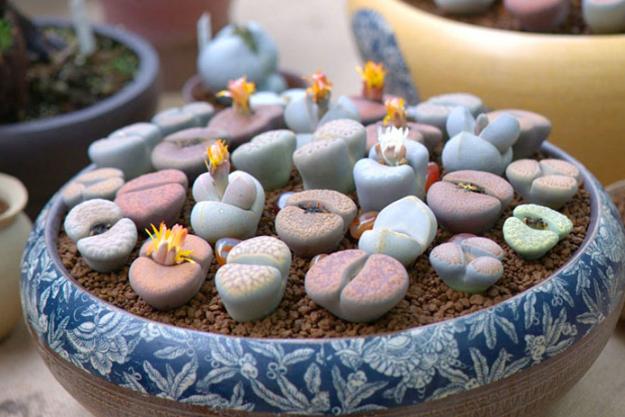
Living stone likes an environment and climate that is warm in winter and cool in summer. The suitable growing temperature is between 10-30 degrees. It fears low temperatures, rain, and snow, and likes warmth, dryness, and sufficient sunlight. During the growing season of living stone, the potting soil can be kept moderately moist, but when the temperature is high, it is best to water in the morning or evening to avoid scorching the leaves. In autumn, do not water unless the soil is dry, and when watering, water thoroughly. In winter, watering can be stopped. Living stone sheds its old skin from February to April each spring. At this time, fertilization should be stopped and watering controlled, in order to let the old skin fall off quickly. However, inexperienced people should not peel off the old skin that has not fully shed with their hands, so as not to damage the small plants inside. As for fertilizer, apply a decomposed dilute liquid fertilizer about once every 20 days, or place a small amount of low-nitrogen, high-phosphorus compound fertilizer in the soil for slow absorption.
These three plants are all quite strong in both beauty and practicality, and the difficulty of growing them is not too great. They each have distinct characteristics, and combined together they can improve the environment, purify the air, repel mosquitoes and insects, and benefit the body from different angles. The editor thinks they are plant varieties very suitable for growing at home. I wonder whether everyone thinks so too?
How much more do you know about flowers suitable for growing at home? You are welcome to share your views in the comment section below. If you like this article, you might as well subscribe, and there will be more wonderful articles to share with you.