The Complete Guide to Angelfish Keeping: Learn How to Keep This Elegant Tropical Fish Well
Angelfish, also known as yan fish, angel, little angelfish, little-fin sailfish, etc., belongs to the genus Pterophyllum in the family Cichlidae, and originates from Guyana and Brazil in South America. Angelfish grow 12-15 cm long, up to 15-20 cm tall, with a small pointed head and a laterally compressed body shaped like a diamond. The dorsal and anal fins are very long and large, standing tall like triangular sails, hence the name little-fin sailfish. Seen from the side, angelfish swimming looks like swallows soaring, so the angelfish is also called the yan fish (swallow fish).
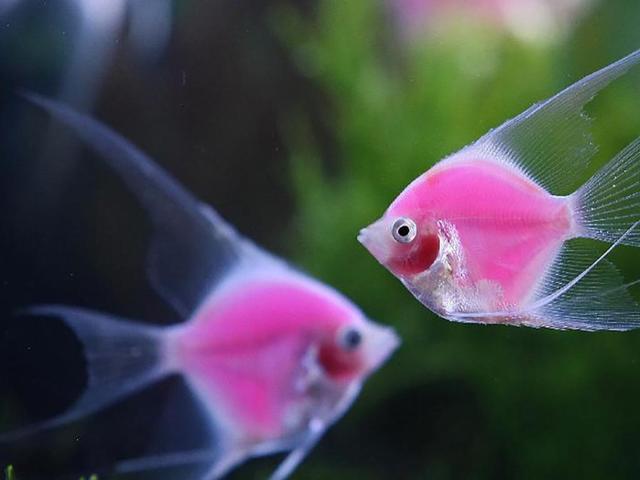
It is distributed in the eastern coast of Africa of the Indian Ocean, the Red Sea, east to Australia, north to Japan, as well as the South China Sea, the Taiwan Strait of China, and other sea areas; it is a warm-water pelagic and midwater fish. It mostly lives often beneath floating objects on the sea surface. The type locality of this species is Lohaja.
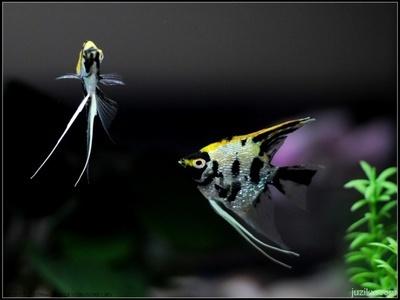
The angelfish has an elegant bearing and graceful swimming posture. Although it does not have gorgeous colors, its popularity among aquarium hobbyists is unmatched by any other tropical fish. It seems no case has ever been found of an enthusiast who has kept tropical fish for many years without having kept angelfish. The angelfish is almost synonymous with tropical fish; whenever tropical fish are mentioned, people's first association is often this fish that glides leisurely among aquatic plants, beautiful and free of worldly vulgarity.
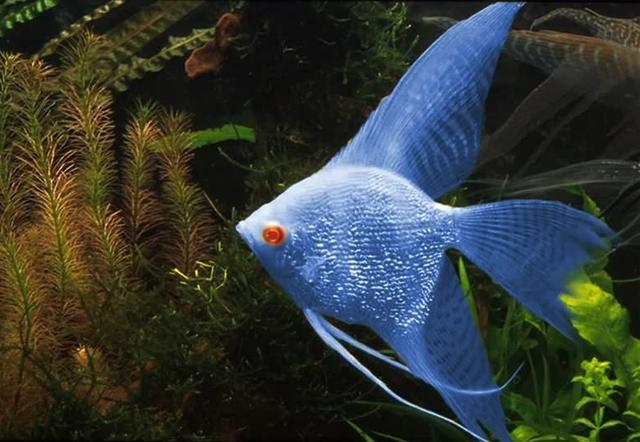
The angelfish is not exactly gentle in temperament; it is territorial and has no special requirements for water quality. It is best not to keep it mixed with small fish. One thing to note is the tiger barb of the Cyprinidae family; this mischievous and lively little fish often likes to nibble at the anal and caudal fins of angelfish. Although it is not a fatal attack, in order to maintain the beautiful appearance of the angelfish, it is still best to avoid keeping angelfish mixed with them.
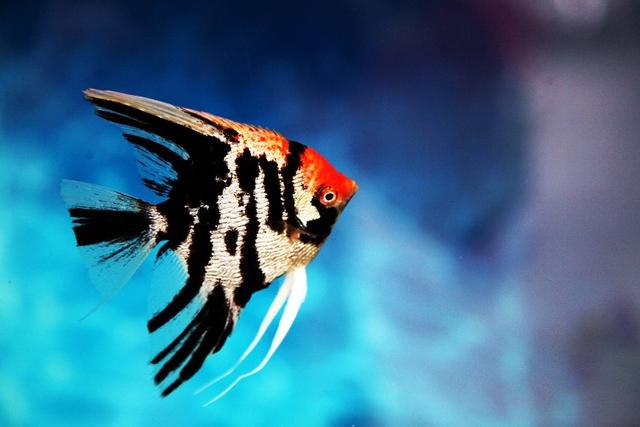
It originates from Pucallpa within Peru in South America. Along the Rio Ucayali northward, the angelfish travels all the way through Amazonian waters to the Amazon Delta in eastern Brazil. Within this range of nearly 5,000 kilometers, their traces can be found. In addition, their traces or the existence of other regional varieties have also been found in the Rio Negro and other tributaries. Generally, adult fish have a body length of 12-18 cm.
Seen from the side, it is like a swallow soaring; the angelfish body is laterally compressed and diamond-shaped, and when swimming it is like a swallow flying in the water! Therefore it is also called the yan fish.
First isFreshwater Angelfish
Discus Fish
Although the discus fish is called "angelfish", its relationship with the angelfish is actually very distant (the angelfish is the collective name for the altum angelfish P. altum, Leopold's angelfish P. leopoldi, and the common angelfish P. scalare under the angelfish genus Pterophyllum, while the discus fish is the collective name for the yellow-brown discus S. aequifasciata, the discus S. discus, and Tarzoo's discus S. tarzoo under the discus genus Symphysodon; the angelfish genus Pterophyllum and the discus genus Symphysodon are two different genera under the family Cichlidae)
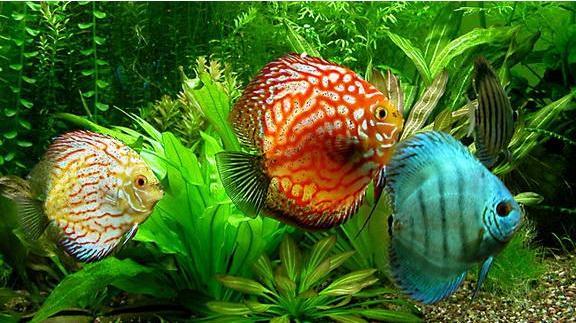
Body length 20 cm, nearly circular, laterally compressed, caudal peduncle extremely short, dorsal and anal fins symmetrical. The body is brilliant blue, or dark green, or brown; from the gill cover to the caudal peduncle, there are 8 evenly spaced brownish-red vertical stripes. The body color changes under the influence of lighting: when the light is dim, the body color is dark; when the light is bright, the colors are gorgeous and rich, with stripes all over the body. From a distance, the head, body, and fins are hard to distinguish, resembling a discus on a track and field field, hence the English name "discus".
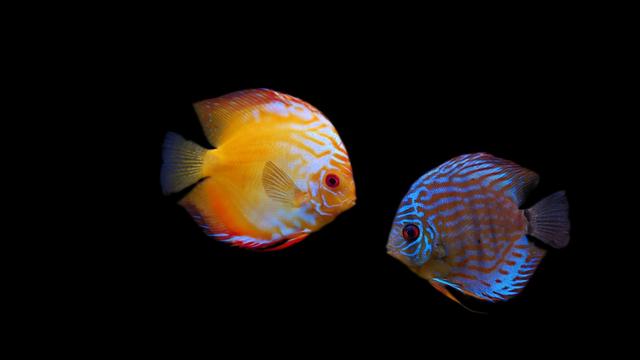
The fish body is nearly disc-shaped and flat. The body color of the fish is rich and varied, including red discus with red as the main tone, brown discus with brown as the main tone, and blue discus with blue as the main tone, accented with red, yellow, blue, green, black, brown, white, purple, and so on. The varieties are numerous and breathtakingly beautiful, and it has long enjoyed the reputation of the "king of tropical fish".
Compared with other fish, it is not easy to keep. A large aquarium should be used (length over 90 cm). It is best to plant aquatic plants of moderate density in the tank and place a few rocks to create a quiet and comfortable living environment for them. According to relevant records, according to the classification method advocated by Mr. Heckel-Bleher, discus fish are divided into two major strains: wild discus and artificially bred discus. Among them, wild discus include wild Heckel discus, wild brown discus, wild blue discus, and wild green discus; artificially bred discus fish.
The discus fish is also known as the discus and the rainbow yan fish. It originates from the Amazon River basin in South America and belongs to the Cichlidae family among tropical fish. When keeping tropical fish first became popular more than ten years ago, everyone still called it the "five-color angelfish", and there were only a few varieties, called "green five-color", "blue five-color", and so on. Later, as "angelfish fans" around the world continued to breed and cultivate this fish, its varieties became more and more numerous and its colors richer and richer, and gradually the name was upgraded to "discus fish", such as wild discus, brown discus, blue discus, green discus, Heckel discus, royal blue discus, royal green discus, and so on.
Some people even joke that perhaps in a few more years, it will have to be renamed "nine-color angelfish".
There is a reason discus fish are expensive; this seems to have become a consensus the reporter reached after visiting all the tropical aquarium shops in the ornamental fish section of the Laitai Flower Trading Center. According to experts who often visit here, the price of discus fish is relatively high mainly because its investment cost is high, because this fish is a high-temperature, high-oxygen fish, with rather strict requirements for water quality and bait, and it is very difficult to keep. As for purebred breeding, it is even more precious because of its rarity; even if you spend enough money and enough time, there are certainly no few cases of failure. However, some people also believe that the reason discus fish are expensive cannot be separated from artificial hype, but for good fish strains, everyone still agrees that they are worth the money.
Golden Angelfish
Around 22 years ago in Penang, Mr. Chin Keng Hoo, who had already had 14 years of experience keeping brown five-color discus, suddenly discovered that among the first batch of fry born from the brown five-color F1 he had bought for breeding, there were five transparent fry, and among the second batch of fry there were another four transparent fry.
Mr. Chin later sold these nine golden discus to Mr. Lin Qinglai. The golden offspring bred by Mr. Lin were then sold to Xiaoshi, Yayi, and others, and later Yaxing also obtained golden discus. At present, the one who still retains the pure golden discus from back then is Xiaoshi. Today's golden discus has been improved to have fewer white stripes; modern golden discus that can retain the original characteristic of golden eyes with red rims are already rare and precious.
The original golden itself is not good-looking; the front half of the body carries white stripes, but it is nevertheless a very important excellent breeding fish for improving many modern yellow discus. For example, Golden Sunrise, Golden-head Devil, Golden Snake Young Lord, Purple Diamond Red Gold, and others all make use of golden for improvement. Another major feature of golden is that it can remove part of the black sand of pigeon discus. Therefore, in much of the improvement work on modern discus fish, golden discus is more or less used. For example, golden discus has a pair of blood-red eyes, but if one wants to breed discus in which even the pupil is blood-red, then one cannot do without making much use of golden discus.
Zebra Angelfish
Belongs to the family Cichlidae. The angelfish has an elegant bearing and graceful swimming posture. Although it does not have gorgeous colors, its popularity among aquarium hobbyists is unmatched by any other tropical fish. It seems no case has ever been found of an enthusiast who has kept tropical fish for many years without having kept angelfish. The angelfish is almost synonymous with tropical fish; whenever tropical fish are mentioned, people's first association is often this fish that glides leisurely among aquatic plants, beautiful and free of worldly vulgarity.
The zebra angelfish is an artificially bred strain of the native Pterophyllum scalare, with the scientific name (Pterophyllum Scalare var zebra), also known as the zebra yan fish. It is a freshwater fish of the order Perciformes, family Cichlidae, genus Pterophyllum. The zebra angelfish is beautiful in color, was bred very early, and is a very traditional ornamental fish.
Body length 10-15 CM, body disc-shaped and laterally compressed. Head pointed, pelvic fins are two long filamentous fins, with 3-5 black vertical bands on the sides of the body, hence the name zebra angelfish because of the zebra-like stripes. Keeping water temperature 22-26°C, water quality slightly acidic soft water, bait mainly insects and fish. Breeding water temperature 26-28°C, parent fish sexually mature in 6 months, male fish larger in size, top of head arc-shaped and slightly raised, fins longer. Female fish top of head smooth, slate egg-layer, laying 300-500 eggs each time.
The zebra angelfish is a relatively primitive variety among artificially hybridized angelfish. It has a body length of 10 cm or more, and its appearance is similar to the original angelfish. Its obvious feature is 3 vertical bars on the sides of the body, sometimes even 4, but besides the original two vertical bars, the bars on the shoulder and below the center of the dorsal fin often appear intermittent, curved, and blurred at the edges. Because the zebra angelfish was the earliest artificially bred angelfish, it has always been said to be "very similar to the original Peruvian angelfish", but in fact this is a huge misconception. Many vendors also use this misconception to sell zebra angelfish as Peruvian angelfish with a clear conscience, and beginners just entering the fish hobby often fall for this trick.
The zebra angelfish is indeed hybridized from wild angelfish, but note that this process is hybridization: it was not purely bred from a single Peruvian angelfish, but drew on many fish from different regional forms, and it is even suspected to have the bloodline of pterophyllum leopoldi (long-nose angelfish). Therefore, the vertical bars on the sides of its body are clearly more numerous than those of the Peruvian angelfish, and this is also the most direct indicator for judging artificial hybridization.
Marine Angelfish
Marine angelfish (family Pomacanthidae, Pomacanthidae S). In terms of scientific classification, fish of this family belong to the same group as the butterflyfish family, and they have many similarities. People in Taiwan, China habitually call the Pomacanthidae "angelfish", perhaps because their usual swimming posture is slow and leisurely, their foreheads are slightly raised, and most have large round eyes with halos, hence the name. Angelfish are larger and rounder in body shape than butterflyfish, and have spines on the gill cover, while butterflyfish do not. Like butterflyfish, they feed by pecking. Although larger in body shape, they still mainly feed on small animal-based and plant-based foods.
Temperature Requirements
The same temperature as the place of origin is the best temperature
The gray angelfish and French angelfish originate from the tropical waters of the Atlantic Ocean. In addition, the gray angelfish is sometimes also seen as far north as the New England region of the United States. These two species are much less colorful than species of the same genus from the Pacific and Indian Oceans. The French angelfish and gray angelfish need cooler temperatures, so the water temperature in the aquarium should be maintained within the range of 21-24°C as much as possible. The same is true for the rock beauty angelfish and P. striatus; if the temperature is limited, they will live better.
Queen Angelfish
Whether juvenile or adult, the fish body has a vivid blue outline, with the exception of the purely yellow caudal fin.
The base color varies depending on lighting conditions (or due to hybridization between the same species); the fish in the picture is in its spawning period. The adult fish's body color is golden brown with bright yellow and green, with well-arranged markings. The rear part of the gill cover and the base of the pectoral fins are bright yellow; the gill cover is protected by small spines; the anal and dorsal fins are very long, extending to the caudal fin.
Because the original habitat has relatively high water levels, it should be kept in a larger aquarium. Feeding habits: omnivorous. Swimming level in the tank: middle and bottom layers. Temperament: gentle.
Seawater specific gravity 1.022, aquarium of over 300 liters, maximum body length can reach 25 cm
Blue Angelfish
Its body shape is similar to the angelfish, with an overall lighter color, while the fins reflect a light blue luster. It is a very elegant variety. There is also an albino variety; the albino is more similar to the red-eye angelfish, except that the fins still reflect a blue luster.
Seawater specific gravity 1.022, aquarium of over 500 liters, maximum body length can reach 45 cm
Halfmoon Angelfish
Seawater specific gravity 1.024, aquarium of over 400 liters, maximum body length can reach 40 cm
Yellowbelly Bride Angelfish
Seawater specific gravity 1.022, aquarium of over 100 liters, maximum body length can reach 11 cm
Golden ButterflyfishHolacanthus septentrionalis
Seawater specific gravity 1.022, aquarium of over 200 liters, maximum body length can reach 22 cm
French AngelfishHolacanthus paru
Seawater specific gravity 1.022, aquarium of over 400 liters, maximum body length can reach 40 cm
Blue-mouth BrideHolacanthus ciliaris
Seawater specific gravity 1.022, aquarium of over 300 liters, maximum body length can reach 30 cm
Blue-ring Angelfish Holacanthus annularis
Seawater specific gravity 1.022, aquarium of over 250 liters, maximum body length can reach 25 cm
Red Sea Tiger King Genicanthus caudovittatus
Seawater specific gravity 1.022, aquarium of over 200 liters, male fish have obvious patterns on the body surface, maximum body length can reach 45 cm
Blue-striped Angelfish Pamacanthus semicirculatus
Seawater specific gravity 1.022, aquarium of over 500 liters, maximum body length can reach 45 cm
Atlantic AngelfishPamacanthus arcuatus
Seawater specific gravity 1.022, aquarium of over 400 liters, maximum body length can reach 36 cm
Six-bar Angelfish Euxiphipops sexstriatus
Seawater specific gravity 1.022, aquarium of over 500 liters, maximum body length can reach 50 cm
Tiger-skin Bride Genicanthus melanospilus
Seawater specific gravity 1.022, aquarium of over 200 liters, maximum body length can reach 21 cm
Blue Treasure KingGenicanthus lamarck
Seawater specific gravity 1.022, aquarium of over 300 liters, maximum body length can reach 24 cm
Goddess of VictoryGenicanthus bellus
Carnivorous; can be fed animal-based food and artificial feed. This fish belongs to a species that is female first and male later, and has sex-change characteristics. Seawater specific gravity 1.022, aquarium of over 150 liters, maximum body length can reach 13 cm
This color combination is really so beautiful!
Black BMWChaetodontoplus melanosoma
Seawater specific gravity 1.022, aquarium of over 200 liters, male fish have obvious patterns on the body surface, maximum body length can reach 20 cm
Yellowtail Black-gold ButterflyfishChaetodontoplus caeruleopunctatus
Distributed in the coral reef waters of the western Pacific. Omnivorous; can be fed invertebrate-based food, algae-based bait, and artificial feed. Suitable for an aquarium with a water temperature of 26 degrees, seawater specific gravity 1.022, and over 150 liters, maximum body length can reach 13 cm
Australian AngelfishChaetodontoplus duboulayi 4
Seawater specific gravity 1.022, aquarium of over 200 liters, maximum body length can reach 22 cm
Australian Masked Angelfish Chaetodontoplus personifer
Seawater specific gravity 1.022, aquarium of over 250 liters, maximum body length can reach 23 cm
Kylin Angelfish Centropyge potteri
Seawater specific gravity 1.022, aquarium of over 100 liters, maximum body length can reach 10 cm
Blue-face AngelfishEuxiphipops xanthometapon
Seawater specific gravity 1.022, aquarium of over 500 liters, maximum body length can reach 45 cm
Yellow BrideCentopyge heraldi
Seawater specific gravity 1.022, aquarium of over 150 liters, maximum body length can reach 12 cm
Masked AngelfishApolemichthys arcuatus
Seawater specific gravity 1.022, aquarium of over 200 liters, male fish have obvious patterns on the body surface, maximum body length can reach 17.5 cm
Sexing Angelfish: Male or Female
Sex identification of angelfish is relatively difficult during the juvenile stage, but in adult fish that have entered sexual maturity after 8-10 months, male and female characteristics are very obvious. The characteristics are: the male's forehead is more developed than the female's, appearing full and high, and the abdomen is not as swollen as the female's; moreover, the male's sperm duct is thin and pointed, while the female's ovipositor is thick and round. Because angelfish are tropical fish that like to pair naturally, successfully paired angelfish often leave the group and swim and feed together as a pair, living an independent life in which they envy only mandarin ducks and not immortals. This characteristic is something enthusiasts buying adult angelfish need to note; they should spend more time observing the fish group to confirm complete pairing, and must not break them apart. Enthusiasts who prefer to start keeping them from the juvenile stage had best buy 6-10 fish at the same time, so that during their growth, even if accidents occur, several may die or several may grow poorly.
Little Tips for Buying Fish
The method for buying fish is observe, smell, ask, and feel. Because the fish in fish shops are "fish from a hundred homes", that is, different fish from different keepers' tanks and different water qualities all entered the retail store's tanks within a short time, and these fish themselves all carry certain parasites and bacteria. If they enter the tank without proper water acclimation, and generally the people in fish shops only float the bag without acclimating the water, then the different water qualities will provoke these parasites and bacteria from the fish's bodies, and moreover the sudden change in different water quality makes it impossible for the fish to adapt. The most obvious manifestation is that there are no excessive symptoms but fish always die for no reason. The people in fish shops scoop out dead fish as they die, and if you do not observe carefully it is very hard to see. This is also one of the reasons why fish in the hands of keepers are worth nothing at all, yet the price doubles 7-8 times when they reach retail stores.
The best water quality has a faint fishy smell; if there is none at all or it is very strong, it proves that the ecosystem in the water has not been established or has already collapsed. First, feel the wall of a bare tank or other equipment in the tank with your hand. If it feels slightly slippery and greasy, it proves that the fish's metabolism is relatively good, but it definitely should not feel very heavy to the touch; excessive slipperiness is actually a sign of excessively high nitrite content. Feel the filter cotton with your hand, or look around the water outlet pump. If there is something like snot, then that proves the water quality is quite good and rich in nutrients. If convenient, bringing a little PH test paper is best. After buying and taking it home, just acclimate the water using the method just introduced. Also, if you really are going to buy fish, it is best not to choose holidays; this time is also when fish shops stock large quantities of fish, which is also the fish's dangerous period, and the survival rate of those bought and taken home is relatively low.
Experienced fish keepers generally feel that angelfish are still a relatively easy species to keep, but beginner fish keepers often, due to lack of experience, encounter symptoms of rapid breathing in angelfish during the keeping process. In fact, there are many reasons causing rapid breathing in angelfish. The editor will analyze them for you here, hoping it will be helpful to beginner fish keepers.
1: Ammonia, nitrite, or high-concentration carbon dioxide in the water, lasting more than one day, can cause rapid breathing.
Measures to take: remove leftover bait, clean the aquarium, 100% water change, and after the water change add 0.01-0.1% salt.
2: Parasites such as white spot disease organisms, Chilodonella, and Ichthyobodo on the gills will irritate the gill mucosa, causing massive proliferation of mucosal cells, leading to rapid breathing in discus, which speeds up the breathing rate to take in enough oxygen.
Measures to take: remove leftover bait, clean the aquarium, 100% water change, and after the water change add 0.05 malachite green oxalate, or 25PPM formalin. After three days, do a 100% water change, then apply the same medication again. It needs to be treated 3-5 times to completely remove gill parasites.
3: Gill flukes on the gills cause rapid breathing in discus.
Measures to take: remove leftover bait, clean the aquarium, after cleaning do a 100% water change, and after the water change add 80PPM formalin. After 8-10 hours, do a 100% water change, and after three days repeat the above treatment. It needs to be treated 3-5 times to completely remove gill parasites.
4: There are parasites on the gills, and they have also been infected by bacteria; cross-infection and inflammation cause rapid breathing, and the gills turn red.
Measures to take: remove leftover bait, clean the aquarium, 100% water change. After the water change, soak with 2PPM potassium permanganate for one day, then do a 100% water change, then soak with 2PPM potassium permanganate for one day and do a 100% water change, then soak with 25PPM formalin for three days and do a 100% water change. Formalin also needs to be treated 3-5 times to be effective.
5: Too great a PH difference during water changes irritates and injures the gill mucosa; this sense of pressure causes rapid breathing in discus.
Measures to take: first add 0.1% table salt, then yellow powder 2 mg/liter, and soak for three days!
6: Fish that are startled will also breathe rapidly.
Measures to take: soak with 0.1% salt water, then soak with yellow powder 2 mg/liter for one day.
7: Too great a water temperature difference during water changes stimulates the fish and causes rapid breathing.
Alright! That is all for today's angelfish!
Really so beautiful, each one is nature's palette
If you like it, follow the editor! Learn a little every day