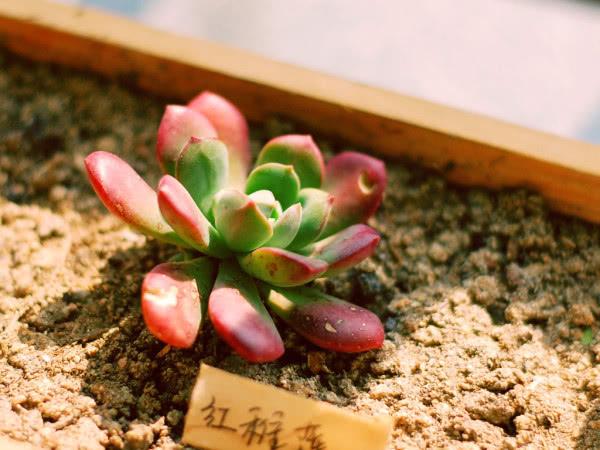
How to Care for the Succulent Echeveria 'Hongzhilian'? A Detailed Guide to Growing Methods
Echeveria 'Hongzhilian' is a succulent in the Crassulaceae family, genus Echeveria. A hybrid species. It prefers a warm, dry, well-ventilated, sunny environment, is drought-tolerant, and does not tolerate shade or hot, humid conditions. It has no obvious dormant period. It can be propagated by leaf or stem cuttings. Mature plants can form clustered small shrubs. The rosette can reach 9 cm in diameter. The stem is upright. The leaves are loosely arranged; broadly ovate to spreading triangular-ovate; generally gray-green, and under strong sunlight and large temperature differences the edges and tips can show a red blush; up to 4 cm long and up to 1.5 cm wide. The inflorescence is about 26 cm long.
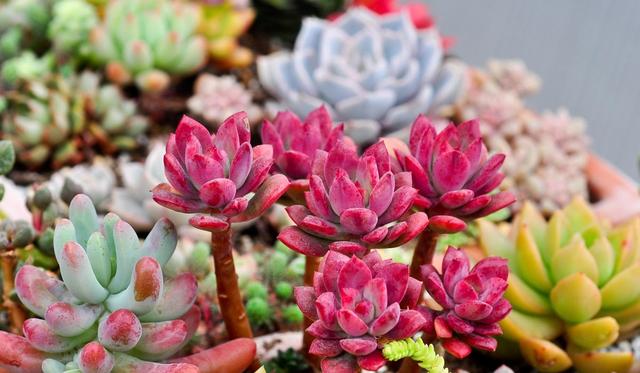
Echeveria 'Hongzhilian' prefers a warm, dry and well-ventilated environment, likes light, is drought-tolerant, cold-tolerant, shade-tolerant, and does not tolerate scorching sun. It has no obvious dormant period. It is suited to loose, breathable, water-retentive soil, which can be mixed with peat soil and granular soil at a 1:1 ratio. The leaf color of Echeveria 'Hongzhilian' stays green to yellow-red year-round; with large day-night temperature differences or during low temperatures in winter the leaf margins turn bright red or deep red, while in weak light the leaf color becomes pale tender green, the leaves also stretch out, and the red edges of the leaves fade. Propagation of Echeveria 'Hongzhilian' generally involves beheading to produce pups for cuttings and leaf cuttings. The beheaded plant can be directly inserted into dry granular soil, and after it roots a small amount of water can be given. It is a very easy-to-grow variety. The leaf cutting method is to take a complete, plump leaf, place it in a cool place to let the wound dry, then place it on slightly moist soil; it will slowly grow roots and then sprout, and the process takes a somewhat long time. After beheading, the plant can grow several side shoots from around the growth point, and once the side shoots grow larger they can be cut off and used for cuttings.
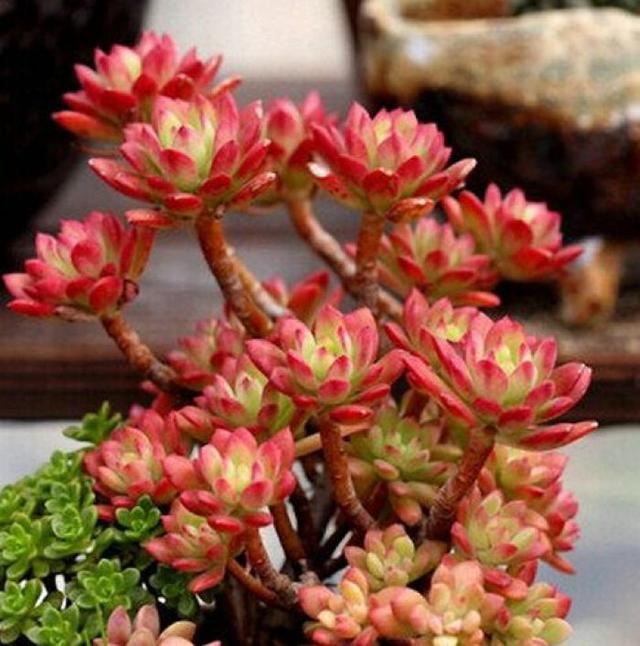
The suitable growth temperature is 15-25°C, and in winter not below 5°C; for soil mixing, generally use one part each of peat, vermiculite and perlite, and add an appropriate amount of bone meal. Alternatively, mix 2 parts organic soil (peat/coco coir/leaf mold), 1 part garden soil (or worm castings), and 1 part coal cinder. If the coal cinder has not been dealkalized, it does not matter; just mix these soils evenly, water thoroughly, and let sit until the soil dries before planting; during the growing season, water thoroughly only when the soil has dried out, and when the air is dry you can sprinkle water around the plant; during the growing season, fertilize generally about once every 20 days; the main propagation methods are cuttings and sowing.