How serious is the harm of cyanobacteria blooms to aquaculture in bloom season?
Cyanobacteria, also called blue-green algae, are the simplest and most primitive single-celled organisms. Cyanobacteria are widely distributed in natural water bodies and have already caused serious harm to aquaculture. How to control the harm caused by cyanobacteria is already an urgent matter for the aquaculture industry.
I. Analysis of the plant characteristics of cyanobacteria
It is well known that the occurrence of cyanobacteria depends largely on temperature. Cyanobacteria are sensitive to temperature during reproduction. When the water temperature is below 17°C, they will not proliferate in large numbers, or will not pose a hazard to fish. When the water temperature rises to 28°C, because the growth of other algae is inhibited and they are also heavily consumed by fish (at higher temperatures, fish feeding and metabolism increase), cyanobacteria can easily form a dominant population and break out in large numbers.
For aquaculture areas, the main reasons for the formation of cyanobacteria are suitable environmental conditions, unreasonable stocking of fish and uneven fertilization. Because cyanobacteria mostly occur from June to September in summer, they are clearly seasonal. Temperature, light, nutrients, climatic conditions and so on are all factors affecting their growth. Under conditions of suitable water temperature (above 20°C), eutrophication of the water body, relatively high pH, and suitable light intensity and light duration, cyanobacteria form gas vacuoles, float to the water surface, and reproduce rapidly in colonies, thus forming cyanobacterial blooms on the water surface. In fish ponds with high fertilization rates and domestic sewage discharge, the water is rich in nutrient salts, which can promote the massive reproduction of cyanobacteria such as Anabaena, Microcystis aeruginosa, Spirulina and Oscillatoria. If at this time the number of silver carp, bighead carp and tilapia that can feed on these algae is relatively small, a large amount of phytoplankton cannot be utilized, naturally ages in the water and dies. Generally, the fertilization rate is too high in the early stage, phytoplankton reproduce in large numbers, and in the later stage fertilizer is lacking or topdressing is not timely, so phytoplankton cells then decline and die. These dead phytoplankton float on the water surface, thus forming blooms.
II. Overview of the harm of cyanobacteria to aquaculture
The notable feature of cyanobacteria is their rampant growth, and in this respect the harm to aquaculture is shown in their being difficult to digest and causing eutrophication of the water body. Fish do not like to feed on cyanobacteria, the algae are difficult to digest, and their utilization rate is low. For example, during the bloom period, a large amount of algal bodies is mixed in the fish intestine. When the contents of the anterior, middle and posterior intestine are examined under a microscope, algal masses are seen to be intact and not easily digested. The presence of a large amount of algal bodies that are difficult to digest and absorb causes eutrophication of the water body. At the same time, cyanobacterial blooms cause a sharp decrease in the biodiversity of the water body. The massive reproduction of cyanobacteria worsens the ventilation and light conditions of the pond water, also inhibits the growth and reproduction of beneficial species of plankton in the fish pond, hinders the photosynthesis of algae, and crowds out the living space of algae that fish can easily digest, so that filamentous algae and planktonic algae in the fish pond cannot synthesize the nutrients they need and die. In addition, the massive reproduction of cyanobacteria leads to oxygen deficiency in the water body and deterioration of water quality. The massive reproduction of cyanobacteria and the decomposition of dead algae consume a large amount of dissolved oxygen, which can lead to oxygen deficiency or even an oxygen-free state in the water body, and can also easily cause pond-wide fish kills in aquaculture water bodies. When cyanobacteria die in large numbers, they easily spoil water quality and can produce algal toxins, large amounts of hydroxylamine and hydrogen sulfide and other toxic substances, directly harming aquatic animals. Dead cyanobacteria release large amounts of organic matter, stimulating the growth of heterotrophic bacteria, some of which also bring pathogenic bacteria to fish, leading to secondary infection with bacterial diseases. When cyanobacteria reproduce in large numbers, they give off a fishy odor, affecting the normal functions of the water body. Deterioration of the environment causes the death of aquatic animals. When cyanobacterial blooms occur, the physical and chemical indicators of the water body often exceed the tolerance limits of aquatic animals, thus causing death.
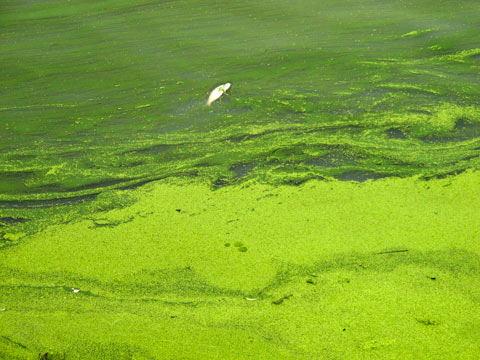
During cyanobacterial blooms, dissolved oxygen in the water body drops, and fish die from oxygen deficiency
Common cyanobacteria in aquaculture water bodies can be divided into two categories: one is filamentous cyanobacteria that live as individuals, including Oscillatoria, Anabaena and Spirulina; the other is unicellular algae that live in colonies, such as Microcystis. Among them, the visible algal aggregates formed by the massive accumulation of Microcystis on the water surface are the most common cyanobacterial blooms in aquaculture. Therefore, microcystins are one of the most common types of algal toxins. Microcystins are a group of monocyclic heptapeptides, among which there are two variable amino acids. So far, according to differences in the degree of methylation, hydroxylation and epimerization as well as the variable amino acids, 80 different subtypes of microcystins have been discovered. Because of their toxicity to organs such as the liver and kidneys and their strong cancer-promoting properties, microcystins have been regarded as environmental pollutants that seriously threaten wildlife and human health and have received widespread attention. It can thus be seen that cyanobacteria, whether living or dead, have obvious biological hazards to aquatic animals.
III. Discussion of prevention and control measures against the harm of cyanobacteria to aquaculture
Different measures can be taken according to different situations of cyanobacterial spread. For example, when cyanobacteria have not yet covered the water surface and are only growing in a small part, manual salvage is the first choice. Apart from requiring a certain labor cost, manual salvage is the safest for the water body composition of the entire aquaculture area. When cyanobacteria gradually show a trend of spreading and manual salvage can no longer stop the overall trend of cyanobacterial expansion, we can try to consider the growth environment of cyanobacteria themselves. Without harming the growth of aquatic products, the general approach is to apply Bacillus, taking advantage of its strong absorption of N and P nutrient salts, with Bacillus subtilis being the best. In still water, a water flow velocity <4 cm/S is suitable for cyanobacterial growth, while >10 cm/S inhibits cyanobacterial growth. In shrimp farming, paddlewheel aerators can be used to increase flow velocity; high temperature, with water temperature >28°C, is suitable for cyanobacterial growth, while <17°C inhibits cyanobacterial growth, so the period before rainy weather is a relatively good time to deal with cyanobacterial problems; high pH, with water body pH >8.4, HCO3- accounts for as much as 95% of inorganic carbon, while CO2 is below 3%. Cyanobacteria can use CO2 and HCO3- for growth, while other beneficial algae can only use CO2, so high pH favors cyanobacterial growth. In production, lactic acid bacteria or EM or organic acids can be applied to lower the overall or local pH of the water body to inhibit cyanobacterial growth. In addition, stocking silver carp can also control algal reproduction from the source through the food chain. As a last resort, chemical killing is not recommended, because this will bring a lot of toxin deposition to the aquaculture water body.
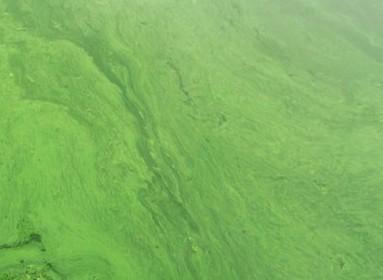
Severe cyanobacterial bloom water
In summary, the harm of cyanobacteria is very frightening, but it is not impossible to control. Cyanobacteria control should be based on the principle of prevention first, and curb cyanobacteria at the source in the early stage of growth. Only this is the healthiest and wisest choice for aquaculture areas.