There's Something Fishy About Farming Subsidies - Farmers Who Haven't Received Them Should Take a Look

Rural Chicken Farmers Happiness
The state issues large amounts of subsidies every year to promote rural economic development and help farmers increase production and income.
But because rural subsidies are distributed by many departments, in many categories, and under many programs, and because there is always a process from higher levels to lower levels, many friends know nothing about farming subsidy information, and as a result they miss out on subsidies and lose a lot of money.
Laying Hen Farming Subsidies
Today, Brother Dan will talk about the agricultural subsidies related to farmers!
1. There Are 15 Agricultural Subsidies - Which Ones Can Farmers Get?
1. Livestock Standardized Large-Scale Farming Support Policy (Brother Dan will focus on this)
The main livestock species supported by the livestock industry includepigs, laying hens, broiler chickens, beef cattle and mutton sheep. Among them: standardized farms with 0.5-5 wan pigs slaughtered; standardized farms with 1-10 wan laying hens in stock; standardized farms with 5-100 wan broiler chickens slaughtered; standardized farms with 100-2000 beef cattle slaughtered; standardized farms with 300-3000 mutton sheep slaughtered.
2. Animal Epidemic Prevention Subsidy
It is divided into five kinds of subsidies, including the compulsory immunization vaccine subsidy policy for major animal epidemics, the compulsory culling subsidy policy for animal epidemics, and the subsidy policy for harmless treatment of diseased pigs in the designated pig slaughtering process.
Laying Hen Farming Subsidies
3. Rural Pension Insurance
The full name of rural pension insurance is "New Rural Social Pension Insurance," which mainly guarantees the basic livelihood of rural residents in old age. Rural residents who have reached 60 years of age and all elderly people with rural household registration who do not enjoy the basic pension insurance benefits for urban workers can receive a monthly pension issued by the government.
4. Subsidy for Renovation of Dilapidated Houses in Agricultural Reclamation Areas
The main subsidy recipients are agricultural reclamation worker families whose household registration is in the reclamation area and who live in dilapidated houses within the area under the reclamation area's jurisdiction, especially low-income families in difficulty as the main target of assistance.
5. Rural Homestead Demolition and Relocation Subsidy
The compensation standard for homestead and house demolition and relocation is: house demolition compensation = homestead location compensation price x homestead area + replacement cost new value of the demolished house.
6. Farmers' Housing Purchase Subsidy
After farmers move to the city, if the homestead and cultivated land are returned to collective ownership, the state will give a certain subsidy, generally 3-5 wan yuan.
Laying Hen Farming Subsidies
2. How Do Farmers Get Farming Subsidies?
For the subsidies they deserve, chicken farmers need to fight for them. Of course, to get subsidies, some conditions still need to be met.
First, there must be a certain farming scale- more than 1 wan laying hens, or more than 5 wan broiler chickens slaughtered; there will be differences between different regions.
Second, three certificates are needed:
1.Animal Epidemic Prevention Condition Qualification Certificate(during the preparation stage of the chicken farm, apply to the county health animal supervision office, providing materials such as chicken house layout, site selection, and facilities), and wait for review.
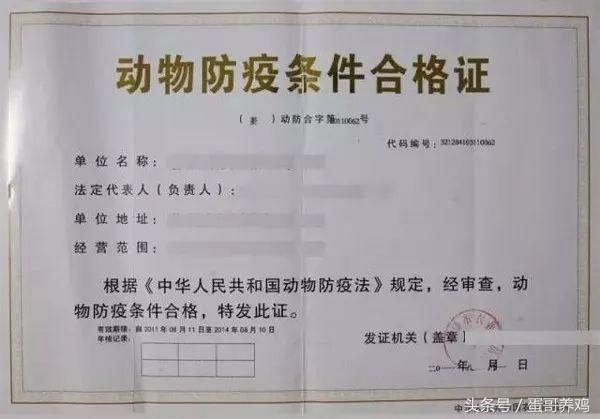
Chicken Farming Animal Epidemic Prevention Condition Qualification Certificate
2.Farming Site Filing Registration(for chicken farm filing, provide the livestock farming site filing application form, legal person business license or farming site responsible person's identity document), and wait for review.
3.Farming Records, during the daily management of the chicken farm, truthfully fill in the production links such as the species and number of livestock and poultry, breeding situation, feed and additive sources, usage amount, usage methods, immunization, testing, disinfection, disease occurrence, treatment, medication period, death, and harmless treatment.
Subsidy intensity and policies vary from place to place; subsidies were increased in 2018!
3. I Submitted the Materials, But What If the Money Didn't Arrive?
Friends will not need to worry about this problem next year, because in 2018 the state will thoroughly investigate where farmers' subsidies go.
The Ministry of Finance and the Ministry of Agriculture of the state issued the "Measures for the Management of Agricultural Production Development Funds," which clearly stipulates that the distribution, use, and management of farmer subsidies must be investigated.
The focus will be on investigating the following people. Once problems are found, they will not even have a good New Year this year.
1. Rural accountants and cashiers in charge of finances
These people know the finances of the rural village committee like the back of their hand, and are also responsible for keeping and spending the subsidy amounts for farmers. If these people engage in "eating, taking, asking for and demanding" in the village, then the subsidies farmers get in hand really will not be much.
2. Village committee members and village group leaders
The rural village committee is responsible for reviewing and reporting the subsidy applications submitted by farmers, and village group leaders are also responsible for issuing farmer subsidies. For farmers to obtain subsidies, the first step is to apply to the village committee, and only after the application is approved will it be issued.
For farmers to obtain subsidies, they must follow a certain process. Although many farmers complain that there are no subsidies to receive, or even that after applying they cannot get approval, they should learn more about agricultural policy and apply according to the process. In this way, the village committee will also have no choice but to issue the subsidy, unless there is something fishy going on.
Starting next year, the state will "airdrop" first secretaries to carry out supervision and management, and farmers' subsidies have hope.
From then on, no matter what subsidies the state has, as long as the requirements are met and the process is followed, there is no fear of not getting the subsidy. If farmers discover that there is something fishy going on, they should take action on their own to protect their interests!
Finally, Brother Dan reminds all chicken farmers to pay attention to the following points during the application process:
1. Standardize operations,project funds must be used for the project; funds cannot be used arbitrarily.
2. Prepare in advance,project defense materials, on-site construction, financial statements, etc. must be properly prepared.
3. Communicate frequently and make more trips.Communicate more with local government and more with experts, let them help offer advice, and do the project well.
4. Pay attention to project implementation acceptance information.Project implementation standards and acceptance information will be posted on government websites or issued from province-city-county to cooperatives. Cooperatives must be well-informed and promptly grasp acceptance inspection information to buy themselves time to prepare.
In short, those who get the news first certainly have an advantage, and standardized large-scale chicken farms also have an advantage, because the state advocates large-scale and intensive production.
So if small-scale chicken farmers do not get subsidies, is there nothing they can do?
There is!
The method is simple and direct: improve the level of farming production and there is a chance to apply for farming subsidies.
Follow Brother Dan Chicken Farming (search the official account: Brother Dan Chicken Farming), everyone come together to talk about chicken farming matters and raise the income of us chicken farmers!