The Complete Guide to Clownfish Keeping: Teaching You to Care for These Little Ocean Sprites
Clownfish is the common name for fish in the subfamily Amphiprioninae of the family Pomacentridae, and they are a type of tropical saltwater fish. There are 28 known species, one from the genus Premnas, and the rest from the genus Amphiprion. Clownfish have an inseparable symbiotic relationship with sea anemones, which is why they are also called anemonefish. The stinging sea anemone protects the clownfish, and the clownfish eats the leftover debris from the anemone's digestion, forming a mutually beneficial symbiotic relationship.
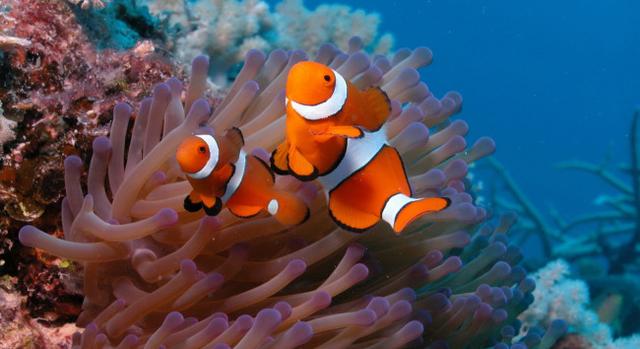
The maximum body length of clownfish reaches 11cm. Total dorsal spines 10~12; total dorsal soft rays 4~16; total anal spines 2; total anal soft rays 14~15. Juveniles are entirely black with scales concentrated in blue; white patches on the forehead and upper sides; all fins black except the transparent pectoral fins and the outer parts of the soft dorsal fin rays. The color of adults varies with geography and behavior.
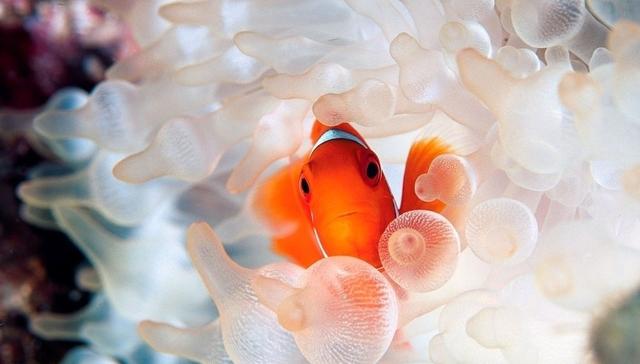
Clownfish are not the only hermaphroditic animals, but they are one of the few species in which males can become females, while females cannot become males. Each clownfish population has one dominant female and several adult males, the latter being hermaphroditic in their youth. If the dominant female dies, one of the adult males will undergo hormonal changes and transform into the new female of the population. During the spawning period, the male and female fish exhibit territorial behavior of guarding the nest and eggs. One end of each egg has a fine filament that anchors it to the rock, and it hatches in about a week. After the larvae drift in the water layer for a period of time, they then settle on symbiotic organisms such as sea anemones. Because they all have one or two white stripes on their faces, resembling the clown role in Peking opera, they are commonly called "clownfish."
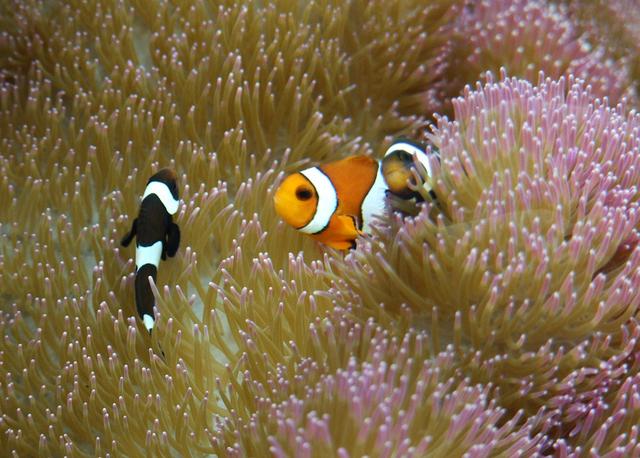
Environment: reef-associated fish; non-migratory; non-migratory; marine; depth range 1~55m
Climate: tropical; between 25 degrees north latitude and 35 degrees south latitude.
Importance: fisheries, low economic value; aquarium, commercial.
Resilience: high, population doubling time less than 15 months
Biological characteristics: inhabits coral reefs and rocky reefs; juveniles often live symbiotically with large sea anemones, sea urchins or the tops of small corals. Forms small to large schools; stomach contents include algae, copepods and other planktonic crustaceans.
Reproduction method: egg-laying type.
Feeding habits: omnivorous.
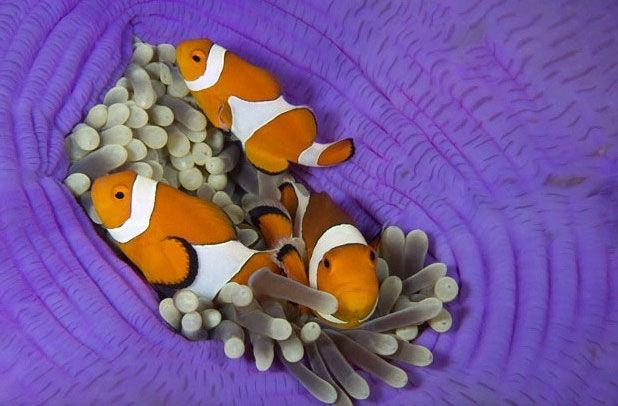
Clownfish are native to the warmer waters of the Indian Ocean and Pacific Ocean, including the Great Barrier Reef and the Red Sea. Although the distribution of most species is limited, some are very widely distributed. Clownfish live in shallow lagoons or coral reefs at the bottom of shallow seas. Indo-Pacific, Red Sea, north to southern Japan, south to Australia, Sydney, etc.
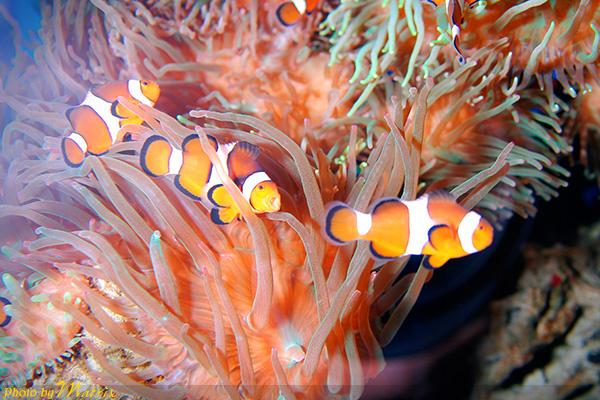
The body surface of clownfish has a special body mucus that protects it from the influence of sea anemones and allows it to live safely and comfortably among them. Because of the protection of the sea anemone, the clownfish is spared from attacks by other large fish, and at the same time the food left over by the sea anemone can also be provided to the clownfish, while the clownfish can also use the anemone's tentacle clusters to build nests and spawn in peace. As for the sea anemone, the free movement of the clownfish in and out can attract other fish to approach, increasing its chances of catching prey; the clownfish can also remove the anemone's necrotic tissue and parasites, and because of the clownfish's swimming, it can reduce debris settling into the anemone's cluster. Clownfish can also remove parasites or fungi from their bodies by rubbing their bodies against the anemone's tentacles.
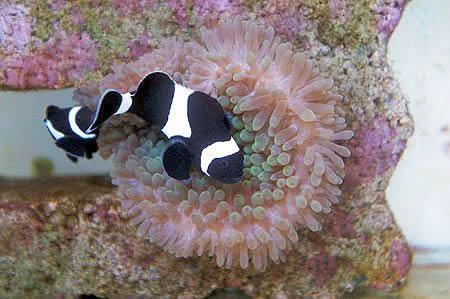
Clownfish lay their eggs in the tentacles of sea anemones. After hatching, the larvae live in the water layer for a period of time before they begin to choose the anemone group suitable for their growth, and only after adapting can they live together. It is worth noting that clownfish cannot live in every kind of sea anemone, only in specific hosts; and clownfish can still survive in an environment without sea anemones, just lacking protection.
Clownfish are highly territorial. Usually a pair of male and female fish will occupy one sea anemone and prevent other members of the same species from entering. If it is a large sea anemone, they will also allow some other juveniles to join in. In such a big family, the strongest in build is the female, and she and her mate the male are dominant, while the other members are all males and juveniles that have not yet shown their characteristics. The female will chase and suppress the other members, forcing them to move only in unimportant corners around the sea anemone. If the dominant female disappears, the male of the original pair will transform into a female within a few weeks, fully possessing female physiological functions, and then spend a longer time changing external characteristics, such as body shape and color, finally completely transforming into a female, while among the other males one of the strongest will become her mate.
Haha! Alright, first let me introduce these clownfish to everyone.
Ocellaris Clownfish
Scientific name: amphiprion ocellaris
Distributed in the reef waters of the South China Sea, the Philippines, and the western Pacific, with a body length of 10~12cm, oval-shaped. The body color is orange-red, with three silvery-white bands on the sides of the body, respectively located behind the eyes, at the center of the dorsal fin, and at the caudal peduncle, among which the white band at the center of the dorsal fin forms a triangle on the side of the body, and each fin is orange-red with black edges. The rearing water temperature is 26~27°C, seawater specific gravity 1.022~1.023, seawater pH between 8.0~8.5, seawater hardness 7~8 degrees dh. Foods include brine shrimp, seaweed, chopped fish meat, pellet feed, etc. It likes to hide in sea anemones, using the anemone's stinging cells to protect itself, forming a symbiotic relationship with the anemone.
Tomato Clownfish
Chinese name: Tomato Clown
Common alias: Tomato (Hong Kong, China)
English name: Tomato Clownfish, Red Clown, Tomato Anemonefish
Latin scientific name: Amphiprion frenatus
Namer, year: Brevoort,
Geographical distribution:The distribution range includes the Gulf of Thailand to the southwestern part of Palau, north to southern Japan, and south to the waters around Java, Indonesia.
Climate zone:Tropical, between 25 degrees north latitude and 35 degrees south latitude
Characteristics:The soft-ray section is elongated and square-shaped; adults are black, with the head, chest, abdomen and all fins of the body red. Behind the eyes there is a wide white band edged in white, extending downward to the throat isthmus. Sub-adults are uniformly orange-yellow, with a white vertical band behind the eyes. As they grow, the body color gradually turns red, and black spots appear on the rear of the body and spread to the entire body.
Habits:Inhabits waters between 1~12 meters deep in lagoons and bays, living symbiotically with the bubble-tip anemone (Entacmaea quadricolor).
The Tomato Clown is a common species and inexpensive. When purchasing, pay attention to distinguishing it from the Indian Red Clown (Amphiprion ephippium). The biggest difference between the Tomato Clown and the Indian Red Clown (Amphiprion ephippium) is that the adult Indian Red Clown has no white vertical band behind the eyes, making it easy to identify.
Sebae Clownfish
Scientific name: amphiprion sebae
Distributed in the coral reef waters of the Indian Ocean, belonging to the family Pomacentridae, with a body length of 10~15cm, oval-shaped. The whole body is purple-black, with three silvery-white vertical bands on the sides of the body behind the eyes, at the middle of the dorsal fin, and at the caudal peduncle; the mouth is silvery-white, with a black band running through the eyes. The rearing water temperature is 26~27°C, seawater specific gravity 1.022~1.023, seawater pH between 8.0~8.5, water hardness 7~9 degrees dh. The water quality should be clear. Foods include brine shrimp, fish worms, chopped fish and shrimp meat, saltwater fish pellet feed, etc. It likes to hide in flower-like anemone tentacles.
Maroon Clownfish
Scientific name: PREMNAS BIACULEATUS
Distributed in the coral reef waters of the Indian Ocean and Pacific Ocean, belonging to the family Pomacentridae, with a body length of 10~15cm, oval-shaped. The whole body is purple-black, each fin is purplish-red, and there are three silvery-white bands on the sides of the body behind the eyes, at the middle of the dorsal fin, and at the caudal peduncle. It is very beautiful. The rearing water temperature is 26~27°C, seawater specific gravity 1.022~1.023, seawater pH between 8.0~8.5, water hardness 7~9 degrees dh.
Foods include algae in seawater, animal plankton, saltwater fish pellet feed, etc. The Maroon Clown is mostly kept in aquariums with invertebrates, inhabiting the gently swaying anemone tentacles, delicate and charming, incomparably beautiful.
Clark's Clownfish
Scientific name: amphiprion clarkii
Clark's Clownfish image distributed in the coral reef waters of the Indian Ocean and Pacific Ocean, as well as Taiwan, China, the South China Sea and the Philippines, belonging to the family Pomacentridae, with a body length of 10~12cm, oval-shaped. The whole body is bright red, with two silvery-white bands on the sides of the body behind the eyes and at the middle of the dorsal fin. The body color of Clark's Clownfish is variable, including bright red, purplish-red, purple-black, etc. The rearing water temperature is 26~27°C, seawater specific gravity 1.022~1.023, seawater pH between 8.0~8.5, water hardness 7~9 degrees dh. Foods include saltwater fish pellet feed, chopped fish meat, seaweed, etc. The water quality should be clear. It likes to hide in colorful sea anemones.
Pink Skunk Clownfish
Scientific name: amphiprion perideraion
Distributed in the coral reef waters of the Philippines, Taiwan, China, and the Pacific Ocean, belonging to the family Pomacentridae. Body length 5~8cm, oval-shaped. The whole body is light brown, with a white band behind the eyes, like a silver ring around the neck. The mouth is silvery-white, and from the mouth along the back to the caudal peduncle together with the dorsal fin, all are silvery-white. The rearing water temperature is 26~27°C, seawater specific gravity 1.022~1.023, seawater pH 8.0~8.5, seawater hardness 7~8 degrees dh. Foods include algae, fish worms, brine shrimp, saltwater fish pellet feed, etc.
It likes to inhabit sea anemones or coral clusters. The mucus secreted on the body surface of the clownfish can protect itself from the anemone's stinging cells. It hides in the flower-like tentacles of the anemone, forming a symbiotic relationship with the anemone.
Wide-band Anemonefish
Chinese name: Black Panther Clown
Black Panther Clown
Common alias: Wide-band Clown (Taiwan, China)
English name: Wide-band Anemonefish Latin scientific name: Amphiprion latezonatus
Geographical distribution: The distribution range is only in the waters around Australia and New Caledonia.
Climate zone: subtropical, between 25~32 degrees south latitude
Characteristics
Morphological characteristics: Dorsal fin spines (total): 10. Eyes medium-large, positioned on the upper side. Mouth large, the end of the maxilla not reaching the front edge of the eye; teeth in a single row, with a notch at the tooth tip. Dorsal fin single, the soft-ray section elongated and bluntly rounded. Adults are brown-black to black, with a white snout. Behind the eyes there is a white band edged in black, and on the middle-rear of the body side there is a large trapezoidal white patch, which is why it is also called the "Wide-band Clown." There is also a broad white ring band on the caudal peduncle. All fins of the body are consistent with the body color.
Body size: maximum body length 14cm
Habits: Inhabits waters between 10~45 meters deep in rocky reef areas and coastal reef areas, living symbiotically with the sebae anemone (Heteractis crispa).
Indian Red Clown
English name: Saddle Anemonefish
Latin scientific name: Amphiprion ephippium
Namer, year: Bloch, 1790
Geographical distribution: Distributed in the coral reef waters of the eastern Indian Ocean, with a distribution range including the Andaman and Nicobar Islands, Thailand, Malaysia, and the waters around Java and Sumatra in Indonesia.
Climate zone: tropical, between 15 degrees north latitude and 11 degrees south latitude
Characteristics: Dorsal fin spines (total): 10~11
The soft-ray section of adults is elongated and square-shaped; adults are red to brown, with 1/2~2/3 of the body side black, and all fins of the body are red to brown. Juveniles are red, with a narrow white vertical band behind the eyes that extends downward only to the edge of the operculum, and an indistinct to black patch on the upper rear of the body side. As they grow, the white band gradually disappears, while the black spots gradually expand to the whole body. The biggest difference between the Indian Red Clown and the Tomato Clown (Amphiprion frenatus) is that the adult Tomato Clown has a broad white vertical band edged in black behind the eyes, extending downward to the throat isthmus, making it easy to identify.
Body size: maximum body length 14cm
Biological characteristics: Inhabits waters between 2~15 meters deep in muddy coastal bays, usually moving in pairs in places with lower visibility.
Supplementary note: The Indian Red Clown is a common species and inexpensive. When purchasing, pay attention to distinguishing it from the Tomato Clown (Amphiprion frenatus).
Skunk Clownfish
English name: Skunk Clownfish
Latin scientific name: Amphiprion akallopisos
Namer, year: Bleeker, 1853
Geographical distribution: The distribution range includes East Africa, Madagascar, the Comoro Islands (an island country in Africa), Seychelles, the Andaman Sea, Sumatra (located in western Indonesia) and the Seribu Islands (located in the Java Sea). It has not been found in the Maldives and Sri Lanka. The western Pacific population -- the Pacific Skunk Clownfish (Amphiprion sandaracinos) -- is very similar to it and is often confused with it.
Climate zone: tropical, between 23 degrees north latitude and 35 degrees south latitude
Body size: maximum body length 11cm
Habits: Inhabits waters between 3~25 meters deep in shallower coastal coral reef areas, usually living in strong-current areas at a depth of about 15 meters. Each sea anemone is occupied by one larger female, along with one smaller functional male (meaning a fish that only provides male function but whose sex is not permanently male, because it can change its sex as needed) and several juveniles whose growth is inhibited. If the female is driven away or leaves on her own, then the functional male will change sex into a female, and the largest juvenile will take on the role of functional male, and so on cyclically.
Biological characteristics: Dorsal fin spines (total): 8~9. Dorsal fin soft rays (total): 17~20. Anal fin spines: 2. Anal fin soft rays: 12~14.
The soft-ray section of adults is elongated and bluntly rounded; adults are uniformly orange, with a white stripe running from the top of the head along the back to above the caudal peduncle; the dorsal fin soft rays are white or yellow, and the remaining fins are consistent with the body color. The Indian Ocean Skunk Clownfish is very similar to the Pacific Skunk Clownfish (Amphiprion sandaracinos). The difference is that the latter's white band starts from the upper lip and extends backward, while the former's upper lip is consistent with the body color, making them not difficult to distinguish.
Breeding of Clownfish
First of all, you need a relatively suitable tank, with several live rocks placed inside, and there must be a certain hiding place, that is, a barrier. Inside this hiding hole, it is best to place a pebble, and outside the mouth of the hole, against the pebble, place a relatively large sea anemone, preferably one that when grown can cover the entire mouth of the hole, or wrap around the pebble. It is recommended to choose a large carpet anemone, or a magnificent sea anemone, so that the clownfish feels secure. In addition, the hole must also ensure that suitable water flow can pass through.
Next is choosing the clownfish. It is recommended to choose smaller male fish; generally the male of the red clown is bright red, choose 1-2. Then choose relatively larger females whose abdomens already have mature gonads; generally the female red clown appears dark red, 4-5 of them. Keep them together for a period of time, and pay attention to observing their pairing situation.
Under normal circumstances, most paired clownfish will nest as a couple in the sea anemone, while the other clownfish are driven to one side. If you find this situation at this time, you can remove the other clownfish. Note that the clownfish couple should be fed regularly, and attention should be paid to nutritional balance. You can mix VG microbial nutrient supplement with vitamin E and feed it in their food.
During the spawning period of clownfish, the phenomena that will appear are:
1. When the gonads of the female and male fish mature, the male's mating organ and the female's oviduct will protrude noticeably.
2. When the spawning day approaches, the clownfish couple will actively and diligently tidy up the nesting environment, using their mouths to sweep away algae, gravel, etc. Isn't that loving? Haha.
3. Clownfish usually spawn in the afternoon or near evening, lasting about 2 hours, and the number of eggs per spawning can range from hundreds to thousands.
4. After the female lays eggs, the male will immediately release sperm, alternating until spawning ends.
5. The fertilized eggs have a transparent outer membrane and orange yolk.
6. During the hatching process of the clownfish eggs, the clownfish couple will alternately blow with their mouths or use their pectoral and caudal fins to remove dirt from the eggs, allowing the eggs to fully contact oxygen. The male is generally more diligent in the later stages.
7. After about 10 days, the eyes inside the egg capsule can be clearly seen, and they hatch in 10-14 days.
8. After hatching, the fry are very fragile and have a strong aversion to light, so they need to leave their parents, avoid water flow, but insist on regular water changes, and pH and temperature must be stable.
9. The hatched fry can be fed rotifers plus VG, once a day. After 5 days, they can be fed rotifers plus newly hatched brine shrimp, twice a day. After 15 days, they can be fed brine shrimp alone, and after one month, they can be fed a small amount of clam meat.
As long as you give the clownfish a good environment, as the saying goes, "well-fed and warmly clothed, one thinks of desire." With good care, natural breeding is no problem. I hope everyone's clownfish will be blessed with many offspring!
Haha! Alright, that's all for today's introduction to clownfish!
If there is anything else you want to see, remember to leave a message for the editor.
Follow the editor, learn a little every day! (^-^)V