Detailed Guide to Artificial Pheasant Farming, Farmers Please Keep It
Recently, Dr. Agri has been outputting various rural farming money-making projects, which might broaden your horizons. We do not seek many likes, as long as we can help people, that is enough!
Without further ado, today we talk about artificial pheasant farming.
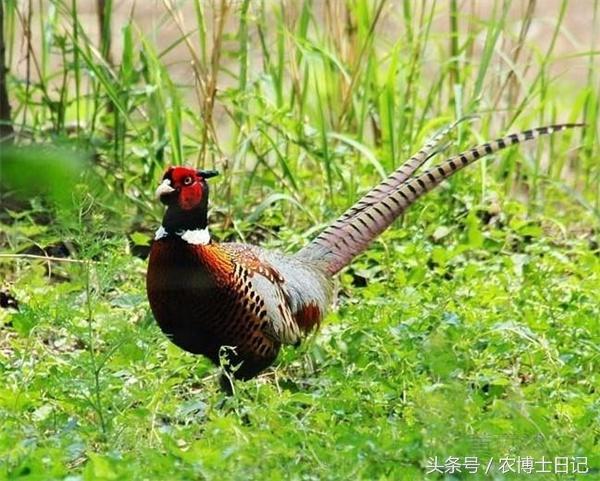
The so-called pheasant is the wild pheasant, also called the common pheasant. Its food value and economic value are both very high. Under the condition that sales channels are guaranteed, raising pheasants will bring relatively high economic benefits. It is indeed a money-making farming project in agriculture.
1. Hatching. The breeding eggs laid by pheasants should be incubated as soon as they are laid. When there are few eggs, domestic hens can be used for brooding; when there are many eggs, artificial incubation can be used. The incubation period of pheasants is 24 days. From 1-20 days after incubation, the temperature should be controlled at 37-37.5°C, with relative humidity of 65-70%; from 21-24 days, during the hatching period, the temperature should be 37°C.
2. Brooding. Controlling temperature well is the key to success or failure in brooding. When chicks are 1-3 days old, the suitable temperature is 34-35°C; at 4-5 days old, 33-34°C; at 6-8 days old, 32-33°C; at 9-20 days old, 31-32°C; at 21-60 days old, 26-28°C.
For pheasant chicks 1-10 days old, 24-hour continuous lighting is suitable; afterward, reduce it by 3-4 hours each week. After 30 days old, natural lighting can be used.
After the chicks hatch, first let them drink a 1 in 10,000 potassium permanganate solution, then start feeding. Since pheasants like to peck at snacks, a method of feeding multiple times should be used. The feed for pheasant chicks is prepared with corn, soybean cake, fish meal, wheat bran, cooked mixed meat, bone meal, green feed, and various trace element additives, etc. The crude protein content of the feed should be above 18%.
Drinking water for the chicks must be guaranteed in supply, and warm water should be used.
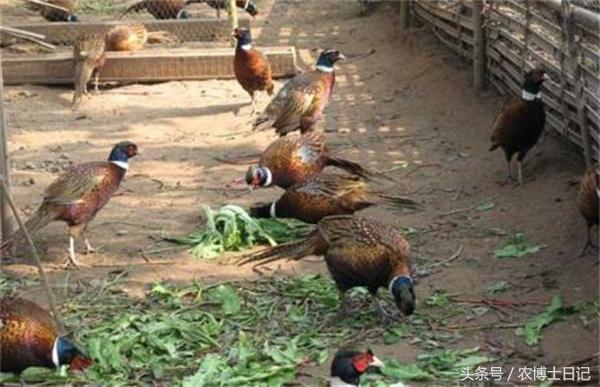
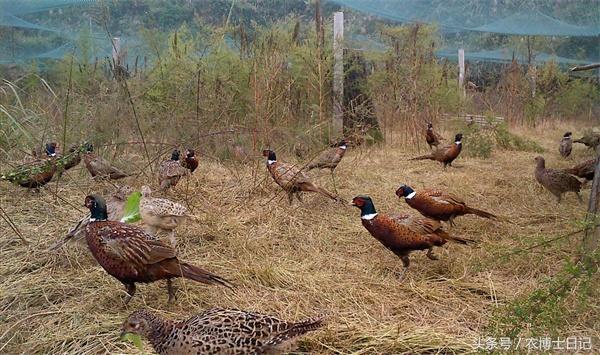
3. Raising adult chickens. Adult chickens can be raised in cages or free-range in net houses. The chicken cages used for cage raising are the same in structure as domestic chicken cages. The net houses used for net raising are built with iron wire or nylon netting, the purpose being to prevent pheasants from flying away. The net house should be equipped with perches, water troughs, feedtroughs, and laying boxes.
The feed formula for adult chickens is: corn 41%, wheat bran 10%, soybean cake 19%, fish meal 15%, green feed 10%, bone meal 3%, a small amount of salt and various trace additives.
For adult pheasants used for breeding, the male-to-female ratio should be appropriate. The suitable ratio is 1:5 or 6. If the ratio is too high or too low, it is not good for breeding.
The disease prevention and control of pheasants is roughly the same as that of domestic chickens.
Adult pheasants grow relatively fast at 61-120 days of age. For commercial chickens, selling around 120 days of age is generally the most cost-effective.
If it is useful, remember to save it! Original by Dr. Agri, reprints welcome, please indicate the source when reprinting!