Detailed Explanation of Ecological Goat Farming Techniques in Southern Regions
Ecological Goat Farming Techniques in Southern Regions
1 Scientific and rational construction of goat pens
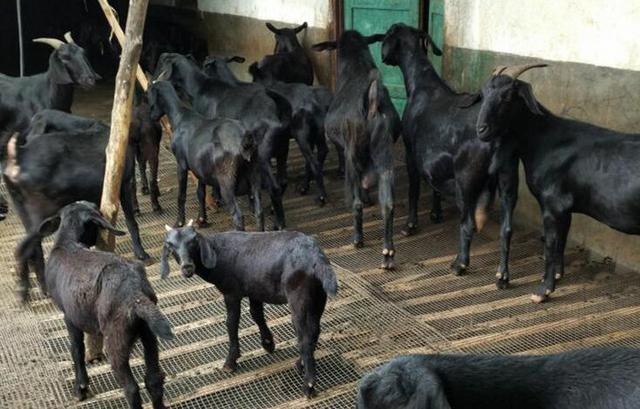
1.1 Building elevated goat pens. Generally, the width of a goat pen is about 5.0 m, the height is 2.5 m, and the length should be determined according to the specific number of goats. Usually, the floor space per goat is about 1.4 sq m, for adult female goats it is 0.9 sq m per animal, and for breeding goats the floor space is slightly larger, at 1.3-1.5 sq m per animal. At the same time, to ensure healthy growth of the goats, a corresponding exercise area needs to be set up next to the goat pen, with an area of more than 1.5 times that of the pen. Some trees also need to be planted around the exercise area to provide shade. It should be noted that when selecting and designing the site for the goat pen, the terrain needs to have a certain slope to facilitate sewage drainage and manure cleaning. For the design of the goat bed, wooden strips, bamboo strips, and similar materials can be used to make the slatted floor, ensuring that the manure and urine produced by the goats can fall to the ground, so as to keep the goat bed clean and tidy.
1.2 Internal design of the goat pen. Inside the goat pen, movable railings should be designed as partitions, and with the separating function of the wooden rails the entire goat pen can be divided into multiple types of pens such as ewe pens, ram pens, and lamb pens. At the same time, more feeders, water troughs, and related hay racks and other facilities need to be set up inside the goat pen to meet the daily feeding needs of the goats. For the hay rack, wooden strips should be used and set against the wall, with a height of 1.0 m and a width of about 15 cm. The feeder can be made from wooden boards or cement into a long trough, with a depth of about 16 cm, ensuring that the bottom of the long trough is curved. In addition, corresponding drinking water equipment needs to be designed against the wall, preferably automatic drinkers spaced at about 2.5 m, with basins or troughs installed below the automatic drinkers to keep the goat pen dry and hygienic.
2 Grass planting and goat raising techniques
2.1 Planting forage grass for farming. To ensure the healthy growth of goats, high-quality forage grass must be planted to guarantee the goats' grass needs. Regarding forage grass planting, in summer, plants such as sweet sorghum, corn, and Sudan grass should be planted more, with the grass supply period mainly from June to November. In winter, ryegrass should be planted, with the grass supply period from November to June of the following year.
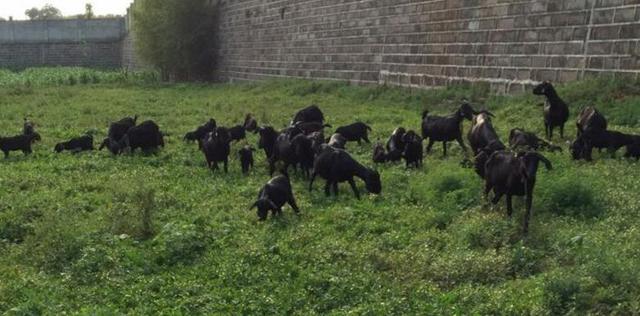
2.2 Rationally selecting high-quality meat goat breeds. With the development of the social economy, people's living standards have greatly improved, and higher standards have been put forward for the quality of mutton. To meet the needs of actual sustainable development, effective innovation should be carried out in goat farming techniques, and a farming model combining grazing and pen feeding should be promoted to improve the growth quality and yield of goats. In terms of feeding, high-quality forage grass such as green feed should be the main farming feed, such as vegetable leaves, peanut vines, and tree leaves and wild grass and other forage. At the same time, in feed feeding, the principle of moderation should be followed, and excessive amounts should not be used, otherwise it will affect the healthy growth of goats. The feeding principle of "roughage first, then concentrate; dry first, then green" should be followed.
3 Straw processing techniques
3.1 Raw materials. In the selection of straw processing materials, non-toxic straw and grain and cotton processing by-products can all be used as the main processed products of raw materials, made into grass meal. Regardless of whether it is any straw or raw material product from the grain and cotton processing series, before processing it should be sun-dried or shade-dried to prevent mold from appearing during the raw material production process because the moisture has not been properly treated.
3.2 Crushing and fermentation. In the process of crushing raw materials, a hammer mill can be used to crush the raw materials into grass meal with a length of about 1.5 cm. At the same time, 1% cornmeal needs to be added to the crushed grass meal or straw and mixed and stirred. Add an appropriate amount of 35°C warm water to the grass meal, and the humidity should be kept at a state where it can be kneaded into a ball by hand and scattered after releasing the hand. By adding a certain proportion of fermentation agent, cover it with plastic film or burlap and place it in a downwind direction. If a distiller's yeast-like smell is produced, the forage fermentation process is completed.
3.3 Feeding. When feeding, fermented forage should not be used alone. Bone meal, salt, cornmeal, and tofu residue and other feed materials should be added to the fermented forage and fully stirred. After mixing, a nutritious forage beneficial to goat growth can be formed.
Scaled Farming Techniques for Meat Goats
Meat Goat Farming Techniques in Southern Regions