How to grow crabapple flowers? Detailed guide to cultivation methods and care essentials
Crabapple flowers are loved by many literati. Su Shi wrote, "I only fear that in the deep night the flowers will fall asleep, so I burn tall candles to light up their red adornment." Crabapple flowers are a symbol of wealth and nobility.
Crabapple flowers have very strong resistance to sulfur dioxide. Their leaf surfaces are glossy, they stay evergreen through all four seasons, and when they bloom they outshine all other flowers. Such crabapple flowers, though small, have great uses. They have obvious resistance to sulfur dioxide, hydrogen fluoride, nitric acid mist and phosgene, and their ability to absorb sulfur dioxide is especially outstanding. According to the indoor air conditions, buying one to several pots of crabapple flowers lets you, while enjoying them, effectively remove harmful gases from the home.
It is a plant of the genus Malus in the rose family (Rosaceae), and is also a plant unique to China. The crabapple flower is a deciduous small tree, and its bark is grayish brown and very smooth. The leaves are alternate, dark green and glossy on the surface, and grayish green with short soft hairs on the underside. On close observation, you can see that the petioles of crabapple flowers are slender and have two lanceolate stipules at the base. The flowers are borne in clusters of 5 to 7, with an umbel-like raceme inflorescence; they are red before opening and gradually turn pink after opening, and most are semi-double, with few single-petaled flowers. The yellow-green pear is spherical. Crabapple flowers are divided into many varieties, including the Xifu crabapple, the drooping crabapple, the crabapple fruit, and the Hubei crabapple.
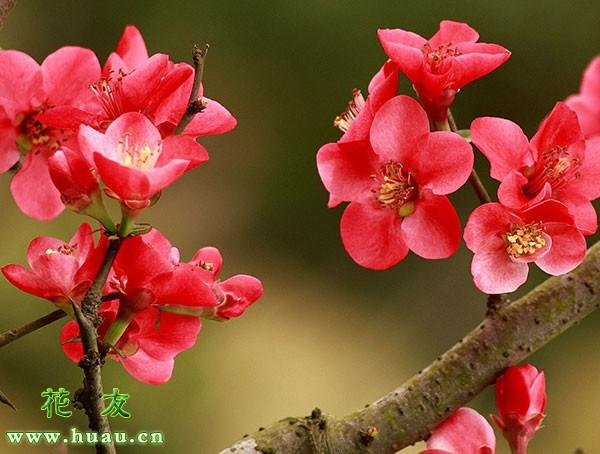
Crabapple prefers sunlight, can also tolerate partial shade, and is cold-resistant. It is not demanding about its environment and is suited to growing in loose, fertile, deep sandy soil with good drainage. The closely attached crabapple (Chaenomeles speciosa) has strong adaptability, and its cultivation and management are relatively extensive.
During the growth period, water according to the plant's growth conditions and changes in air temperature. Water less during the budding stage and keep the potting soil slightly dry; excessive moisture will cause root rot. During the growing season, water once every two days, and frequently spray water around the plant to increase air humidity. It is worth noting that when watering, do not pour water down from the top of the leaves and stems; water along the edge of the flower pot, otherwise the stems and leaves easily accumulate water and rot.
Crabapple flowers should be watered and fertilized in combination. In autumn, after the leaves fall, a heavy fertilizing must be applied to replenish the nutrients it has lost, so that it can stay healthy. When the spring buds sprout, apply an organic fertilizer and give one thorough watering.
The closely attached crabapple (Chaenomeles speciosa) fears waterlogging, otherwise its roots rot easily, so watering must be moderate; in the dry season each year, watering a few times appropriately is enough, and from October to before the following spring it should be watered little or not at all. Fertilizing can be done after flowering, applying 1-2 times of decomposed human and animal manure or barnyard manure, and cutting off the tips of old branches to encourage new shoots to sprout; after autumn, apply organic fertilizer once more to help increase the amount of flowering the next year. When the winter temperature is below minus 20°C, outdoor plants need protection against the cold, and potted closely attached crabapples can be moved indoors to overwinter.
The common disease of the closely attached crabapple is pear-juniper rust, also called pear trellis rust. This disease infects through two hosts. The first host is cypress-type plants, such as Chinese juniper, dragon juniper, and horned juniper; the second host is the closely attached crabapple, the drooping crabapple, and the mountain hawthorn. After the pathogen invades juniper and similar plants, in the first year it produces pale yellow spots in the leaf axils or on small branches, which then swell up. By February and March of the second year, it produces coffee-colored grain-like bodies that break through the epidermis; these are the telial horns. The telial horns are borne singly or in clusters, causing the plant's branches to swell. After the closely attached crabapple is infected as the second host with telial horns, yellow-green small spots appear on the upper surface of the leaves in early to mid-April, then expand into round yellow diseased spots. In the early stage, several small yellow dots appear on the diseased spots, and later they turn black, causing the corresponding place on the underside of the leaf to gradually thicken and produce some grayish-white hairy structures, which in August and September become yellow-brown powdery matter. In severe cases, diseased leaves cover the whole plant, the leaves become deformed with uneven surfaces, causing the leaves to wither and fall early, and even causing the plant to die. The closely attached crabapple is relatively simple to manage; because it flowers mainly on short branches, before spring sprouting the long branches need to be appropriately shortened, pruned into a hemispherical shape to stimulate more new shoots to sprout. During the summer growth period, the growing branches should also be pinched back.
In the process of cultivation and management, pay attention to watering in the dry season; in the hottest days of summer, it is best to apply decomposed organic fertilizer once, or an appropriate amount of compound fertilizer (N, P, K elements). For potted plants forced to bloom, suitable plants can be dug up and potted from September to October, first placed in a cool, ventilated place for a period of care, then moved into a 15°C-20°C greenhouse after winter arrives, and water sprayed on the branches frequently; after about 25 days they will bloom, and can be used for New Year's Day and Spring Festival viewing.
For more flower-growing experience, succulent cultivation, and bonsai appreciation, and to communicate with fellow flower lovers, please go to the Flower Lovers Micro Community: http://m.huau.cn, or follow the WeChat public account: huaucn. To join the Flower Lovers WeChat group, please add the WeChat private account: wwwhuaucn.