A detailed guide to growing pennywort (Hydrocotyle vulgaris) in water, easy enough for beginners to learn
Pennywort is one of the most beautiful foliage plants, and many plant lovers like to grow it in water, clean, beautiful and elegant. Pennywort is also known as marsh pennywort. Growing pennywort started from growing aquatic plants, and later when I saw someone growing it in water, I thought it was quite fun, so I tried it.
And then, there was no stopping it. When I used to plant it in an aquatic plant tank, because the water was deep, the light that could reach the bottom was limited, the leaves of pennywort were limited in size, and the growth rate was also average (relative to water culture, the actual speed was also astonishing).
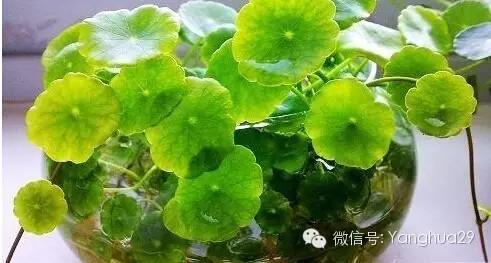
Water culture was initially done with half soil and half water. The soil used was potting soil. This way, the fertility was sufficient, but it was not good for the root development of pennywort. After all, it propagates by stolons. Later I switched to half sand and half water. This way, the roots of pennywort developed more easily. And compared to half soil and half water, it was somewhat cleaner. The sand used was ordinary quartz sand, and the particle size should not be too large. If conditions permit, you can consider Xiantu or other aquatic plant substrate. If not, it does not matter. Through comparison, it was found that pennywort does not have very high fertilizer requirements, and under special conditions there can be unexpected gains.
At first it was planted in a square glass container, placed on a windowsill facing the sun. I found that it needed to be rotated every day to avoid growing in one direction, which would make the shape unattractive. And there was another problem: transparent glass easily grows green algae, brown algae and other algae, which affects the ornamental effect.
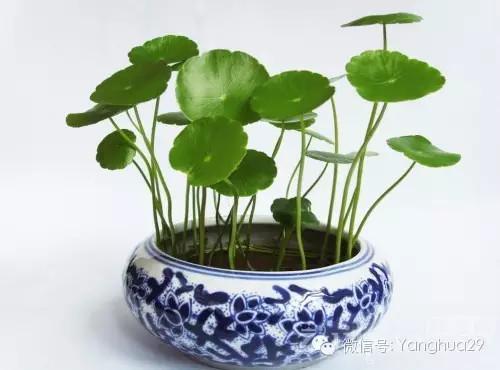
Later I put the pennywort on the table. Apart from the time the light was on, there was no direct light (the room was moved to the shady side). A miracle appeared: the pennywort grew toward the window, seeking light. All things grow relying on the sun. Following the light, the pennywort spread out radially in one direction, a bit like a peacock spreading its tail, and it looked very beautiful too. At the same time, because of light-seeking, the leaf diameter was much larger than in the sun-facing position and underwater, reaching a maximum of 9cm-10cm. The larger the area, the more light it receives and the more energy it obtains.
When the light is relatively weak, there is a tendency for the leaves to enlarge, but when the light is too strong, the plant's protective effect will cause the leaves to shrink. Under the condition of ensuring sufficient energy, it reduces leaf area to protect itself, which is the inhibitory effect of strong light on plants. I do not know whether it was the season or other reasons, but the pennywort produced many flowers and set many seeds, hanging down like a spider plant.
---------------------------------------
Flower-growing knowledge
WeChat: yanghua29
Flower-growing knowledge, questions and answers, solving flower-growing problems!