Why is the basa fish a farming species with boundless prospects?
The basa fish is an important freshwater aquaculture species in Southeast Asian countries. It belongs to the order Siluriformes, and the basa fish (Paugusiushamiltoa) of the genus Pangasius is a scaleless fish. It is a unique high-quality commercial fish species in the Mekong River basin. In Vietnamese it is transliterated as "CABaSa", meaning "three-fat fish", because during its growth the fish accumulates three large masses of fat in its abdominal cavity, accounting for about 58% of its body weight.
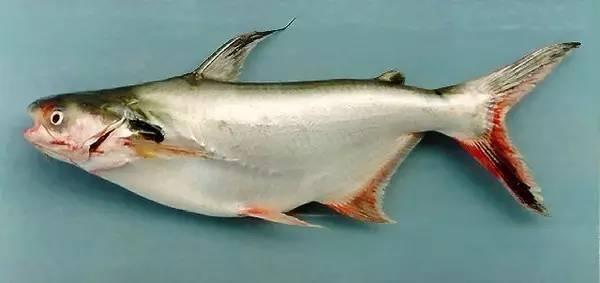
The basa fish is the aquatic product with the largest processed export volume among Vietnamese aquatic products.This fish has low farming costs and extremely high yields, and features tender white flesh, a delicious taste and rich nutrition. Its most outstanding advantage is that after processing the finished product has no small intermuscular bones, making it a white-fleshed commercial fish extremely suitable for processing and export.

Beautiful scenery of Vietnam
The basa fish is a freshwater fish species unique to Vietnam. They favor water temperatures that remain steady throughout the four seasons; local temperatures in Vietnam stay between 20 and 35°C year-round, making the Mekong River basin an excellent place for them to reproduce and grow. A basa fish farming base with 14 ponds can reach an average annual output of 4200 tons. A basa fish takes about 8 months to grow from fry to juvenile, then small fish, then large fish. Once fully grown, its whole body has only one main bone and no small bones. But although these basa fish seem to grow quickly, they are very demanding about water quality. Farming workers at Can Tho aquatic products say that basa fish must be farmed in open-air ponds and the water must be changed every day.
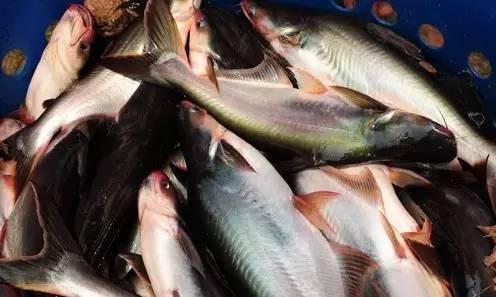
Vietnamese basa fish
In recent years, basa fish export products have shown a strong tendency to sweep the globe, and it is considered the fish most likely to replace tilapia's position as the global leader.
The rise of Vietnamese basa fish originated from the Vietnamese government's "catfish strategy". The "catfish strategy" is an export strategy plan in which Vietnam lists two commercial catfish species, Basa (commonly known as basa fish) and Tra (commonly known as Tra fish), as the country's main export aquatic products.
The basa fish is considered the fish most likely to replace tilapia's position as the global leader. After it was introduced into China, some people once thought of developing it into a replacement species for domestic tilapia farming, but this idea has now suffered a blow from reality.
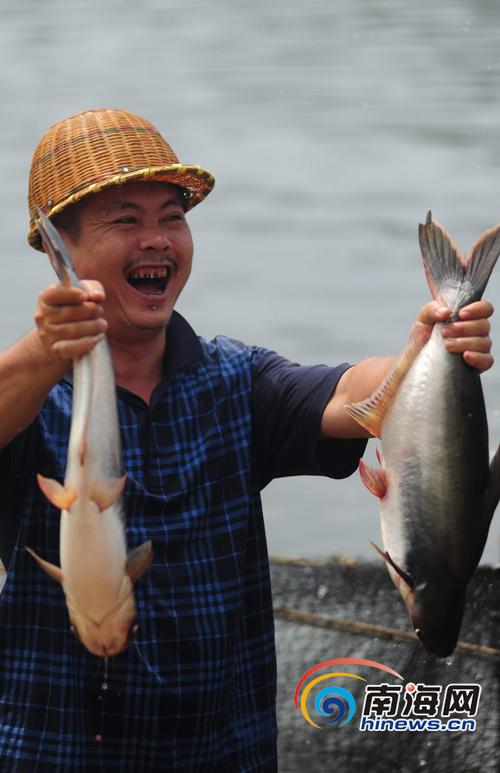
Tilapia replacement species -- basa fish successfully trial-farmed in Qionghai, farmers delighted as they look at the plump fish (photo by Nanhai Net user Meng Zhongde)
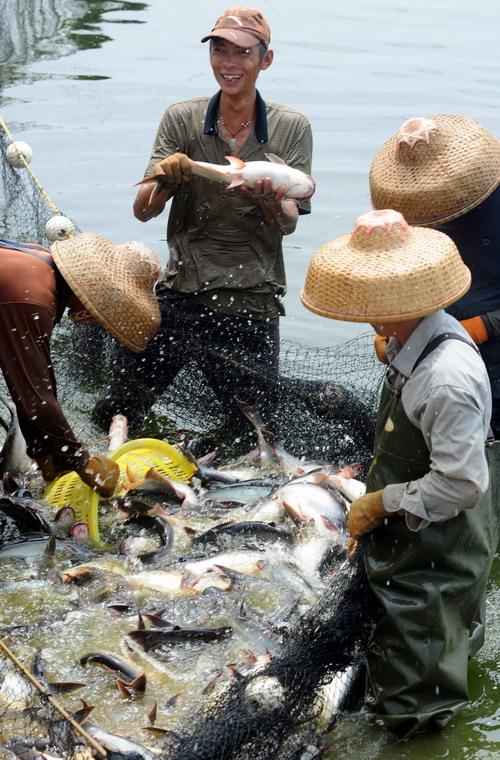
After 9 months of farming, basa fish reached a yield of 4500 kg per mu, and are now being harvested and brought to market one after another (photo by Nanhai Net user Meng Zhongde)
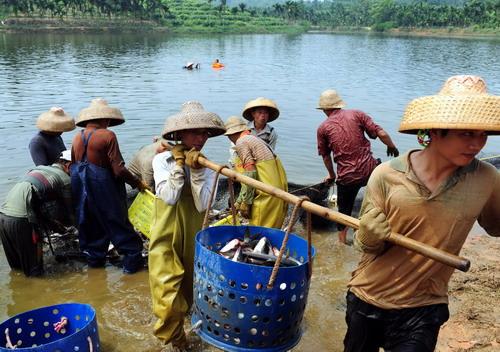
After 9 months of farming, basa fish reached a yield of 4500 kg per mu, and are now being harvested and brought to market one after another (photo by Nanhai Net user Meng Zhongde)
Vietnam's local aquatic industry is very developed, and the processes from seedling breeding, farming and processing to storage all control product quality and safety to very high standards. Basa fish, with tender flesh and no small bones, are mostly exported to Europe and the United States. As is well known, most people in European and American countries prefer sea fish and rarely eat freshwater fish. On the one hand, this is because freshwater fish themselves have a fishy smell; on the other hand, freshwater fish have many bones and are not suitable for varied preparation and consumption. The appearance of Vietnamese basa fish, however, made them see something new. During the inspection process, the Bubugao joint procurement team found that although basa fish is a freshwater fish, it has no fishy smell. According to the color of the flesh, it can be divided into three grades: grade-one basa fish has white flesh and the best quality, followed by pink flesh, and finally only yellow flesh.
Joining hands with three major Vietnamese aquatic companies to establish a direct basa fish procurement base
From original-ecology fry cultivation to refined feeding management, and then to 9 major basa fish processing techniques, from Can Tho city in the far south to Ho Chi Minh City in the far north, the Bubugao joint fresh food procurement team inspected the most representative local basa fish farming bases and cooperated with the three largest local aquatic companies, including Can Tho, Dai Thanh and Hung Vuong, to establish a direct basa fish procurement base in Vietnam.
Workers are screening qualified basa fish
The processes of slaughtering, cleaning, gutting, deheading and skinning basa fish are all very particular, and there is no off-odor. Some basa fish are finally portioned or quick-frozen whole to maintain freshness, and there are also methods such as breading and frying followed by vacuum-compressed packaging to preserve freshness, all of which are very suitable for Chinese consumers to buy and then prepare.
Basa fish sterile operation workshop
Vietnamese people like sour and sweet flavors and use little oil in their diet, so basa fish preparations often add spices to make soup, while Europeans and Americans prefer methods such as pan-frying and deep-frying to ensure the texture of basa fish. For basa fish products, the joint procurement team decided to introduce the finest white-fleshed basa fish into China in single-fillet packaged and transported form. "To use an old advertising line, we do not produce fish, we are merely the movers of these delicious and healthy basa fish. If they are unwilling to swim over, we send them over by plane and ship," Xu Fei said with a laugh.
The basa fish is actually a type of catfish. Data show that catfish is the fastest-growing farmed fish in the world. In 1995 global farmed output was only 15000 tons, rising to 1.4 million tons in 2008 and expected to approach 1.8 million tons in 2010, with 90% of the farmed output coming from Vietnam. Some once predicted that global catfish output would surpass tilapia in 5 years and become the world's number one farmed white-fleshed fish.
One of the species in Vietnam's "catfish strategy"
Wang Xingcan, general manager of Ningbo Haichuan Aquatic Feed, once had work experience in Vietnam and knows local basa fish farming quite well. According to him, basa fish farming is mainly concentrated in the Mekong Delta, with farming ponds 4-5 m deep, using an intensive model of pure feed input, marketed at more than 8 liang, and two crops can be farmed per year. The common market size is 0.8-1.0 kg per fish. During the fish's farming process there is little disease, and even aeration equipment is not needed; flow-through farming or changing 20-30% of the water daily is used.
In terms of farming costs, it is understood that at the current stage it is about 10000-11000 Vietnamese dong/jin (equivalent to 3.1-3.5 yuan/jin), of which feed cost is equivalent to about 2.7-2.8 yuan/jin. What is astonishing is that under these conditions the yield per mu can reach 23-27 tons/mu, which is not comparable to tilapia's yield of 1-1.5 tons/mu.
In terms of meat yield, it also has a clear advantage compared with tilapia. It is understood that the meat yield of tilapia is generally about 33%, while that of Vietnamese catfish can reach 40%. In addition, the current selling price of raw basa fish is equivalent to 3.8-3.9 yuan/jin, which is not only far below the level of nearly 6 yuan/jin when Chinese tilapia was at a high price, but still has an advantage compared with the current price slightly above 4 yuan/jin.
Data provided by Beijing Haiqiao Market Promotion Co., Ltd. show that in 2009 the average international market price of Vietnamese frozen catfish fillets was 2.21 USD/kg. In the same year, as the country with the lowest global price of frozen tilapia fillets, China's average international market price of frozen tilapia was 3.61 USD/kg, 63% higher than the former.
It can thus be seen that compared with tilapia, Vietnamese catfish has more obvious advantages in terms of farming difficulty, yield and international market price.
At many farms and processing plants in the Mekong Delta, the price per kilogram of fish delivered by farmers to the factories is 20000-23000 Vietnamese dong (about 6-7 yuan). Farming is mostly in ponds, with water depth above 4 m, no aerators, no feeding machines, and extremely high farming density. Three crops can be farmed every two years, each crop lasting 8 months. At stocking the average weight of each fish is 1 liang, and at harvest the average weight is 1 kg. The average yield per mu is more than 25 tons, and one person can manage 10 mu. With such high yields, there is probably no other fish in the world that can compare with it. And China
Related Articles
- Why swine semen becomes a vehicle for virus transmission (Part Four)
- Why does boar semen become a vehicle for virus transmission? (Part Three)
- Why is swine fever so hard to control? Five common clinical causes and countermeasures
- What is the most effective way to prevent and control foot-and-mouth disease? All the methods are here
- PED is the number one killer of piglets, and prevention and control must be prioritized in autumn and winter
- What is a yellow-fat pig? Let's hear what pig buyers say
- Detailed diagnosis and treatment process of classical swine fever in piglets, sharing of one case
- What are the reasons for poor treatment results after illness in nursery pigs?