Prevention and Treatment Methods for Skin Rot Disease in Aquacultured Giant Salamanders
Skin rot disease is one of the most harmful diseases to artificial giant salamander farming, and it spreads relatively quickly. Because the water quality in artificial salamander farming is easily polluted, large amounts of pathogenic microorganisms often breed in the water. When giant salamanders suffer body injuries from scrapes, mutual biting and fighting, or other causes, pathogenic microorganisms easily invade and cause lesions. In the early stage of the disease, the skin fluid at the affected area decreases, red spots or speckle-like spots appear, and the surrounding tissue becomes congested and inflamed, then sore-like lesions form. The lesions often have large amounts of pathogenic bacteria and debris attached. In severe cases, the muscles at the lesion site necrose, exposing bones, tendons, and internal organs. Diseased salamanders have reduced appetite or stop feeding, their activity capacity is obviously weakened, and they soon die.
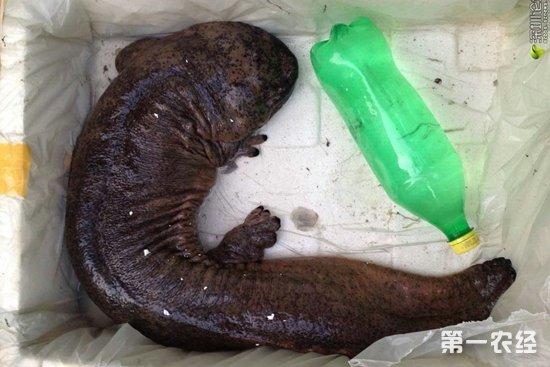
Prevention: After the salamander pond is built, fry cannot be stocked immediately, because newly built ponds have relatively strong alkalinity. The optimal pH value for giant salamanders is 6-7; when the pH value is >9, giant salamanders will die catastrophically. Before stocking, fill the pond with water and soak continuously for 2-3 days, then drain, and repeat several times to bring the pond water pH close to neutral. The pond walls and cave walls should be smooth to prevent skin scrapes on giant salamanders. Before stocking, the salamander pond should be disinfected with bleaching powder or other drugs to kill harmful organisms. When fry are placed in the pond, soak and wash them with 1% gentian violet for 20 minutes. Pay attention to keeping individual specifications uniform in the same pond, and set up escape-prevention facilities to avoid injuries from mutual biting and fighting among individual giant salamanders. During rearing, keep the water quality clear and pollution-free; when conditions permit, maintain year-round flowing water. In summer, water temperature is relatively high, and pathogenic microorganisms reproduce quickly in small water bodies, so frequently changing the pond water is even more important. Treatment: For diseased salamander ponds, splash the entire pond with strong chlorine essence 0.3-0.4 g/cubic meter or chlorine dioxide 0.3 g/cubic meter, once a day for 3 consecutive days. For diseased salamanders, first soak and wash with 10-20 g/cubic meter for more than half an hour, and thoroughly clean the attachments on the wound surface, then apply Kuiyangling or other disinfectant ointment to the affected area, once a day. For more severely diseased salamanders, inject 80,000-100,000 units of penicillin per kilogram, and the number of injections depends on the condition.