Aquaculture and fresh-keeping dry goods express delivery, helping you lock in the umami
Aquatic Product Operations and Management - Aquaculture & Fresh Keeping
▼
Fresh food training videos, please follow the Zhongxian Network WeChat official account Fresh Food Classroom
▼
Aquatic products are the highest-level expression of supermarket operations, and there are many operational difficulties: aquaculture, product preservation, maintenance, care...... And aquatic product categories are mostly divided into: live fish, sea fish, live crabs, shellfish...... How to overcome the difficulties of aquatic product operations? You might first look at the current status of aquatic product operations:
▶ 'Analysis of the Current Status of Aquatic Products'
▼
Analysis of the Current Status of Aquatic Products
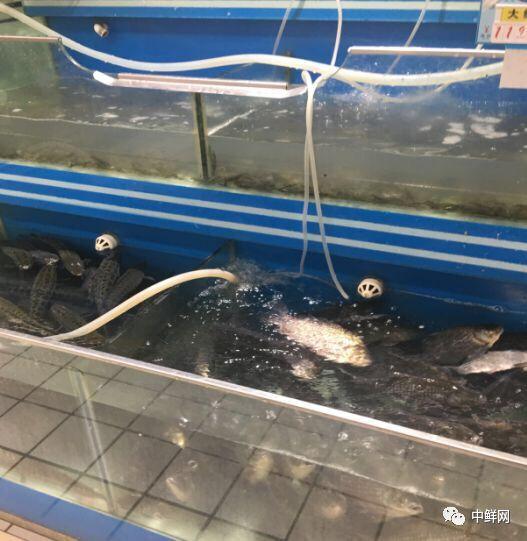
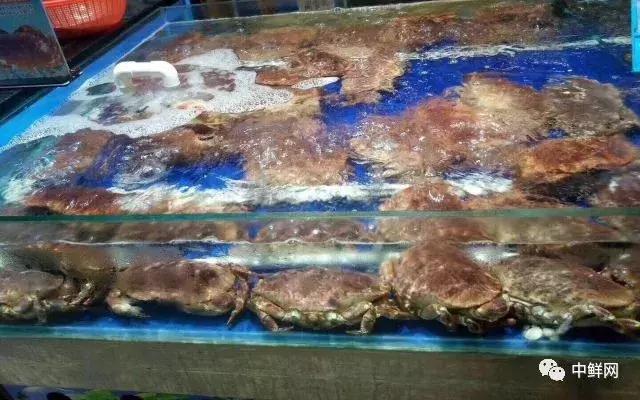
☑ The aquaculture technology for live fish, seafood, and shellfish in aquatic products needs improvement
☑ Main operating products are not clearly reflected
☑ Lack of equipment maintenance and product maintenance management
☑ Insufficient display aesthetics, poor product atmosphere
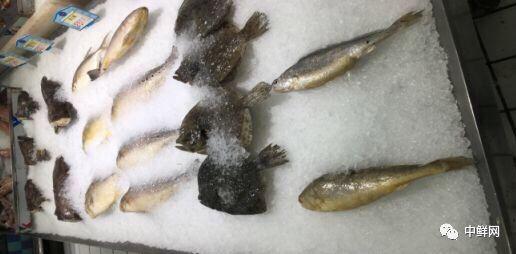
☑ Loose frozen products are displayed in a messy way
☑ Products are not sorted out in time, causing severe frost accumulation on frozen products
☑ Products affecting sales quality appear on the display
☑ Serious shortage of item varieties
▶ 'Aquaculture'
▼
Aquaculture and product preservation
☑ Marine fish and freshwater fish should be cultured separately, as their water quality requirements are different
☑ High-end seafood and ordinary seafood should be cultured separately
☑ Scaly fish and scaleless fish should be cultured separately, and tropical fish should be cultured separately
☑ Fish cultured together should have water temperature and salinity as similar as possible. For example: Boston lobster and turbot can be cultured together. The salinity for Boston lobster is between 25-26 degrees, and turbot basically adapts at 18-19, but it can also survive in a 25-degree environment.
☑ New and old stock should be cultured separately, and it is best to achieve first in, first out. The operation of freshwater fish mainly requires increasing the product turnover rate.
Seafood aquaculture temperature and salinity
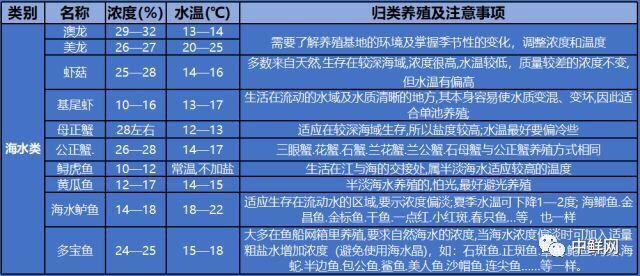
For rationalized aquaculture, you need to understand the living habits of the products, grasp seasonal changes, and adjust concentration and temperature. It is recommended to make a table and record at two-hour intervals every day. Records include water quality and water temperature, salinity, product status, and equipment operation. Before long, you will be able to figure out the culture conditions for most seafood products, handle problems in time, and make predictions in advance.
Salinity and temperature for conventional item culture
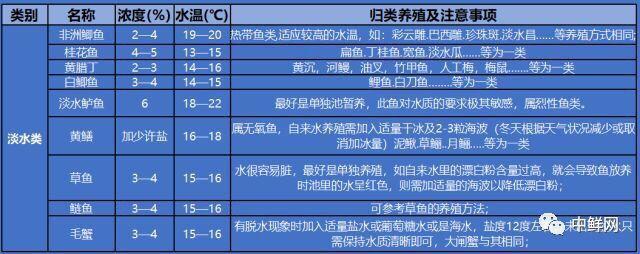
Basic requirements for live seafood culture
Live seafood products are living, and they have certain requirements for the living environment (water quality, water temperature, salinity), so it is necessary to create a culture environment similar to the original living environment of live seafood products to prolong their lives. During the culture process, close attention must be paid to the condition of the products and the culture environment:
☑ Eyes on
▫ Observe the color of the water to judge the cleanliness of the water
▫ Observe the fish's appearance, swimming strength, and eye brightness to judge the fish's liveliness
☑ Hands on
▫ Touch the fish body with your hands to judge the fish's condition
▫ Touch the pond water with your hands to judge whether the water temperature meets the requirements (manual perception varies, so this is only for daily rough checks; actual measurement tools are required)
☑ Nose on
Smell the water to judge the degree of water pollution
Problems to note in nighttime aquaculture work and countermeasures
Nighttime aquaculture is a key and difficult operating period in aquatic product operations. Due to factors such as strong independence of work and high difficulty of nighttime work, the following situations may occur and cannot be discovered and solved in time, causing product losses:
▫ Equipment suddenly trips or burns out
▫ Oxygen tubes become loose or fall off
▫ The culture pond leaks
▫ Abnormal water temperature
▫ Fish jump onto the ground
Countermeasures: It is recommended to train night shift duty personnel as aquaculture personnel and strengthen their sense of work responsibility. Conduct detailed patrol inspections of equipment operation, water temperature changes, fish activity, and fresh-keeping products, and handle problems in time when found. For example, when fish are found at night floating belly-up on a large scale, first add salt or sea crystal, then use ice to hit the water and try to activate them, and add oxygen, and finally replace part of the water to lower the water temperature.
Preparation work before fish arrive and inspection work after fish are put into water
Before fish arrive, the culture vehicle must be thoroughly disinfected. After storing water, adjust the water temperature well and disinfect the water quality. After putting in the fish, closely observe and inspect them. Otherwise, the following situations will occur:
▫ Fish suffer from lack of oxygen due to excessive density
▫ Water quality becomes dirty and pollution is severe, or severe foam covers the pond, causing fish to suffocate
▫ Dead fish are not handled in time
Countermeasures:
① When fish arrive and poor activity is found, report it in time, and use an appropriate amount of sea crystal to stimulate the fish's activity, while checking whether the circulating water is working normally. For freshwater fish water, replace 1/3 of the old water with 1/3 of new water every day. For seawater fish water, do not change it frequently. Every day use a fishing net to remove debris, and it is recommended to clean the filter sponge once in the morning, noon, and evening.
② When fish density is high, divide them into ponds in time
③ When water quality becomes dirty, change the water in time, and pay attention to changes in water temperature and fish activity.
④ Preserve dead fish in time to reduce loss of value
Problems to note in aquaculture work and countermeasures
Common problems:
▫ Forgetting to turn off equipment before cleaning the fish pond, and the water pump burns out while circulating
▫ After cleaning, the water is still not clean, and dirt and moss appear in the water
▫ After cleaning the pond, the fish are returned without checking water temperature or salinity. After cleaning, disinfecting, and changing water, the water must be conditioned for 6-8 hours.
Countermeasures:
① Strictly follow the steps
② Leave no dead corners (including filter pond walls, water storage ponds, bottom pond walls, and water pump filter screens, etc.)
③ After cleaning is completed, before returning the fish or when only changing water, pay attention to adjusting the water temperature and carry out effective disinfection treatment.
Key points of aquaculture
Water quality: Ensure the water quality in the culture pond is clean, change water in time, and disinfect the fish pond.
Temperature: Continuously adjust according to product characteristics and seasons to reach a suitable level
Density: According to the actual size of the store's fish pond, reasonably adjust fish density to avoid oxygen deficiency caused by culturing too many.
Oxygen content: Reasonably adjust oxygen in the culture pond to avoid fish death caused by too much or too little oxygen
Salinity: Understand the living environment and living characteristics of the products, and continuously adjust to reach a suitable level
▶ 'Product Preservation'
Preservation of fresh products - ice salt water preservation method
☑ Prepare the products that need preservation
☑ Add coarse salt and stir evenly:
Concentration: 7% (for example: 20 jin ice water + 1.5 jin salt)
☑ Add water and ice, and stir evenly:
Temperature: 3-5 ℃ (ice water ratio is 50% each)
☑ Completely soak the products in ice salt water
☑ Then cover with a layer of dry ice and flatten with your hands
☑ Store in a cool and ventilated place
Products suitable for salt water preservation: pomfret, squid, cuttlefish, meat pomfret, anchovy, octopus, Spanish mackerel
Preservation of fresh products - dry ice preservation method
☑ Prepare the products that need preservation
☑ Punch four small holes in the bottom of the foam box
☑ Spread a 5 cm layer of dry ice on the bottom of the foam box
☑ Arrange the products (fish bellies need to be symmetrical), achieving one layer of ice and one layer of products
☑ Finally spread 15 cm of dry ice and smooth it flat
☑ Store in a cool and ventilated place
Operation points: When preserving large yellow croaker, half-side fish, golden thread fish, etc., the products must be separated from the ice.
Applicable products: All chilled fresh products are applicable except water-soaked types, pomfret, meat pomfret, and Spanish mackerel.
Preservation during the chilled fresh sales process
☑ Spray ice water: Evenly spray ice water on the products to keep them fresh.
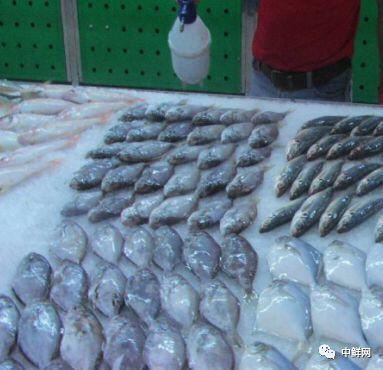
Applicable products: All products are applicable except water-soaked types, packaged types, and products that easily change color when exposed to water (such as boss fish, grouper belly, yellow croaker)
☑ Spread dry ice: Spread a thin layer of dry ice on the products, achieving "cover the belly and expose the gills."
Applicable products: Except for products that easily change color (such as boss fish, fresh ribbonfish, grouper belly, yellow croaker), which need to avoid use, all other products are applicable.
☑ Soak in ice salt water for preservation: Soak the products in ice salt water for 1-2 minutes before putting them on the counter for sale, which can restore the products' freshness.
Applicable products: Except for products that easily change color (such as boss fish, grouper belly, yellow croaker), which need to avoid use, all other products are applicable.
Storage of shellfish and preservation in aquaculture fresh-keeping storage
☑ Operation steps
Tie the bag opening tightly, put it into storage after tying tightly, and cover with cloth. After tying the bag opening tightly, put it into the fresh-keeping storage and cover and isolate it with cloth, and store the products on pallets.
Applicable products: flower clam, freshwater clam, Erdu blood clam, freshwater mussel, T snail, razor clam, oil clam
☑ Notes
When there is a lot of leftover sea oyster, ice can be added after pouring out all the ice water
Flower clams need to dissipate heat before being put into storage in summer
T snail need ice bags added in summer
Water quality table for major shellfish aquaculture
Method for recovering products to cold storage
Maintenance process for chilled fresh fish cold storage
☑ Use turnover boxes or foam boxes and punch holes in the bottom, top, bottom, left, right, and other positions
☑ Evenly place flake ice at the bottom of the box, with an ice layer thickness of about one finger
☑ For maintenance, fish must use white (colorless) plastic film to isolate the flake ice (to avoid ice water directly contacting the fish body)
☑ Place chilled fresh fish (taking yellow croaker as an example) with the belly facing up and arrange the fish bodies closely and neatly in order
☑ Use white plastic film for isolation, add 8-10 cm of flake ice
☑ Add the foam box lid and seal it tightly. Fill in the warehouse shelf life card according to the product and stick it at the lower right of the foam box
Note: This preservation method can be applied to various scaly fish. For chilled fresh Spanish mackerel and pomfret, use a fresh-keeping box or iron box with ice salt water plus ice for sealed maintenance