How to grow Begonia maculata, so the flowers bloom beautifully and charmingly
Begonia maculata, also known as arrowhead begonia, is a perennial subshrub with excellent shade tolerance, fond of warm and humid environments, and very beautiful and charming, loved by many people. So do you know how to grow Begonia maculata? Below, the editor will introduce the cultivation methods for Begonia maculata.
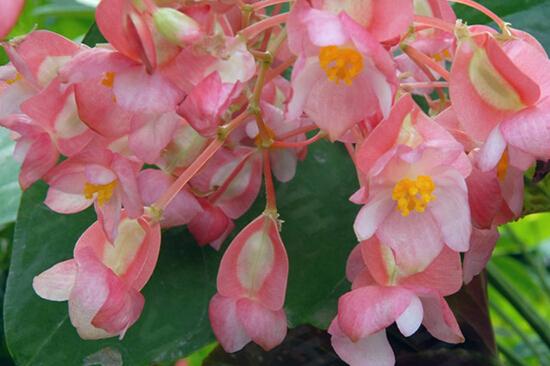
Propagation methods for Begonia maculata
Propagation of Begonia maculata is mainly by cuttings, and can be done by water cuttings and division. When taking cuttings, select healthy growing tender top shoots and cut them into 3 to 4-node sections about 10 cm to 15 cm long, with the lower cut at 0.5 cm below the lowest node, then insert them into a river sand seedbed. All leaves on the part inserted into the soil should be removed, keeping only 2 to 3 leaves on top.
Watering management
Begonia maculata is a shallow-rooted plant that likes semi-shade and a mild, humid environment. Its optimal growing temperature is between 15 and 25 degrees. It is drought-tolerant but afraid of waterlogging, so watering Begonia maculata should follow the principle of watering when dry and keeping moist, with the best being to keep the potting soil moist. In midsummer, the leaves and the ground need to be sprayed with water; increasing air humidity will help its growth.
Light management
Begonia maculata likes ample scattered light, but too strong light will cause the leaf tips to dry and the edges to scorch, causing the leaves to turn yellow and even drop. In hot summer, it is best to place it under a cool, ventilated trellis or on a north-facing balcony to receive scattered light. If it is placed in a dark place for a long time, it will cause insufficient light, which will also cause yellow leaves and, in severe cases, plant death.
Fertilization management
Fertilization of Begonia maculata should be done when the potting soil is dry; watering after fertilizing ensures it is fully absorbed by the plant. When Begonia maculata has just been repotted and when the stems and leaves are not vigorous, heavy fertilizer should be avoided. During the vigorous growth period, applying a thin liquid fertilizer once every 10 to 15 days is enough.
Pruning the plant
Because Begonia maculata plants are tall, perennial plants may grow too tall, causing the flowers and leaves on the lower part of the stems to drop, making the plant's shape unattractive and affecting the ornamental effect, so a certain amount of pruning is needed to maintain a good shape. Pruning the plant can be done together with repotting in spring, which will help the plant sprout new branches and bloom more.
Pest and disease control
Excessively high summer temperatures and humid weather can cause pests and diseases in Begonia maculata. For pest and disease control, on the one hand, ventilation and light transmission should be strengthened, and a large amount of water should not accumulate in the pot. At the same time, ensure a fungicide spray once every 15 days, such as thiophanate-methyl and carbendazim, to prevent diseases. If red spider mite damage is found, spray with a 1500-fold solution of dicofol; if a small number of scale insects are found, they can be removed manually with a brush.
Begonia maculata is still quite easy to grow. As long as you understand its habits, Begonia maculata is a shallow-rooted plant that likes semi-shade, moisture and warmth, is not cold-tolerant, and avoids direct sun, heat and waterlogging. The suitable growing temperature is 15°C to 25°C. It has strong drought tolerance, is afraid of water accumulation, and likes loose, fertile sandy loam. The watering principle is to water when dry and keep moist.
----------BIU~BIU~BIU~I am the dividing line-------------- If you are planning to renovate, please pick up your phone and follow our WeChat! Editor's personal account: 13775489929, sharing renovation guides and case designs every day, follow the WeChat public account: lygyhjjw [Follow the editor to help check your floor plan! Free on-site measurement and design plans in 69 cities nationwide