How to Grow and Care for the Echeveria 'Perle von Nurnberg' Succulent
Name: Echeveria 'Perle von Nurnberg'
Family and Genus: Crassulaceae, Echeveria genus
Morphological characteristics:
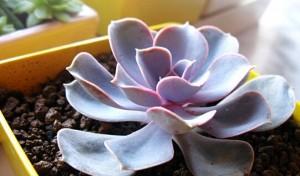
Echeveria 'Perle von Nurnberg' is a perennial succulent herbaceous plant of small to medium size. The fleshy leaves are arranged in a tight rosette. The purplish-gray leaves curve inward with distinct wavy edges, and under strong light or with a large temperature difference, the leaves develop a beautiful pink to purplish-red color. In weak light, the leaves turn light grayish-green, stretch out, and also become grayish-white in color. The leaf surface is smooth and does not easily hold water. The leaves have a slight powdery coating. Echeveria 'Perle von Nurnberg' needs plenty of sunlight for the leaf color and leaf edges to be vivid, and for the plant shape to be more compact and attractive. After clustering for many years, the plant becomes very spectacular, especially old stems that have been pruned for many years. Echeveria 'Perle von Nurnberg' has clustered inflorescences with pinkish-red flowers, and the flower shape is the same as that of most Echeveria.
Cultivation points:
Echeveria 'Perle von Nurnberg' needs a sunny, cool and dry environment. It tolerates partial shade, fears waterlogging, and dislikes muggy and humid conditions. It has the habit of growing in the cool season and going dormant at high summer temperatures.
Each year from September to June of the following year is the plant's growing season (the growing season varies in length depending on the grower's environment). If there is insufficient light, the plant's leaves will become leggy, and the pink color of the leaves will gradually fade; while plants grown in sunny places have a short, sturdy shape and compact leaf arrangement.
During the growing season, keep the soil moist and avoid waterlogging. Fengzheng used a soil mix of coal cinders mixed with peat and a small amount of perlite, in a ratio of about 5:4:1, with large-grained river sand spread on the soil surface.
Summer and winter care:
In winter, Echeveria 'Perle von Nurnberg' can withstand low temperatures of around minus 4°C, which is an indoor temperature, not outdoors. If it gets any colder, the growing point at the tip of the leaves will suffer frost damage, dry up and die. Basically cut off watering throughout the winter; below 5 degrees, start gradually cutting off watering.
At high summer temperatures, the whole plant grows slowly or stops growing completely. At this time, ensure good ventilation and appropriate shading, avoid exposure to the scorching sun, restrain watering, and do not let it be rained on for long periods, so as to prevent the plant from rotting.
Propagation methods:
Echeveria 'Perle von Nurnberg' is generally propagated by beheading to produce pups for cuttings and by leaf cuttings. The beheaded plant can be directly stuck into dry granular soil, and once it has rooted, a small amount of water can be given.
For the leaf cutting method, take a complete, plump leaf and place it in a cool place to let the wound dry (it is fine to just remove the leaf and drop it on the soil surface, as long as the leaf wound does not touch the soil), then place it on slightly moist soil. It will slowly grow roots and then sprout. The process is a bit long, but you can get many small offsets. Once the offsets grow larger, remove them and plant them as cuttings.
---------------------------------------
Gardening Knowledge
WeChat: yanghua29
Gardening knowledge, questions and answers, solving your gardening problems!