How to grow ground-cover roses? Cultivation methods and common pests and diseases
[Introduction]Ground-cover roses actually refer to climbing roses, because they mainly grow in a creeping, spreading manner and are a relatively good ground-cover plant, which is why they are called ground-cover roses. Ground-cover roses have unique advantages when used in garden design, such as creeping expansion, large coverage, tolerance to high temperatures and drought, and strong disease resistance. There are also many types of ground-cover roses, and most are very easy to keep alive.
Although ground-cover roses are plants with relatively strong resistance to pests and diseases, this does not mean they will never be affected by pests and diseases. Of course, this does not prevent them from being widely used in gardens. Let's take a look below.

Eight major advantages of ground-cover roses in garden applications
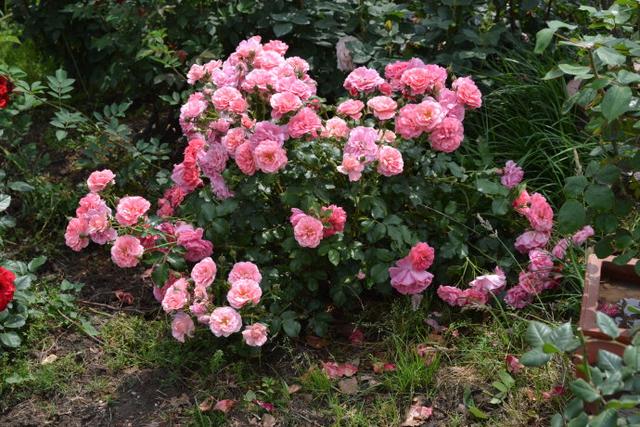
1. Creeping and spreading type, height not exceeding 20 cm. Each plant produces more than 50 branches per year, and the branches root when they touch the ground. Each branch can bloom 50-100 flowers at one time.
2. The root system is well developed, with the deepest roots reaching more than 2 m.
3. Large coverage area, with a single plant covering more than 1 sq m.
4. Strong flowering in groups, with continuous blooming through all four seasons.
5. Drought tolerant, able to grow in areas with annual rainfall of 150-200 mm; tolerant of poor soil, and able to be planted and grow on slopes, in dense shade, and in areas where irrigation is difficult.
6. Tolerant of high temperature and high humidity; it can grow normally at a low temperature of -30°C and a high temperature of 42°C.
7. Extensive management and strong disease resistance; no need for pesticide application or pruning, reducing a large amount of management costs.
8. Remarkable effect in arranging color blocks and roadside strips; it not only beautifies the environment but also has advantages such as reducing noise and absorbing heat. It is an excellent choice for conserving water sources and preventing soil erosion.
Classification methods of ground-cover roses
1. There are many ways to classify ground-cover roses. According to their growth characteristics, they can be classified into upright type and climbing type. Upright type: the branches are thick and strong, able to grow upright without relying on supports such as flower trellises, and the height is relatively low, generally between 1.5 m and 2.5 m. It can be used for flower hedges, flower screens, flower walls, and other places. Climbing type: it has slender stems and vines, with a height from 2.5 m to 10 m, and needs to climb upward by relying on flower trellises, pillars, and so on. It is mainly used for flower arches, flower corridors, flower columns, and so on.
2. According to their flowering habits, they can be classified into three types: multi-season flowering, two-season flowering, and one-season flowering. Multi-season flowering varieties can bloom repeatedly during the growing season, blooming continuously until dormancy in winter. Some climbing varieties not only bloom continuously but also have a large flowering volume, making them the most suitable varieties for landscaping, with excellent beautification effects. Such as 'Dortmund' and others. Two-season flowering varieties generally bloom in May to June, then bloom little or not at all in summer and early autumn, and bloom again around mid-autumn, but the flowering volume is far less than in May to June. One-season flowering varieties generally stop flowering after blooming in May to June, or only produce very few flowers afterward, and do not bloom again until next year. These varieties often have relatively strong drought resistance, disease resistance, and cold tolerance, and also have relatively strong climbing ability.

Common diseases of ground-cover roses and their control
1. Crown gall: Crown gall is a major disease for producers in countries without cold winters, and the disease is common in Asia, Africa, Australia, and India. It is said that crown gall is brought by rootstock, but it may also already exist in the soil and have already attached to the host when the seedlings are planted. Chemical control and the use of resistant rootstock can only play a controlling role to a certain extent. The only way to prevent crown gall infection is to use soilless cultivation or to buy rootstock from areas with frost. Routine control is to disinfect the seedbed soil before planting, plant resistant rootstock, or carry out soilless cultivation.
2. Gray mold, caused by Botrytis cinerea. After Botrytis cinerea infects the buds, the buds become brown and rotting. When flowers are attacked while opening, individual petals become brown and shrunken. The disease easily occurs on old flowers that have not been picked, especially under humid conditions and in the rainy season. When the disease is severe, flower opening is hindered. In winter, Botrytis cinerea is present on the dead stems of roses. For control, promptly remove diseased flowers, remove withered old flowers, and burn them in a centralized manner. Spraying chemical agents in the early stage of plant growth, such as 70% ferbam 1000-fold solution and 50% benlate 1000-fold solution, can effectively control it.
Generally speaking, as long as cultivation and care are proper, pests and diseases occur relatively rarely on ground-cover roses. Therefore, whether in irrigation, fertilization, or other cultivation steps, even if we do not proceed with extreme caution, we should still be careful and meticulous, so as to ensure their healthy growth.
Follow WeChat ID: xiaobency, shared every day around 9 o'clock, listened to by ten thousand people