How to Identify the Quality of Fish Fry? Practical Aquaculture Tips
Sturdy and robust fish fry are an important foundation for increasing adult fish yields, and also one of the main conditions for improving the survival rate of fish fry. There are 5 main criteria for identifying the quality of fish fry, which can be summarized as "four looks and one sampling".
First, look at whether the size at harvest is uniform. For fish fry of the same species, those harvested at a uniform size generally have sturdier constitutions. When individual differences are relatively large, the population survival rate tends to be relatively low.
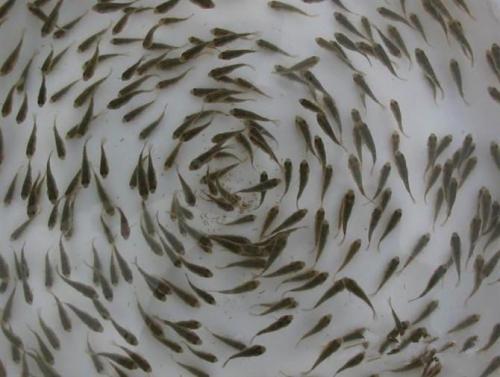
Second, look at the body color of the fish fry. The body color of fish fry may reflect the quality of their constitution. Different fish species have different body colors. Generally speaking, high-quality grass carp fry have a pale golden-yellow body color, with grayish-black net-like scales that are relatively distinct. The sturdier the fish, the more pronounced the pale golden-yellow color. High-quality black carp fry have a bluish-gray body color with white, and the sturdier the fish, the lighter the body color. High-quality silver carp fry have a silver-gray back, with the sides and belly being silver-white. High-quality bighead carp fry are mostly pale golden-yellow in body color, with black markings across the body not being obvious. If the body color of the fish is relatively dark, or appears blackish, it indicates that these fish are thin fish or diseased fish.
Third, look at whether the body surface is glossy. Sturdy fish fry have a thin layer of mucus on the body surface, used to protect the scales and skin from pathogen invasion, so the body surface shows a certain gloss. Diseased, weak, or injured fish fry lack mucus, and the body surface has no gloss. Some diseased fish have excessive mucus on the body surface, which can also cause a loss of gloss.
Fourth, look at the activity of the fish fry. Sturdy fish fry swim actively and have a strong ability to swim against the current. When crowded in net cages or flowing water, the fish fry keep their heads down, and only the tails are seen continuously fanning. Those fish fry that swim sluggishly and have poor ability to swim against the current are diseased or weak fish fry.
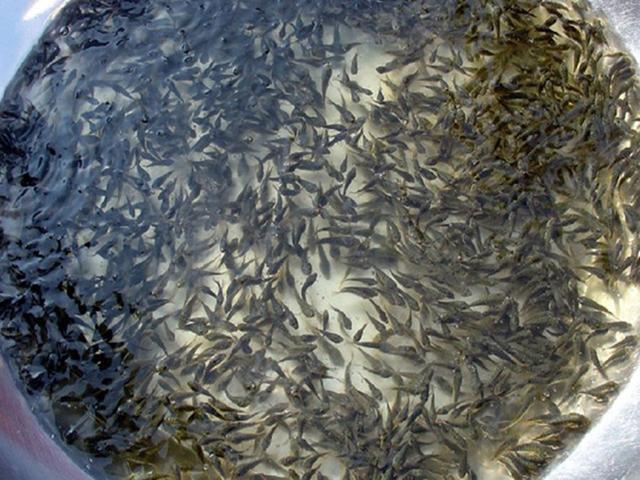
The "one sampling" means sampling to check the growth condition of the fish fry. The increase in body length and body weight of fish fry is generally corresponding. However, for the same species of fish under different rearing conditions, although the body length may be the same, the body weight may differ slightly, and especially in fish fry that have become thin after insufficient food or illness, the difference in body weight is even more striking. Therefore, the quality of fish fry can be identified based on the relationship between body length and body weight. Taking silver carp and grass carp as examples, high-quality fish fry with a body length of 8 cm number 37 per kilogram; high-quality fish fry with a body length of 10 cm number 25 per kilogram; high-quality fish fry with a body length of 13 cm number 10 per kilogram; high-quality fish fry with a body length of 17 cm number 5 per kilogram. Generally speaking, those whose ratio of body length to body weight conforms to the above standards are all high-quality fish fry; otherwise, they are low-quality fish fry.