A detailed guide to common freshwater ornamental fish keeping methods
Taisho Sanke
On an overall white base, adorned with red and black markings #A pure Taisho Sanke koi has a pure white base color#It must never contain other mixed colors#It should not appear amber yellow. Those with only clear red patches on the head#black spots only on the back#and black stripes on the pectoral fins are considered top grade#The black should be as jet black as ink#All markings should win by novel color, and the red patches on the head must not spread to the eyes, nose, or cheeks#It is best to have a white base behind the tail joint#The markings on the body should be evenly distributed left and right^The fins should not have red stripes. The head must not have black spots#but the shoulders must have them#This is the viewing focus of the entire fish. Black spots on the white base are called window black#black spots on red patches are called overlapping black#window black is preferred. Those with a few solid block-like black spots evenly distributed left and right on the white base are of higher taste. The rear half of the body must not have too many black spots.

Showa Sanke
On a black base there are red and white markings^and the base of the pectoral fins has black spotsTogether with Kohaku and Taisho Sanke koi, it is called the "Big Three"#and is a representative variety of koi. It was bred in Japan in Showa 2 (1927) by Hoshino Shigekichi by crossing Ki Utsuri koi with Kohaku koi.
The marking requirements for Showa Sanke koi are: the head must have large red patches#with even red quality#and clear edges^those with deep color are preferred. The white base should be pure white#those with white spots on the head and tail are of higher grade. Black markings with a break on the head are preferred#the black markings on the body must be lightning-shaped or triangularthick and large and curling to the belly. The pectoral fins should not be all white, all black, or have red patches.
The main types of Showa Sanke koi include Light Black Showa koi, Hi Showa koi, Kindai Showa koi, and German Showa koi, etc.
Bekko koi
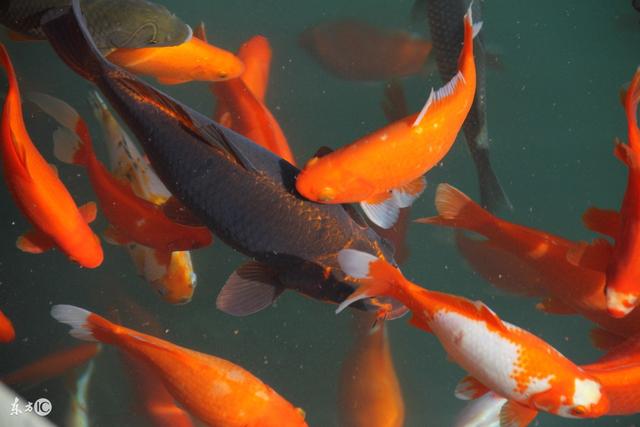
Black markings on a white, red, or yellow base#belonging to the Taisho Sanke koi system. Its main types include Shiro Bekko (Bekko) koi, Aka Bekko koi, Ki Bekko koi, and German Bekko koi, etc.
Utsuri koi
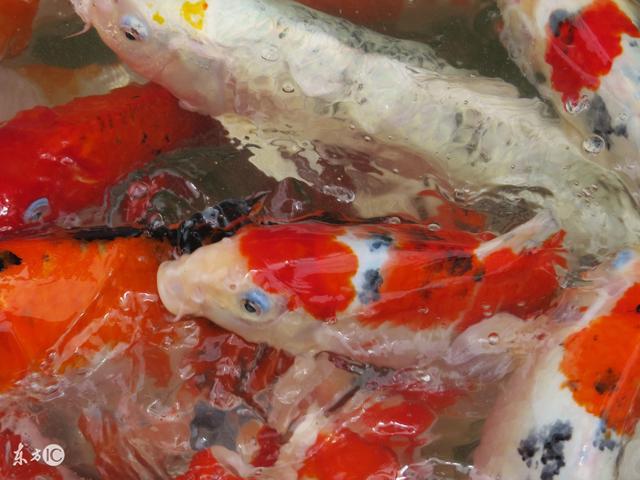
The characteristics of Utsuri koi differ somewhat depending on the variety. Shiro Utsuri koi has triangular white markings on a black base. The white base, like that of Kohaku koi#should be pure white. Ki Utsuri koi has triangular yellow markings on a black base. If the yellow of Ki Utsuri koi is deep#approaching orange-red#it is called Hi Utsuri koi. Ki Utsuri koi, Hi Utsuri koi, and Showa Sanke koi have the same requirements for the texture and pattern of black markings#the deeper the color the better#and the pectoral fins should have a beautiful stripe pattern.