If the watering method for orchids is wrong, they are prone to disease; these points must be noted
Orchids by nature prefer to grow in cool, moist environments. The so-called moist does not mean that a large amount of water must be poured into the soil, but rather that they should be given the necessary humidity for suitable growth. Orchid leaves are relatively thick, covered with a cuticle, and also have plump pseudobulbs and fleshy roots. Besides storing a certain amount of nutrients, they can also accumulate a certain amount of water to regulate themselves during brief dry periods, so they are not easily killed by drying out quickly. But if the soil is too dry, the pseudobulbs shrivel and other tissues lose water, affecting metabolism. If too much water is added, water accumulates in the soil, aeration is poor, the roots' air exchange is blocked, and water absorption is affected, easily causing root rot.
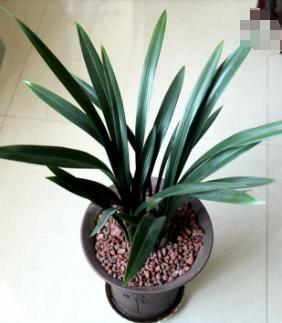
(1) Watering time. Generally speaking, in spring and autumn it is best to water in the morning; during the hot midsummer period, it is best before sunrise and at sunset; in early winter and early spring, watering can be done after the sun is at its zenith and the temperature has warmed slightly. During the period of moving indoors for the winter, watering must be done around noon on clear days, but care should be taken to avoid water droplets wetting the leaf surface or seeping into the leaf sheaths.
(2) Watering time. In summer and autumn, watering should be done early in the morning and in the evening. Watering early in the morning can avoid damage from sunburn, and when the temperature is low it releases moisture, which can lower the temperature inside the shed; watering in the evening can benefit nighttime growth. Never water at noon on a sunny day. If the water in the pot is already sufficient and the air is very dry, then it is enough to lightly spray the leaf surface in the morning and evening. In winter and early spring, watering can be chosen between 10 a.m. and 3 p.m.; the temperature in the morning and evening is too low, which more easily leads to nighttime cooling, harming the plant, and the water stagnates, even causing heart rot. For the winter-flowering Baosui orchid (Cymbidium sinense), watering in winter should be slightly more.
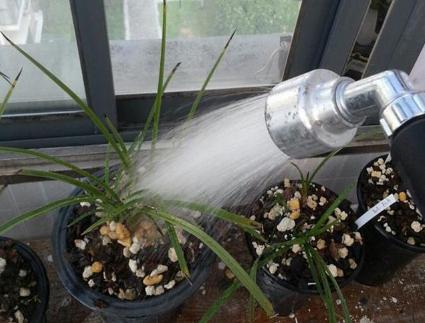
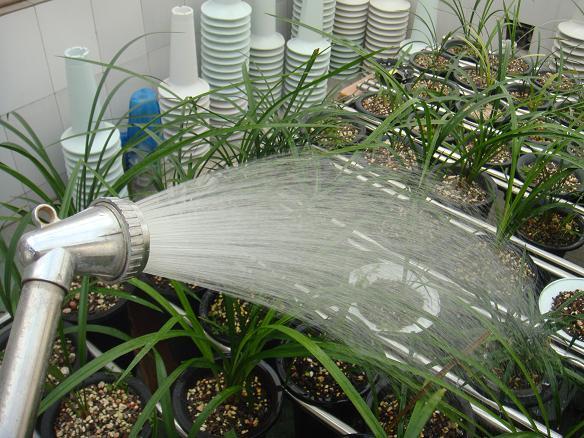
(3) Watering tools. A watering can with a long neck and a fine-holed nozzle is best, because this kind of can sprays out fine droplets, does not easily wash away the surface soil layer of the pot, and sprays a large and even area. When watering during indoor care, only a fine-mouthed watering can may be used, so as not to splash the leaves. In addition, if no Selaginella uncinata or moss cover is laid on the pot surface, then during routine watering, besides using a fine-holed nozzle watering can, the long neck spout should be brought close to the pot surface to water, or the water should be poured around a tile placed on the soil layer of the pot surface so that it spreads out; this can reduce the risk of the loose humus soil being washed away and exposing the roots.
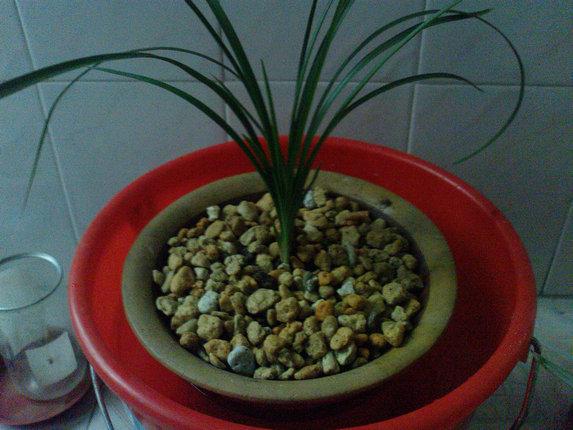
Besides watering with a spray can, there is also the immersion method. That is, immersing the orchid pot in water and letting the water slowly seep through the holes in the bottom of the pot into the soil layer. Although this method can make the soil in the pot absorb enough water, if it is a newly repotted orchid, it should not be immersed too deep; just up to the waist of the pot is enough. If it is too deep and reaches the pot surface, then due to water pressure, the new soil in the pot is easily floated up by the seeping water, causing the soil layer to loosen, and the roots cannot fit well with the soil. When it is taken out in a saturated state, although excess water can gradually drain out, the soil in the pot has already been loosened; at this time, the surface soil must be gently pressed firm with the fingers to make it more compact.
As many orchid-growing experts have said: "Spring prefers moistness, summer and autumn prefer slight dampness, winter must be moist with some dryness," which fully explains the principle of orchids' humidity requirements in different periods.