How to grow Portulacaria afra 'Medio-picta'? Full guide to care methods and things to note
Portulacaria afra 'Medio-picta' likes a sunny, warm, dry environment with good ventilation. It is drought-tolerant and dislikes damp shade and cold. Although it can grow normally under semi-shade and diffused light, the variegated colors on the leaves will fade and the distance between stem nodes will lengthen, making the plant loose and not compact, which affects its ornamental value. Today the editor will briefly introduce how to grow Portulacaria afra 'Medio-picta'.
Propagation methods
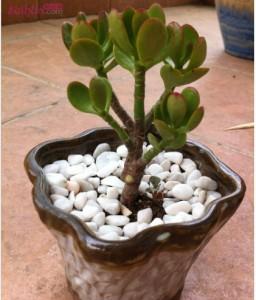
Portulacaria afra 'Medio-picta' is commonly propagated by cuttings or grafting. Cuttings are usually taken during the growing season. The cuttings can be branches trimmed off during shaping; there are no strict requirements on length, but they must have at least 3 to 4 pairs of leaves. Before planting, remove the lower leaves and let them dry for 1 to 2 days. Once the wounds are dry, insert them into potting soil and place them where there is no direct sunlight, keeping the soil slightly moist. They can root in 2 to 3 weeks. After the seedlings survive, apply dilute fertilizer frequently to make them grow vigorously. Once the plant grows to a certain size, shaping can begin. Grafting is also done during the growing season, using the original species Portulacaria afra (elephant bush) as the rootstock, grafted by cleft grafting.
Bonsai creation
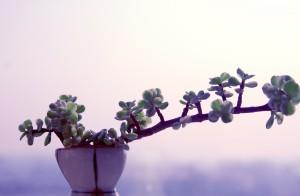
The shaping of Portulacaria afra 'Medio-picta' bonsai can be carried out by combining wiring and pruning. Common forms include the straight-trunk style, curved-trunk style, slanting-trunk style, cascade style, and waterside style. Because the stems are fleshy, do not let the wire cut into the epidermis when wiring, otherwise the fleshy stems will tear. Its branches are sparse and spreading, with long branches drooping slightly. The crown mostly adopts a natural style, elegant and graceful, with proper density, very distinctive. You can also take advantage of its small, dense leaves by pruning frequently to encourage small branches, training the crown into a compact triangular or bun shape. For Portulacaria afra 'Medio-picta' that has rooted from cuttings, you can lightly wire and prune it, plant it in a small pot, and pair it with ornamental stones to create a cute, exquisite miniature bonsai.
Management and care
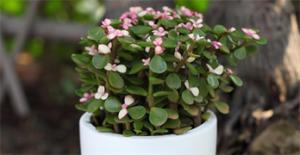
For daily watering, follow the rule of "do not water until dry, and water thoroughly when you do," avoid water accumulating in the pot, and do not leave it in the rain for long periods, so as to prevent root rot. During high summer temperatures, ensure good ventilation to prevent leaf drop and root rot caused by stuffy, humid conditions. During the growing season, apply a decomposed dilute liquid fertilizer or compound fertilizer about once every 20 days. After fertilizing, loosen the soil to increase its air permeability, which helps the roots absorb nutrients. During the growing season, prune branches that affect the tree shape at any time (the pruned branches can be used as material for cuttings or grafting), and promptly remove sprouting branches and leaves on the rootstock of grafted plants. In winter, move it indoors to a sunny place for care, control watering, and it can safely overwinter at around 10°C. Carry out shaping once every spring, cutting off branches that affect the tree's appearance and shortening overly long branches to encourage vigorous new branches and make the bonsai more attractive. Repot once every 1 to 2 years in spring. When repotting, cut off rotten roots and plant in fresh potting soil. The potting soil should be loose, fertile, sandy soil with good drainage and air permeability.
Apart from slightly shading it during high summer temperatures, it should receive as much sunlight as possible in other seasons. In summer, ventilation should be strengthened to avoid a stuffy, humid environment, otherwise root rot will cause leaf drop. In the peak growing seasons of spring and autumn, apply a decomposed dilute liquid fertilizer or compound fertilizer once every half month. Note that the nitrogen content in the fertilizer water must not be too high, so that the leaves do not contain too much green and fail to highlight the variety's characteristics. For daily watering, follow the rule of "water thoroughly after the soil dries out," and avoid long-term water accumulation in the pot. In winter, keep the potting soil dry, and it can safely overwinter at around 5°C. Because this species grows quickly, it needs frequent pruning and shaping, removing excess branches to maintain a graceful plant shape. According to its growth, repot once every spring. The potting soil should be loose, fertile, and have good drainage and air permeability. A common mix is 2 parts leaf mold, 2 parts coarse sand, vermiculite or perlite, and 1 part garden soil, mixed with a small amount of plant ash or bone meal as a base fertilizer, stirred evenly before use.
---------------------------------------
Flower-growing knowledge
WeChat: yanghua29
Flower-growing knowledge, questions and answers, solving flower-growing problems!