Standardized pearl mussel farming becomes a new benchmark for the green transformation of China's traditional fishery
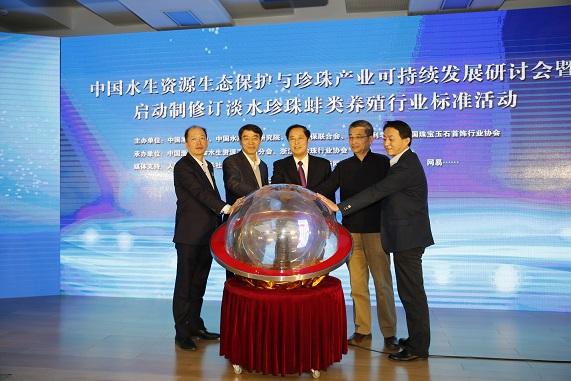
Recently, the "Symposium on Ecological Protection of China's Aquatic Resources and Sustainable Development of the Pearl Industry, and Launch of the Revision and Formulation of Industry Standards for Freshwater Pearl Mussel Farming," jointly organized by the China Fisheries Association, the Chinese Academy of Fishery Sciences, the All-China Environment Federation, the Chinese Hydraulic Engineering Society and the Gems & Jewelry Trade Association of China, was held at the Ministry of Agriculture. The event was hosted by the Aquatic Resource Handicraft Branch of the China Fisheries Association and the Zhejiang Pearl Industry Association. Chen Xiaohua, former Vice Minister of Agriculture and President of the China Green Food Association, Gui Jianfang, Academician of the Chinese Academy of Sciences, Zhao Xingwu, former Director of the Bureau of Fisheries of the Ministry of Agriculture and President of the China Fisheries Association, and other relevant leaders, together with heads of relevant fishery research institutes, experts in fisheries and malacology, heads of government management departments from key pearl mussel farming provinces across the country, and representatives of some farmers, totaling several hundred people, attended this grand event.
Up to now, China's freshwater pearl output accounts for more than 95% of the global total, with an annual output value of more than 20 billion yuan, making it a national industry with extremely strong advantages. In today's era of global economic integration, Chinese freshwater pearls are already one of the most internationally recognized types of jewelry. In particular, at the Beijing Olympics, the Shanghai World Expo and the G20 Hangzhou Summit, Chinese pearl products were all on the list. At the same time, there are ten large pearl-related markets nationwide, including Zhuji in Zhejiang, Weitang in Jiangsu, Duchang in Jiangxi and Hanshou in Hunan, all of which regard the pearl industry as a local specialty or pillar industry. According to incomplete statistics, the total number of people employed in China's pearl mussel farming, processing and sales industry has approached 10 million, making it a specialty industry with broad reach and a large workforce.
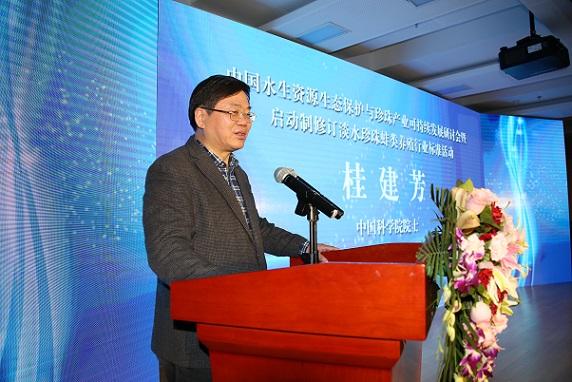
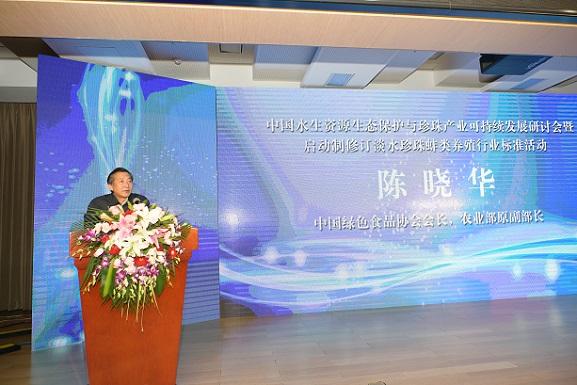
It is understood that against the current backdrop of the state's vigorous implementation of environmental protection, pearl mussels, like other traditional aquaculture industries, have encountered development bottlenecks. The extensive farming model of a small number of farmers has affected the image of the entire industry, while in fact pearl mussels, like other shellfish, have a water-purifying effect. Research shows that one adult freshwater mussel can filter more than 100 liters of water per day, and by filter-feeding on suspended particles in the water, it can effectively reduce the content of ammonia, nitrogen and phosphorus in water bodies and effectively improve water quality. Chen Xiaohua, former Vice Minister of Agriculture, pointed out at the meeting that "the event held by the fisheries association this time is very necessary and very timely. It has grasped the demands of the industry and closely followed national policy. Our agricultural transformation and upgrading requires one industry, one sector, to transform, and requires the research and development of one product, one category." Gui Jianfang, Academician of the Chinese Academy of Sciences, also mentioned at the meeting that "the pearl mussel itself is a good species for purifying and cleaning water. We should make full use of its characteristics and give play to its functions in the process of building a Beautiful China. This will drive the industry to develop in a more civilized direction."
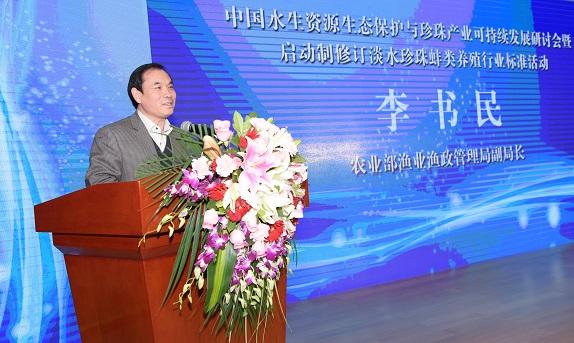
As a small part of China's traditional fishery aquaculture, pearl mussel farming has taken the lead in launching an aquatic resource protection project within the industry, precisely to actively respond to the national call that "lucid waters and lush mountains are invaluable assets." At the meeting, Zhao Xingwu, President of the China Fisheries Association, said that "as one of the species in aquaculture, mussels have played an important role in ensuring food security, purifying water with mussels, expanding employment, driving structural adjustment in fishery areas, promoting fishermen's income growth, enhancing fishery efficiency and advancing regional economic development. In particular, they play a uniquely irreplaceable role in promoting the development of the pearl industry. When mussels thrive, pearls thrive; when mussels are strong, pearls are strong; when mussels develop greatly, pearls contribute greatly. This has become an indisputable fact." Data from relevant research reports point out that the national pearl mussel farming area is nearly 300,000 mu, with about 800 pearl mussels farmed per mu, and the mussels farmed nationwide can purify about 12 million tons of water per day. This is an extremely vast natural water purification system. Li Shumin, Deputy Director of the Fisheries Bureau of the Ministry of Agriculture, said in his speech that "we can combine this characteristic of pearl mussels with water environment governance. At present, pond recirculating aquaculture and raceway aquaculture are being promoted on a large scale. Using pearl mussels to filter water and combining this with local government efforts to treat eutrophic water can form a sound development path that both drives farmers' employment and promotes environmental governance."
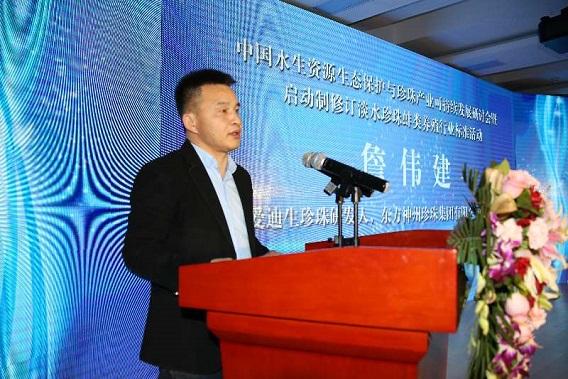
It is also understood that the meeting simultaneously launched the revision and formulation of standards. The China Fisheries Association will organize experts from the National Aquaculture Standardization Technical Committee and relevant departments such as environmental protection, as well as representatives of farmers, to form an expert group for revision and formulation. The next step will be to carry out visits and investigations in key farming provinces across the country, and, in response to current development needs and environmental protection requirements, revise and formulate new industry standards for freshwater pearl mussel farming that conform to green and environmental protection requirements, and establish a long-term mechanism for pollution control in pearl mussel farming. On the basis of revising and formulating new national industry standards, effective methods will be explored for industry associations to coordinate with relevant local functional departments, and to supervise the implementation of the new industry standards for freshwater pearl mussel farming that conform to green and environmental protection requirements. It is planned to implement declaration, approval and licensed farming for pearl mussels, establish an exit mechanism for those failing to meet standards, and implement effective measures such as a farm director responsibility system and one file per farm.
The meeting also brought together the largest farmers from seven key pearl mussel farming provinces across the country. Among them, Zhan Weijian, developer of Edison Pearls and Chairman of Oriental Shenzhou Pearl Group Co., Ltd., said at the meeting that "we have the determination and the confidence to carry out self-regulation and self-supervision, and we can resolutely implement national and local laws and regulations, crack down on farming without approval and the practice of indiscriminately dumping poultry and livestock manure. If any such case is found and reported, it will be resolutely banned." He also said that while developing the pearl industry, we are even more willing to incorporate pearl mussel farming into local pollution control measures, so that pearl mussel farming receives the same policy support as other aquaculture. By releasing pearl mussels into eutrophic rivers and ponds, we can promote local economic development and help farmers increase their incomes and become prosperous, while at the same time making a contribution to the nation's beautiful environment.