What to Do When a Flowerhorn Cichlid Gets Sick? Years of Breeding Experience and Exchanges with Tropical Fish Hobbyists
The following are the situations encountered and solutions for raising tropical flowerhorn cichlids
Flowerhorn cichlids have a large bulge on top of their heads, a peculiar body shape, and captivating body colors, which has earned them many people's affection.
When raising flowerhorn cichlids, the most important things are to change the water frequently, change the filter cotton frequently, and feed on a fixed schedule.
The principle of keeping them is that you must never be lazy. Observe the fish's behavior and activities regularly, learn about the flowerhorn cichlid's living habits, and understand the diseases it is prone to.
Hello fish hobbyist babies
Here comes the editor
Recently, many fish hobbyist babies
left messages for the editorsaying their little flowerhorn has "gotten sick"
Today the editor will share several common cases of flowerhorn illnesses
with you fish hobbyist babies
Of course, each flowerhorn's symptoms
may be different
We hope you fish hobbyist babies will speak up and comment enthusiastically
to provide advice for flowerhorn cichlid keepers everywhere
A: Editor, why won't my little flowerhorn baby eat?
B: Anorexia: It is caused by the stress a flowerhorn feels from adapting to a new environment or from environmental changes; or when the food doesn't suit its taste, or when it is sick, the flowerhorn cichlid will show symptoms of anorexia. Prevention and treatment: When switching to a new tank or changing the environment, your beloved flowerhorn will be restless at first, so do not feed it for one or two days; flowerhorns need a period of adaptation when switching food, so you can fast it for a few days first and then feed the new food; or mix the new food together with the old food when feeding.
A: My little flowerhorn baby has white spots on its body?
B: White spot disease: This is a common disease that troubles fish. Poor water quality, drastic changes in the aquarium environment, plus the weakened resistance of a flowerhorn that has just arrived in a new environment, can easily lead to infection by white spot parasites. Prevention and treatment: Use a heater tube to raise the water temperature to 30°C to kill the pathogens; add methylene blue solution to the water for a medicated bath; you can also add an appropriate amount of salt to the water for a salt bath treatment.
A: There are holes in the bulge on the flowerhorn's head?
B: Hole-in-the-head disease: It is mainly caused by nutritional deficiency and by the harm from parasites such as tapeworms, capillary worms, and hexamita. Prevention and treatment: You can improve the nutrition in the food and strengthen the supply of vitamins and other nutrients; if the flowerhorn cichlid is seriously ill, you can use antiprotozoal medication for deworming treatment. Of course, the dosage of the medication should be determined according to the doctor's instructions.
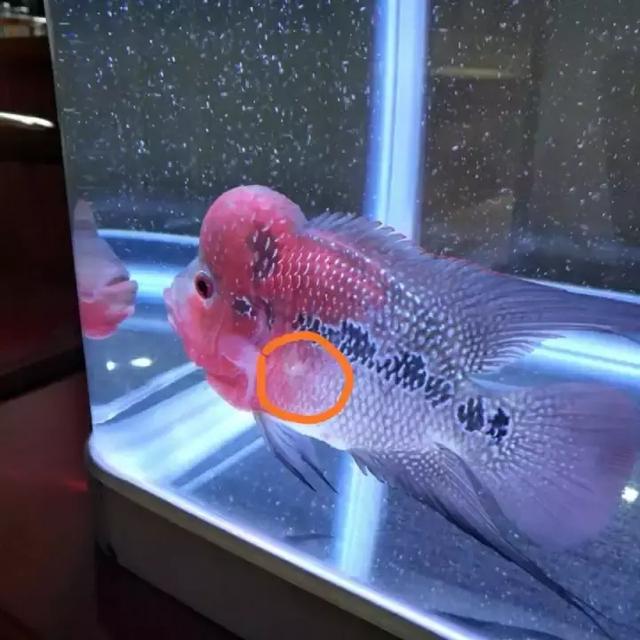
Fish hobbyist babies, pay attention
On the gill area of the little flowerhorn baby
there is a yellow sticky substance
This is a very serious matter for a little flowerhorn
The editor discussed it with fellow fish hobbyist babies for a long time
and temporarily calls it gill rot disease
Gill rot disease
The root cause of gill rot disease is actually still the water quality. So when you find that a fish has gill rot, you should immediately replace the water with new water and add salt. If there are parasites, it is best to use a mixed medicated solution of nitrofurazone and tetracycline for a medicated bath. The dosage and duration of the medicated bath must be well controlled. Generally, one medicated bath lasts half an hour, once a day. The medicated bath should use a separate basin or tank, and after the bath, return the fish to the original tank.
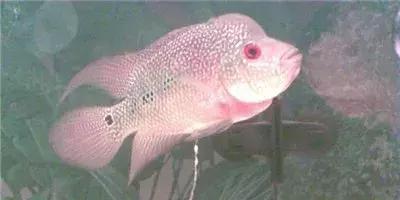
Attention, fellow fish hobbyist babies
This fish has a typical case of ascites disease
Ascites disease
This disease is called the "cancer" of fish. You can use oral antibiotics for treatment, and then adjust the water temperature environment to 30°C; you can also apply a fungicide to the wound or drip an appropriate amount of methylene blue medicated liquid into the water for treatment.
Handle specific situations on a case-by-case basis
Even when a person has a cold, there are times when medicine doesn't work and they must get an injection!
Every fish has a different constitution
So the treatment methods are for reference only