The Complete Guide to Ring-Necked Pheasant Farming, from Beginner to Expert

Many friends who grew up in rural areas have surely eaten pheasant, and the taste in one word - delicious! The pheasant, also known as the wild pheasant, was actually first introduced into our country from Nevada in the United States. More than ten years of farming practice at this farm from 1985 to the present shows that the Ring-Necked Pheasant is the easiest to raise, simplest to manage, most disease-resistant, and has the largest market among rare poultry breeds - an excellent rare poultry breed that has already become widely popularized throughout both northern and southern parts of our country. In the south, the American Ring-Necked Pheasant has the elegant names of Dragon-Phoenix Bird and Phoenix Bird; its feathers are beautiful and its body is large. After three and a half months of rearing, the chicks can reach a weight of 3 jin for males and 2-2.5 jin for females, at which point they can be sold on the market, with a feed-to-meat ratio of 3.5:1. At a market price of 15 yuan per kilogram, each pheasant can yield a profit of about 10 yuan. Under normal conditions, they can lay eggs and reproduce at 6 months of age, with an annual egg production of 130 eggs, which is 10 times the egg production of the Ring-Necked Pheasant of Northeast China. The American Ring-Necked Pheasant has broad adaptability, and rearing methods can be varied; the most commonly used is indoor confinement. For market pheasants, the indoor lightless intensive rearing method can be used; for egg-laying breeding pheasants, indoor group free-range rearing, combined indoor housing with outdoor shed, or multi-tier cage rearing can be used, with the same rearing results. The feed is the same as for domestic chickens; either complete pellet feed for domestic chickens or self-mixed feed can be used, and feed can also be self-formulated. Market pheasants are stocked at 4 per sq m, and egg-laying breeding pheasants at 1-2 per sq m. As long as appropriate environmental conditions are met, the American Ring-Necked Pheasant can lay eggs and reproduce year-round.
1. Food value:Pheasant meat is tender and delicious with a strong game flavor. Its protein content is as high as 30%, which is 2 times that of ordinary chicken and pork, while its fat content is only 0.9%, which is 1/39 of pork, 1/8 of beef, and 1/10 of chicken. It basically contains no cholesterol (see table below), making it a high-protein, low-fat game food. Because of this, pheasant became a royal tribute through the dynasties. After eating it, Emperor Qianlong of the Qing Dynasty was full of praise and wrote the famous line: "Its fame shakes the northern frontier for three thousand li, its flavor surpasses the twelve towers of Jiangnan." Ye Xuanping, Vice Chairman of the National Committee of the Chinese People's Political Consultative Conference, evaluated it after eating: "Good-looking, good-tasting, with a game flavor." The famous nutritionist Yu Ruomu also gave high praise to the nutritional components of pheasant. Sending pheasant as a gift is a high-grade present, and serving it to guests is a rare game dish; it is also a reserved dish at the White House in the United States for entertaining heads of state. Precisely because of this, every year around the Spring Festival, a wave of pheasant gifting sweeps the market.
2. Medicinal value:The Compendium of Materia Medica records: pheasant supplements qi and blood; eating it makes people intelligent, brave, strong, and plump; it stops diarrhea and dysentery, and eliminates chronic diseases and panting of the five organs. According to determinations by Sun Yat-sen University of Medical Sciences in Guangzhou: it contains as many as 21 kinds of amino acids essential to the human body, many of which cannot be synthesized by the body itself, conforming to the amino acid pattern stipulated by the World Health Organization. It is also rich in germanium, selenium, zinc, iron, calcium, and other trace elements essential to the human body, and has good therapeutic effects on child malnutrition, anemia in women, postpartum weakness, uterine prolapse, stomach pain, neurasthenia, coronary heart disease, cor pulmonale, and more. Its nourishing function for the human body is far higher than that of the long-renowned soft-shelled turtle and eel. The content of strontium and molybdenum in pheasant is 10% higher than in ordinary chicken, and it also has a role in preventing and treating cancer.
3. Ornamental value:Giving pheasant as a festival gift is a tradition in our country since ancient times, expressing wishes for good fortune and a bright future. At the same time, it can also be made into beautiful and highly sellable specimens. The specimens made from pheasant skins and feathers by our farm are brightly colored, lifelike, noble, and elegant; each sells for more than 200 yuan and still sells well in craft gift shops and tourist attractions in major cities. Pheasant feathers are uniquely distinctive and can also be made into feather fans, feather paintings, toys, and other handicrafts. The UK Ministry of Defence even used them to make the most effective bulletproof vests.
Artificial rearing techniques for pheasants
The Ring-Necked Pheasant is a high-protein, low-fat food, delicious and tender, and rich in nutrition; its feathers are colorful and beautiful, and its comprehensive economic value is also relatively high. Each female pheasant can lay 59-70 eggs per year, and each female pheasant produces 40-55 chicks per year. If, for example, a group is formed at a male-to-female ratio of 1:4, a group of 4 female pheasants produces 160-200 chicks per year, and one laborer can raise 10-20 groups of breeding pheasants in their spare time.
Hatching of breeding eggs:
Breeding eggs must be disinfected before incubation. Place the breeding eggs in 0.5% potassium permanganate solution and wash them, then remove them and let them dry before putting them into the incubator for hatching. But before incubation, the breeding eggs should first be preheated indoors at 20°C-24°C for 4-6 hours. During the incubation process, temperature and humidity must be strictly controlled. For the first 7 days, the temperature is 37°C-38°C, and the relative air humidity is 55%-60%; for the middle 10 days, the temperature is 37°C-37.5°C, and the relative air humidity is the same as in the earlier stage; for the final 4 days, the temperature is 37°C, and the relative humidity is 75%. Air circulation must be maintained, eggs turned once every 2 hours, eggs aired once daily (10 minutes), and eggs candled in a timely manner to remove infertile or dead-embryo eggs. One hour after the chicks hatch, give them one feeding of penicillin water to cleanse the digestive tract, with 800 units of penicillin per milliliter.
Brooding management:
Temperature, lighting, density: The brooding temperature should gradually decrease as the chicks age in days. At 1-3 days of age it is 35°C-34°C, and from 4-10 days of age it decreases by 0.5°C per day. From 11-28 days of age it drops to a normal temperature of 28°C. At 1-3 days of age, light is provided day and night, using one 25W bulb per 7 sq m, continuing until 30 days of age, but the lighting should be gradually reduced, after which natural light can be used. Rearing density is 50-60 birds per sq m at 1-10 days of age, 20 birds at 11-30 days of age, and then adjusted as the birds age.
First feeding:
Once the chicks have shed their shells and their down is dry, they must be moved into the brooding room or brooding box for rearing. At this time, although the chicks have pecking motions, they cannot peck accurately and do not recognize feed. To induce the chicks to recognize feed, tear red and green paper into scraps and put them into a glass bottle, place the bottle in the middle of the feeding tray, and scatter feed around the bottle. When the chicks see the dazzling things in the bottle, some will run over and peck randomly. When they accidentally peck the food in the feed tray, they will swallow it. As long as a few start, the whole group of chicks will approach the feed tray and imitate them. After 2-3 days of such inducement, they will find food on their own. At 1-20 days of age, feed 6-7 times daily; at 21-30 days of age, feed 5-6 times; at 31-60 days of age, feed 4-5 times. When feeding, feed frequently and add little at a time, and also keep the feed in the feeding tray clean and hygienic.
Brooding methods:
1. Heated kang brooding: A heated kang can be set up according to environmental conditions, with a nylon net used as a surrounding fence. The mesh size should be such that chicks cannot squeeze out. Lay wire mesh 16 cm from the kang surface, preferably with 0.5 cm mesh. This brooding method keeps chicks from contacting feces and can prevent coccidiosis and other diseases. 2. Cardboard box net-pen brooding: For small rearing numbers, chicks can be raised in packaging cardboard boxes placed above the heated kang, but temperature control must be paid attention to. When the chicks can run, net pens can be used for rearing to prevent escape. 3. Floor brooding: Spread a layer of chopped short straw on the floor, but be careful to replace it and always keep the air flowing, fresh, and clean. Use heating or underground flues to raise the temperature and keep warm.
Daily ration formulation for chicks:
At 1-20 days of age, use 60% cooked eggs, 13.5% cornmeal, 16% roasted soybean powder, 3% bran, 1% bone meal, 0.5% salt, 2% yeast powder, 3.5% poultry growth hormone, 0.5% poultry multivitamins, and an appropriate amount of chopped green leafy vegetables. This formula is equivalent to the nutrition of natural live food obtained by foraging.
Rearing of growing pheasants:
Generally, pheasants at 3-4 months of age are growing pheasants. During this period, feed formulation should be done well to promote rapid growth and development. At 90-120 days of age, the Newcastle disease strain I vaccine should be injected. Because pheasants are very sensitive to drugs, the dosage should be slightly less than for domestic chickens to prevent side effects. Set up shade sheds inside the net enclosure to prevent rain and scorching sun.
Outdoor net-enclosure rearing:
The net enclosure is 2.5 m high. Use nylon netting or wire mesh with 2×2 cm or similar mesh to build an arched net enclosure. The width of the chicken house or net enclosure should be determined according to the rearing quantity. The site should be chosen in a ventilated, dry place that can block cold and wind, and it is even better if there is tree shade around. When temperatures are high, the net shed needs shading to prevent heatstroke. Feeding troughs and waterers are set inside the net enclosure. When entering the net enclosure, the keeper should wear plain-colored clothing and must not wear bright red or green floral clothes, because pheasants will panic and fly about when they see them. Around the inside of the net enclosure, perches 0.5 m high and 0.4 m wide should be set up for pheasants to rest on, with soft grass placed beneath for the birds to shelter on at night. Males and females should be raised separately, and kept together in the same pen during the laying period.
Feed formulation for growing pheasants:
1. At 30-60 days of age, use 50% cooked fish, 20% cornmeal, 14% cooked soybean powder, 8.5% bran, 2% bone meal, 0.5% salt, 2% yeast powder, 2.5% poultry growth hormone, and 0.5% poultry multivitamins; 2. At 60-120 days of age, use 5% cooked pork, 15% cooked fish, 38% cornmeal, 14% soybean cake powder, 4% fish meal, 2% yeast powder, 3% bone meal, 15% green leafy vegetables, 0.5% salt, and 0.5% poultry multivitamins. With the above 2 formulas, growing pheasants grow and develop well, gain weight quickly, and reach market earlier. If ingredients are inconvenient to prepare during rearing, you can refer to the formula for raising domestic chickens and mix and feed according to proportion.
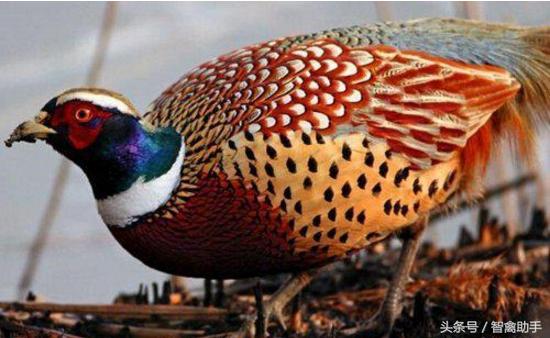
The Ring-Necked Pheasant is named for its colorful feathers. Pheasant meat is delicious and rich in nutrition, containing many amino acids essential to the human body and trace elements such as calcium, sodium, and sulfur. The gallbladder, blood, and gizzard lining of pheasant can be refined into pharmaceutical preparations, with extremely high nourishing, medicinal, health-care, and beauty value. Male pheasant feathers can be made into feather handicrafts and can also be woven into satin and brocade to make formal attire, and pheasant skin can be made into various exquisite leather goods. Pheasants are omnivorous: they can be fed rice bran, wheat bran, various vegetables, paddy rice, sorghum, corn, fly maggots, and more, similar to domestic chickens.
Strong adaptability: Pheasants tolerate high temperatures and resist severe cold. The rearing benefits of pheasants are relatively good, but there are more and more farmers, so in developing pheasant farming now, one should start from improving quality, reducing costs, and opening up broad sales channels in order to remain invincible. The rearing techniques for Ring-Necked Pheasants are as follows: I. Chick rearing techniques
1. Timely drinking water and first feeding: Chicks should be given their first feed 24-36 hours after hatching. Before first feeding, they should first drink water, and it is best to add 5% glucose or 0.1% potassium permanganate to the drinking water. For chicks that do not know how to drink, promptly train them so they drink as soon as possible, and give first feed 1-2 hours after drinking. The first feed should be soft, palatable, nutritious, and easy to digest, and it is best to feed moist mixed feed for the first 3-5 days. Remove leftover feed before each addition of feed. During first feeding, lure them to eat once every 2-3 hours, then gradually increase the interval. At 0-2 weeks, feed 6 times daily; at 3-4 weeks, feed 5 times daily. Generally, as the birds age, feed intake also increases, and when they grow close to adult body weight, the feed requirement tends to stabilize.
2. Temperature and humidity regulation:The suitable brooding temperature is: 1-3 days of age 35-34°C, 4-7 days of age 33-32°C, 2 weeks of age 31-28°C, 3 weeks of age 27-24°C, 4 weeks of age 23-22°C, and after 5 weeks of age maintain normal temperature. Relative humidity is 65%-70% at 1-10 days of age, and 55%-65% after 11 days of age.
3. Density: As the birds age, their body weight and water requirements also change accordingly, so rearing density should be adjusted in a timely manner, and the number of waterers and feed troughs increased. When using net cages for floor rearing or box-type brooding, the density is: 1-10 days of age 50-60 birds per sq m, 10-20 days of age 30-40 birds per sq m, after which they can be transferred to multi-tier cages (4-tier cages for brooding egg-type pheasants), 21-42 days of age 20-30 birds per sq m, and 43-60 days of age 10-20 birds per sq m.
4. Ventilation and indoor environmental control:Poor indoor air circulation and excessive ammonia concentration will directly affect the growth and development of pheasants and can induce chronic respiratory diseases, eye diseases, and other illnesses. Ventilate frequently to keep indoor air fresh, clean feces and sweep the floor in a timely manner, maintain suitable temperature, disinfect regularly with the birds present, and disperse density in a timely manner. Doing a good job of the indoor environment is one of the important measures for increasing the survival rate of chicks.
5. Control of lighting time:Chicks are not very strict about lighting requirements. For newly hatched chicks at 1-3 days, maintain 24-hour lighting; at 4-7 days, maintain 20-22 hours of lighting; after that, switch to natural light according to the chicks' feeding conditions. When transferring to multi-tier cages at around 3 weeks, full lighting should be added on the first night so the chicks can adapt to the new environment as quickly as possible. It is advisable to use 3 watts per sq m. After most of the flock has eaten and drunk, natural light can be used.
6. Immunization:Develop a good immunization program according to the farm's own situation.
II. Rearing techniques for adult pheasants. After 6-7 weeks of cage rearing, chicks can be transferred to floor rearing or to growing-pheasant cages. The period up to 18 weeks of age is the stage of fastest growth and development for pheasants, with an average daily gain of 10-15 grams. By 20 weeks of age, they are basically close to adult pheasant body weight. Therefore, the 6-20 week age stage of rearing, management, and feeding is the key to ensuring the growth and development of growing pheasants. While doing all routine management tasks well, the following points should also be noted:
1. Transfer time and points to note: Generally, chicks hatched from late March to mid-April are transferred at 6-8 weeks of age, while chicks hatched in summer can be transferred at 5-6 weeks of age. Three days before transfer, a designated person should be assigned to night duty and provide 24-hour lighting. During transfer, weak chicks should also be separated and raised, and sick or disabled chicks culled in a timely manner. For 1-2 weeks after transfer to the floor, choose warm, windless weather, open doors and windows, and let them move briefly in the indoor-outdoor exercise area, then gradually extend the time, driving them indoors at night.
2. Restricted feeding of reserve breeding pheasants: For growing pheasants determined to be kept for breeding, in addition to preliminary selection at 6-8 weeks of age, body weight must also be controlled to prevent excessive fatness, so as to ensure a higher egg production rate and fertilization rate during the breeding period. Specific measures are: reduce the protein and energy content in the daily ration; increase the amount of crude fiber and green feed; reduce feeding frequency; increase exercise; and restrict feed intake, etc.
3. Second beak trimming to prevent pecking vice: Pheasants have a relatively strong wild nature and like to peck foreign objects. Growing pheasants grow rapidly, and if certain nutrients are deficient during this period, or the environment is not ideal, or the density is too high, pecking vice is even more likely to occur. To effectively prevent pecking vice, a second beak trimming can be carried out between 5-10 weeks of age, using the same method as beak trimming for domestic chickens.
4. Prohibit moldy and spoiled feed to prevent aspergillosis: Growing pheasants in the early stage are susceptible to Aspergillus, and the morbidity and mortality of this disease are relatively high. Therefore, in rearing and management, attention should be paid to prohibiting moldy and spoiled feed and moldy bedding, controlling the housing environment well, maintaining the required humidity, frequently disinfecting with peracetic acid and the like with the birds present, and before transfer burning the floor and burnable equipment with a flame sprayer to prevent the occurrence of this disease.
III. Breeding techniques
1. Establishment of the breeding pheasant flock. The establishment of each breeding pheasant flock generally undergoes more than 2 selections: the 1st selection is conducted from October to November each year, strictly selecting according to breed standards, growth and development, and health conditions to form the reserve flock; the 2nd selection is conducted from January to February of the following year, with selection standards: male pheasants have full and bright feathers, upright feather bundles, broad and deep chests, large bodies, sturdy builds, and strong masculinity; female pheasants have upright bodies in an oval shape, tightly attached and glossy feathers, tails that do not touch the ground, and no defects in the legs and eyes. If conditions permit, a 3rd selection can be conducted at the end of February and the beginning of March, removing individuals that do not conform to breed characteristics or have weak masculinity, poor mental state, or females whose faces are not red by early March or whose tails drag on the ground. At this point, after 2-3 rounds of selection and culling, the breeding pheasants can be determined.
2. Breeding techniques for pheasants
① Pairing month and years of use: Under good artificial domestication conditions, male pheasants generally reach sexual maturity at 9-10 months of age, and females are slightly later, reaching sexual maturity at 10-11 months of age. If the breeding season has already arrived, timely pairing can be considered. In the northern part of our country, pairing is generally around mid-March, while in the southern part, it is generally in early February. Breeding farms generally replace breeding pheasants once a year, but the death-and-culling rate of the same flock of breeding pheasants in the 2nd year is significantly lower than in the 1st year of use. Egg production and fertilization rate do not change much.
② Flock size and male-to-female ratio: During the breeding season, pheasant flocks should not be too large; generally 100-150 birds form one flock, and barriers to block sightlines should be set between flocks to avoid affecting mating. Under ordinary nutrition and management levels, the male-to-female ratio can be set at 1:4, at which the fertilization rate can reach more than 85%. With high feed nutrition and management levels, the number of female pheasants paired with each male pheasant can be appropriately increased, changing the ratio to 1:5-1:6.
③ Timely pairing for mating: The determination of pairing time must consider factors such as temperature, breeding season, and nutrition level. Pheasant flocks with good growth and development can be paired slightly earlier, while breeding pheasants in poor condition can be delayed. The timely pairing time can also be determined through a trial pairing method: first place 1-2 male pheasants into the female pheasant flock and observe whether the females are willing to "accept pairing." Practice has proved that the pairing time should be determined by the females' behaviors such as crowing, reddening of the face, or nest-building. Pairing too early not only affects the survival rate of the breeding pheasant flock, but also promotes premature aging of male pheasants and affects the fertilization rate of eggs later on, while pairing too late causes waste of breeding eggs.
④ Protecting the "prince pheasant" and setting up barriers: After male pheasants enter the female pheasant flock, after several days of fighting, a "prince pheasant" emerges, and the "prince pheasant" enjoys priority mating rights in the female pheasant flock. After the pecking order of the male pheasant group is established, new male pheasants must not be added at will, in order to maintain the status of the "prince pheasant," reduce physical exertion, and stabilize the flock. However, the "prince pheasant" has the characteristic of not allowing other male pheasants to mate, so barriers should be set up within the net or on the exercise ground; for example, 3-4 plastic tiles per 100 sq m, or piles of branches, or rockery stones, to increase egg production rate and fertilization rate.
IV. Breeding pheasant rearing techniques. Pheasant reproduction is seasonal. In northern regions, the breeding season is from March to July each year, while in southern regions it may be 1-1.5 months earlier. Generally, adult breeding pheasants are divided into two stages, the breeding period and the rest period, and different management is adopted.
① Pheasants entering the breeding period require rich nutrition, especially an adequate supply of animal protein feed. After laying begins, as egg production increases, gradually increase the protein content. During the peak laying period, the crude protein content in the feed can reach 18%-20%. While increasing protein content, attention should also be paid to appropriately increasing the content of multivitamins and trace elements.
② Because pheasants have been domesticated for only a short time and have a relatively strong wild nature, both male and female pheasants have the bad habit of pecking eggs, and females also have the characteristic of not having a fixed laying location, resulting in a relatively high rate of broken eggs. Therefore, eggs should be collected frequently, and any broken eggs or leftover eggshells should be promptly cleaned out of the pen to prevent the spread of egg-pecking vice.
③ Maintain good and stable environmental conditions and achieve the "three fixeds," namely fixed personnel, fixed timing, and fixed management procedures. When entering and leaving the pheasant house, movements should be gentle, and the net enclosure should be frequently inspected and repaired to prevent wild animals from frightening and disturbing the pheasant flock; in hot summer weather, build sheds or plant climbing vines such as loofah and beans beside the net enclosure for shade, to avoid direct sunlight and ensure normal sexual activity and mating frequency of breeding pheasants.
④ Breeding pheasants mostly lay eggs between 10 a.m. and 3 p.m., accounting for about 86.7% of the whole day's egg production. Normal egg laying lasts 0.5-5 minutes per egg. First-time laying pheasants occasionally experience difficult labor, and keepers should pay attention to the dynamics of the pheasant flock and provide timely assistance when difficult labor is found. The method is: first drip lubricant, glycerin, etc. into the cloaca, then fix the two sides of the egg with the left hand, press the abdomen forward with the right hand, and help remove the egg. Movements must be gentle, and this work requires two people to complete. Because the cloaca of first-time laying females carries blood, and other pheasants will peck the anus after seeing red, the flock must be observed at all times, and measures taken promptly, applying gentian violet or black ink to the bleeding area, or raising the bird separately.