A Detailed Explanation of the Mysteries of Dissolved Oxygen in Aquaculture
In the process of farming whiteleg shrimp (Litopenaeus vannamei), the chemical indicators and physical properties of water quality are usually expressed through physical and chemical factors such as dissolved oxygen, pH value, ammoniacal nitrogen, hydrogen sulfide, nitrite, salinity, water color and transparency. Changes in these indicators and properties directly affect the growth, yield, quality and profitability of the shrimp. The level of dissolved oxygen has an important effect on shrimp growth and directly affects the feeding and growth of the shrimp. Dissolved oxygen is an essential substance for ensuring normal and healthy growth of shrimp, and at the same time it plays a leading role in regulating the oxidative decomposition of numerous substances in the water environment; it is an essential substance for improving water quality and bottom sediment. During shrimp farming, dissolved oxygen in the bottom water should not be lower than 4 mg/L, and is best kept above 6 mg/L. Insufficient dissolved oxygen in the water can reduce the shrimp's mobility, decrease appetite, increase the feed conversion ratio, weaken body condition and increase disease; at the same time, insufficient dissolved oxygen promotes the production of harmful substances such as ammoniacal nitrogen, nitrite and hydrogen sulfide in the pond water and increases their toxicity, and in severe cases can cause mass mortality of the shrimp. Therefore, monitoring and regulating dissolved oxygen is the central link in shrimp farming management.
1 The relationship between dissolved oxygen and shrimp farming production
1.1 The level of dissolved oxygen content in the water body affects the products of organic matter decomposition
(1) When dissolved oxygen in the water body is sufficient, organic matter is decomposed at a relatively fast rate under the action of aerobic bacteria, and the decomposition products are CO2, NO3-, PO43-, H2O and other substances that are harmless to the farmed shrimp and beneficial to the growth of aquatic plants.
(2) When dissolved oxygen in the water body is insufficient, anaerobic bacteria in the water layer or bottom layer multiply and dominate; they decompose organic matter at a slower rate, and their decomposition products are mostly substances toxic to shrimp (such as H2S, NH3, CH4). When dissolved oxygen is insufficient, denitrification occurs in the water body and NO3- disappears, the concentration of NH3 increases, and the reduction reaction of SO42- ions produces H2S. At the same time, anaerobic conditions accelerate the release of phosphorus and ammoniacal nitrogen from the bottom sediment, slow down oxidative decomposition, and slow the degradation of pollutants in seawater. This in turn causes shrimp mortality and produces the problem of bottom exhaustion.
1.2 A decrease in dissolved oxygen in the water body affects the growth and development of the farmed shrimp and the shrimp pond environment.
Dissolved oxygen is consumed in the shrimp pond; after the pond water becomes oxygen-deficient, the shrimp respond slowly, grow slowly, reduce their feed intake, have lower resistance and may even die. Organic waste increases in the shrimp pond, and the problem of bottom exhaustion arises.
2 The consumption of dissolved oxygen in shrimp ponds and its patterns of change
2.1 The main factors consuming oxygen in shrimp ponds are:
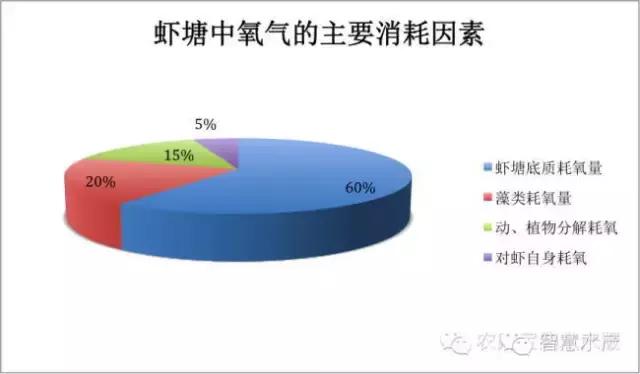
Respiration of the shrimp; respiration of phytoplankton (algae); oxygen consumption from the decomposition of dead planktonic animals and plants in the pond; oxygen consumption from the oxidation of organic matter in the shrimp pond water body and bottom sediment, etc. The oxygen consumption of the shrimp themselves in the shrimp pond is relatively small, while the oxygen consumption of the shrimp pond bottom sediment is the main factor affecting dissolved oxygen in the farming environment, accounting for about 60% of the total oxygen consumption of the shrimp pond, followed by algae at about 20%, decomposition of animals and plants at 15%, and shrimp at 5%.
2.2 Dissolved oxygen in shrimp ponds shows obvious seasonal and day-night changes.
The day-night change in dissolved oxygen content in the water body of intensive shrimp ponds is shown by the lowest dissolved oxygen content before the sun comes up in the early morning, reaching the highest value at around 16:00 in the afternoon; the monthly change is mainly shown in July and August, when the average afternoon surface peak value is greatly higher than the average value in May and June.
3 Countermeasures
In order to ensure that there is sufficient dissolved oxygen during the growth of whiteleg shrimp, corresponding measures must be taken to regulate dissolved oxygen in the water body.
3.1 Arrange the stocking density reasonably and feed reasonably
The stocking density should be arranged reasonably according to the depth and bottom sediment of the shrimp pond, as well as the temperature and other relevant conditions throughout the entire production cycle. Feed should be given reasonably according to the number of stocked fry, the size of the shrimp and other relevant factors, to prevent excessive leftover feed from increasing oxygen consumption.
3.2 Cultivate phytoplankton
Although the effect of phytoplankton on dissolved oxygen in the water body is twofold, under normal sunlight conditions a pond with vigorous plankton can produce 10-20 g of oxygen per cubic meter of water per day, and the oxygen consumed by phytoplankton respiration accounts for about 1/5 of the oxygen produced by photosynthesis. At the same time, these plankton can also absorb large amounts of nitrogen, phosphorus and other components, thereby accelerating the self-purification capacity of the pond water; therefore, in the middle and late stages of shrimp farming, by appropriately increasing the density of phytoplankton, the dissolved oxygen in the farming environment can be greatly increased. A large amount of phytoplankton will also consume a large amount of oxygen under insufficient light. Therefore, seeking an appropriate amount of phytoplankton reproduction so that it remains stable throughout the entire farming process is an important technique in water quality management.
3.3 Frequently add fresh water or apply microbial preparations
Under normal circumstances, the dissolved oxygen concentration in seawater is at saturation. By adding fresh seawater, water with a higher dissolved oxygen concentration can be brought into the shrimp pond, significantly increasing the dissolved oxygen in the shrimp pond. For shrimp ponds that lack a water source or where adding water is inconvenient, beneficial microbial preparations such as photosynthetic bacteria and Bacillus can be used to regulate water quality.
3.4 Oxygenation with chemical substances
Use chemical substances that can produce oxygen in water, such as calcium peroxide and sodium percarbonate, to increase the level of dissolved oxygen in the pond water body.
3.5 Correct use of aerators in the farming water body can effectively increase the dissolved oxygen content in the water
The role of aerators in shrimp farming can be roughly summarized as follows:
① Increase the contact area between air and water;
② Promote the mixing of bottom water and surface water, maintain a balanced water temperature, and increase the dissolved oxygen of the bottom water; ③ Make the shrimp pond water circulate and collect waste, improving the waste discharge effect of the shrimp pond;
④ Increase dissolved oxygen, promote the oxidative decomposition of organic matter in the pond, and reduce the formation of harmful substances,
⑤ Benefit algae growth and stabilize water color;
⑥ Increase dissolved oxygen, help cultivate aerobic bacteria, inhibit the growth of pathogenic bacteria, and prevent and reduce the occurrence of diseases, etc. The time for running the aerator should be determined according to the dissolved oxygen content of the shrimp pond, the number of farming days and the farming density, so that the dissolved oxygen content of the pond water is always kept above 5 mg/L.
In addition, the nanotube pond-bottom oxygen pump is a new pond oxygenation technology that has emerged as shrimp farming technology has gradually matured. These pumps blow fresh air to the bottom of the pond through a blower, increasing the dissolved oxygen content of the water body at the bottom of the shrimp pond, making the shrimp full of vitality, both increasing yield and improving quality. Its working principle mainly uses nanotechnology, compressing air through an air compressor into nanotubes distributed near the bottom of the pond for aeration, so as to achieve the effect of oxygenating the shrimp pond from the bottom. Compared with traditional surface mechanical oxygenation, it has the advantages of uniform oxygenation area, balanced oxygenation layers, lower mechanical energy consumption, and obvious effects in improving the bottom environment, and is a new pond farming technical measure that is being promoted year by year.
Use smart devices to monitor dissolved oxygen and safeguard pond dissolved oxygen.
With the development of science and technology, many people in aquaculture have begun to use smart aquaculture measurement and control instruments to effectively achieve real-time monitoring of dissolved oxygen in farming ponds, and to automatically start the aerator when the dissolved oxygen reaches the set minimum value, and to remotely control the start and stop of aerators and other fishery machinery and equipment, making oxygenation more scientific and smarter.
You are welcome to follow the China Aquaculture WeChat official account: zgsc0879 to exchange and interact with 100,000 aquaculture friends.