What harm does moss cause in crayfish farming?
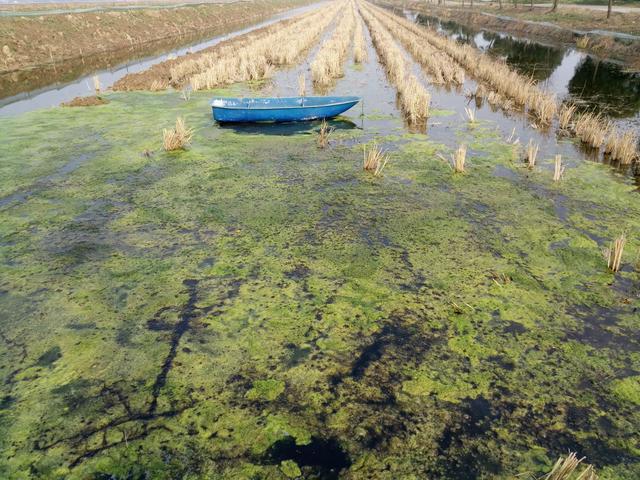
Moss (photographed by Hong Wei)
Moss, also called green mud moss, is a general term for green algae such as Spirogyra, Hydrodictyon, Zygnema and Mougeotia, as well as blue-green algae such as Microcystis and Coelosphaerium. It is the product of excessive reproduction of algae. Its formation occurs in two ways: asexual reproduction and sexual reproduction. In asexual reproduction, after mechanical damage it breaks into several short filaments, and each short filament grows into moss again. In sexual reproduction, first two Spirogyra filaments come close together in parallel, and a protrusion forms on the side of each filament's cell facing the other. The "protrusions" elongate and their tips touch and fuse. The cell protoplast concentrates to form one gamete, and the gamete moves into the conjugation tube and fuses with the gamete of the other filament, forming a zygospore that develops into moss.
I. Sources of moss
The main sources of moss are as follows: first, the moss algae species in the water body itself germinate, and newly dug ponds are especially prone to moss; second, it is introduced into the water by the placement of aquatic plants and snails; third, the water source contains moss and it is brought in when water is added from the inlet pond; fourth, the pond water is relatively clear, fertilization is inadequate, and algae grow poorly; fifth, improper use of chemicals causes an imbalance among various factors in the water body; sixth, during the winter slack season the pond holds standing water that is not drained in early spring, or after the pond is cleared and disinfected, fertilization work is not done well, leaving the water body too clear.
II. Harm caused by moss
1. Moss mostly occurs in spring and early summer. After the weather warms up in spring, moss germinates in the shallow water of clear ponds. As long as the temperature is suitable, it will grow and reproduce in large amounts within a few sunny days, forming tangled masses of filaments and occupying
the water body space.
2. Moss absorbs nutrients such as nitrogen, phosphorus and potassium from the water body, consumes nutrients, and worsens water quality.
3. Moss affects the absorption of light energy by plankton, reducing plankton, and hindering the rise of water temperature and the dissolution of oxygen.
4. Moss becomes entangled with aquatic plants, directly affecting the growth of aquatic plants. In particular, in summer Cladophora attaches to the leaves of Hydrilla, preventing them from carrying out photosynthesis and purifying the water, which leads to a decline in water quality.
III. Prevention and control measures for moss
To prevent and control moss, the focus should be on balancing the bacterial phase and algal phase in the water body, with the purpose of protecting aquatic plants and promoting fish growth.
1. Prevention
(1) After drying the pond, spray copper sulfate directly or use quicklime or plant ash to clear the pond.
(2) Choose a pond with better water quality as the water source to avoid bringing moss into the pond.
(3) Change the clear water frequently: change the water as soon as the water quality changes color slightly.
(4) Rational fertilization: fertilize rationally according to water quality. To cultivate abundant natural feed, regularly apply some manure with long-lasting fertilizer effect, so as to avoid the recurrence of moss, keep the water quality fertile and fresh, and promote the normal growth of aquatic products.
2. Removal
Manual removal of moss is the most economical, safe, environmentally friendly and also the most laborious method. When there is a lot of moss, before using chemical agents, doing one's best to manually scoop out part of the moss is a good method, as it both reduces chemical harm and avoids large amounts of moss dying and rotting and spoiling the water quality. When moss breaks out in large amounts, agents and other methods are needed to remove it, and this is also a commonly used method in production.
(1) Broadcasting plant ash: it is best to use plant ash from highly alkaline rapeseed stalks or bean stalks. On a cloudy morning, use a small boat to carry the plant ash, mix it with water, and splash it onto places where moss is dense. After a few days, the moss will slowly rot.
(2) Clever use of quicklime: cleverly sprinkle quicklime where the algae masses gather to kill the algae, controlling about 150 grams per square meter, for 3 consecutive times, with an interval of 3 to 4 days each time.
(3) Splashing copper sulfate: if the amount of moss is not large, use 50 grams of copper sulfate per mu, add 30 kg of water, and spray; if the amount of moss is large, use 500 grams of copper sulfate per mu, put it in a gauze bag and place it at the water inlet, so that the chemical enters the rice seedling field with the irrigation water and kills the moss. Notes: the toxicity of copper sulfate rises and falls in direct proportion to water temperature, and if the dose is not controlled well it easily harms snails
and aquatic plants. The toxicity of copper sulfate is inversely proportional to pH value, and sometimes poor results are related to strong alkalinity in the pond.
(4) Splashing Qingtainning:
Qingtainning is a specializedagent for removing moss and other algae, featuring a small dosage, low toxicity and good results. It has a significant inhibiting and killing effect on moss and other algae in breeding ponds of fish, shrimp, crabs and shellfish, in cages, and attached to the body surface of shrimp and crabs. The main component of Qingtainning is 4,6-bis(isopropylamino)-2-methylthio-1,3,5-triazine, a grayish-white powder. 200 grams can be applied to 1 mu of water surface (1 m water depth); add an appropriate amount of water or mix with fine soil and splash it evenly over the whole pond, or splash it on areas where moss grows densely. After using Qingtainning, because moss and other algae are prone to decay and fermentation in the water after dying, consuming a large amount of oxygen and easily causing oxygen deficiency in the pond water body, the dead moss and algae should be scooped out to prevent oxygen deficiency, and oxygenation measures should be taken at the same time. Qingtainning is strictly prohibited for use when the breeding pond is short of oxygen.